


Quick answer: Uninsured/underinsured motorist (UM/UIM) coverage is your own insurance that pays when the at-fault driver has no insurance, not enough insurance, or fled the scene. Because you collect from your own company, a UM/UIM claim is a first-party claim — and your insurer becomes the adversary, with a financial incentive to dispute fault, minimize your injuries, and delay. About 1 in 7 U.S. drivers (15.4%) is uninsured, so this coverage is often the only thing standing between a seriously injured person and nothing. Watch the traps that quietly destroy these claims — the consent-to-settle rule, the UIM offset, prompt notice, and the policy deadline. Call 800-224-5546 for a free consultation — no fee unless you win.
- UM/UIM is YOUR coverage — you (or a family member) paid for it, and it steps in when the at-fault driver can’t.
- About 1 in 7 drivers is uninsured (15.4% nationally in 2023), and the rate is even higher in several states we serve — 28.2% in Mississippi, the highest in the country.
- Your own insurer is now the adversary. It owes you a duty of good faith, and an unreasonable denial or lowball can be bad faith.
- Never settle with the at-fault driver before getting your UIM carrier’s written consent — doing so can waive your UIM claim entirely.
- The deadline to pursue UM/UIM can differ from the tort deadline — it may be set by your insurance policy, so confirm it with a lawyer.
UM/UIM Claims at a Glance
| Question | Short answer |
|---|---|
| What is UM/UIM coverage? | Your own coverage that pays when the at-fault driver has no insurance, not enough, or fled. |
| Who do I file the claim against? | Your own insurer — it’s a first-party claim, which is what makes the dynamic adversarial. |
| How common are uninsured drivers? | About 1 in 7 nationally (15.4%, 2023); 28.2% in Mississippi — the highest in the U.S. |
| What’s the biggest mistake to avoid? | Settling with the at-fault driver before getting your UIM carrier’s written consent. |
| How long do I have to file? | Usually the state injury deadline (1–3 years), but your policy can set a different deadline — confirm with a lawyer. |
| What will a lawyer cost? | Nothing up front — a contingency fee, paid only if you recover. |
Uninsured Motorist Statistics
Sources: Insurance Research Council / Insurance Information Institute, Uninsured and Underinsured Motorists: 2017–2023 (2025); state minimum bodily-injury limits, Insurance Information Institute (Dec. 2023).
If a driver with no insurance hurts you, the hard truth is that there is usually no policy on the other side to pay your bills. That is exactly the situation uninsured/underinsured motorist coverage was built for — and it is a far more common situation than most people realize. In 2023, 15.4 percent of drivers — more than one in seven — were uninsured, and in the states we serve the numbers run even higher.
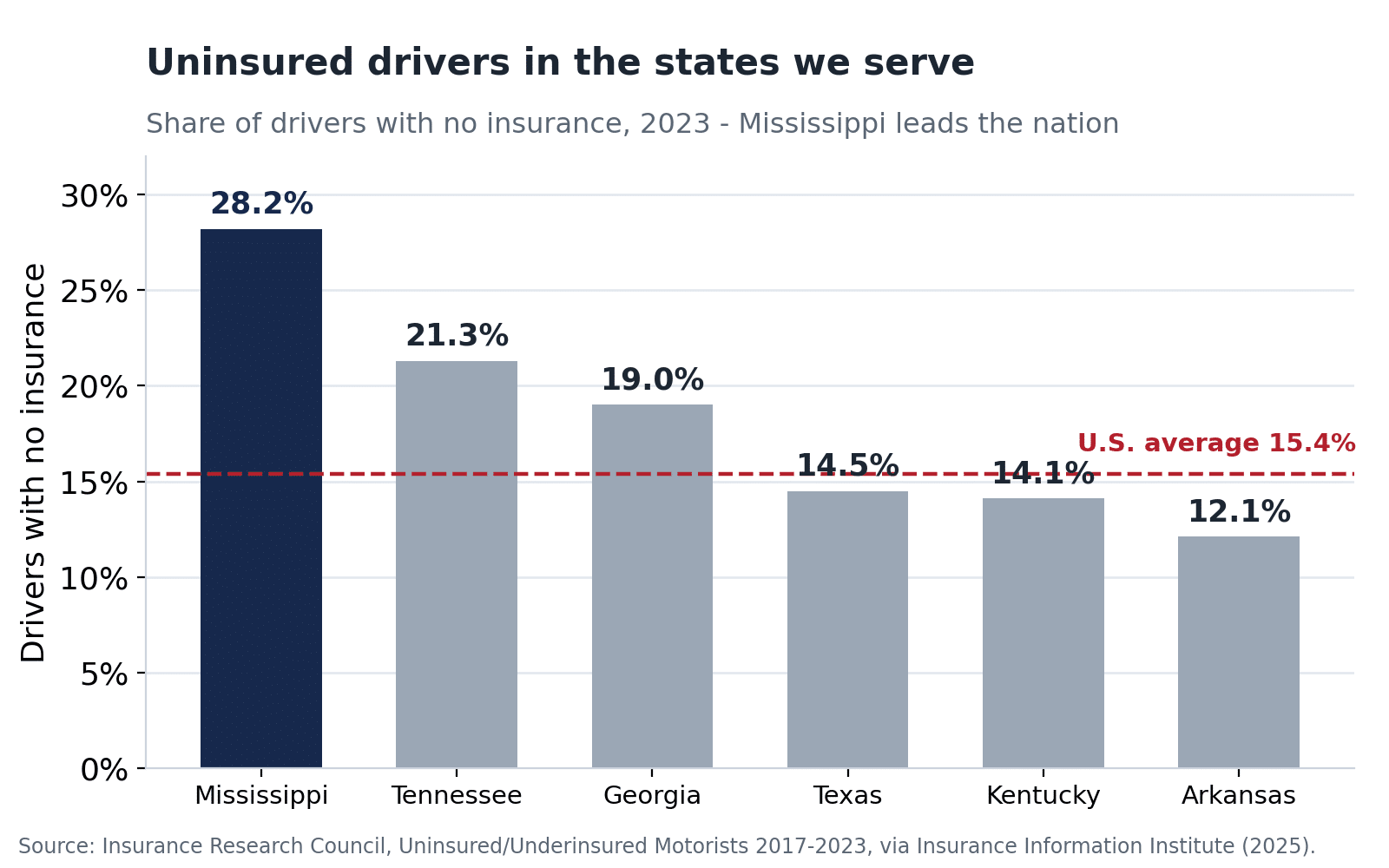
Mississippi (28.2%) has the highest uninsured-driver rate in the country, and Tennessee (21.3%) and Georgia (19.0%) are both far above the national average. Texas (14.5%), Kentucky (14.1%), and Arkansas (12.1%) are lower but still mean that a meaningful share of drivers on the road carry nothing. When you add underinsured drivers — those who carry only a bare-minimum policy — the picture is worse: nationally, about one in three drivers is either uninsured or underinsured. For anyone with a serious injury, that makes your own UM/UIM coverage the difference between a real recovery and nothing at all.
What Is Uninsured/Underinsured Motorist Coverage?
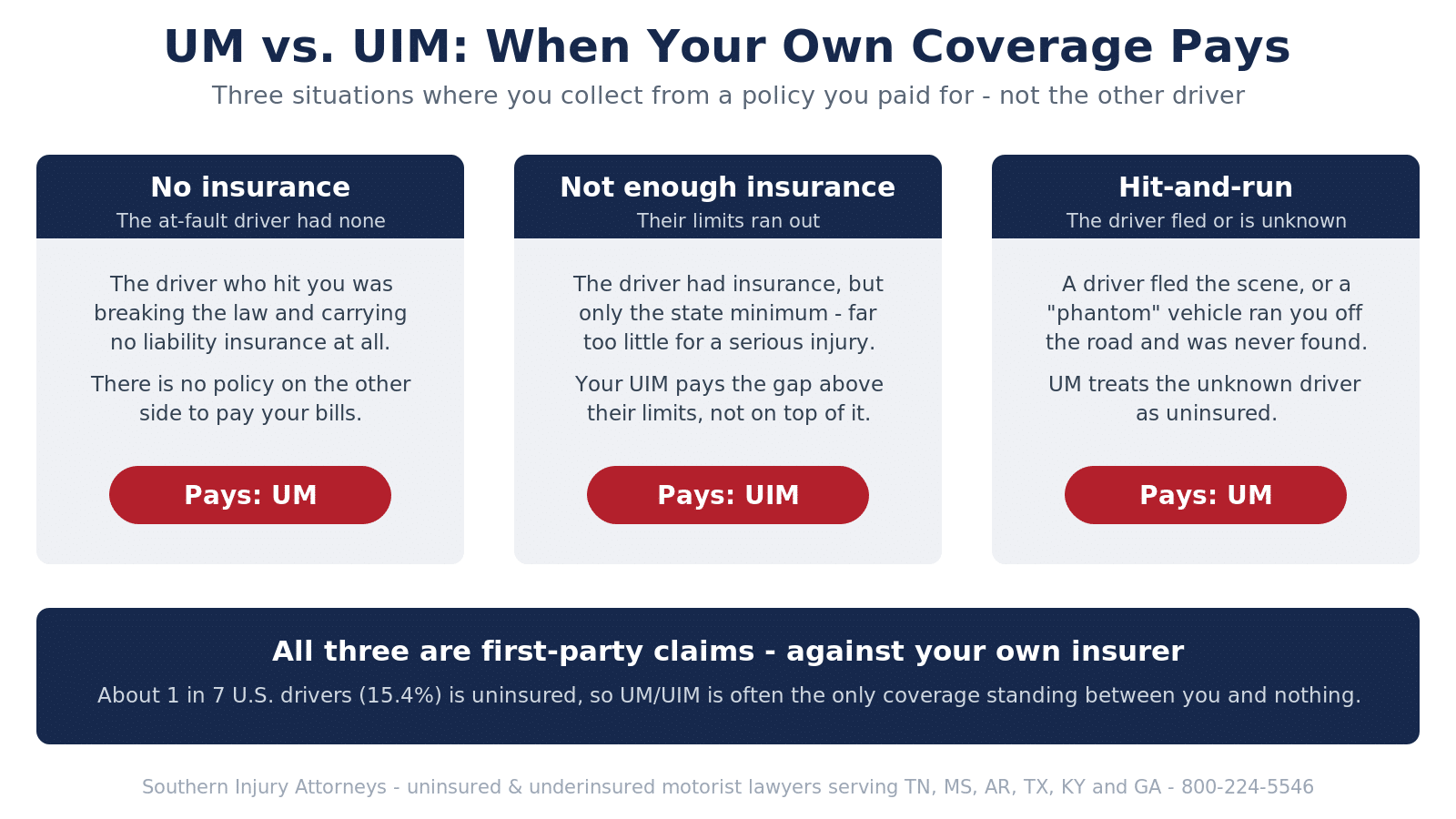
Uninsured/underinsured motorist coverage is insurance you carry on your own policy that pays you when the at-fault driver cannot. There are two parts. Uninsured motorist (UM) coverage applies when the at-fault driver had no insurance at all, including a hit-and-run or “phantom” driver. Underinsured motorist (UIM) coverage applies when the at-fault driver had insurance, but not enough to cover the full extent of your injuries. In both cases the money comes from your own insurer, not the other driver’s — which is the single most important thing to understand about these claims.
This coverage usually protects more than just you. Depending on the policy, it typically covers you, members of your household, and passengers in your vehicle, and it can apply whether you were driving, a passenger, or even a pedestrian struck by an uninsured driver. Insurers in every state we serve are required to offer UM/UIM coverage, and in most states you can only go without it if you rejected it in writing — so many people have this coverage even if they don’t remember buying it.
When Does UM/UIM Coverage Apply?
UM/UIM coverage applies in three situations: the at-fault driver had no insurance, the at-fault driver had insurance but not enough to cover your damages, or the at-fault driver fled or was never identified (a hit-and-run or phantom vehicle). The “not enough” scenario is more common than people expect, because the minimum coverage a driver is legally required to carry is so low.
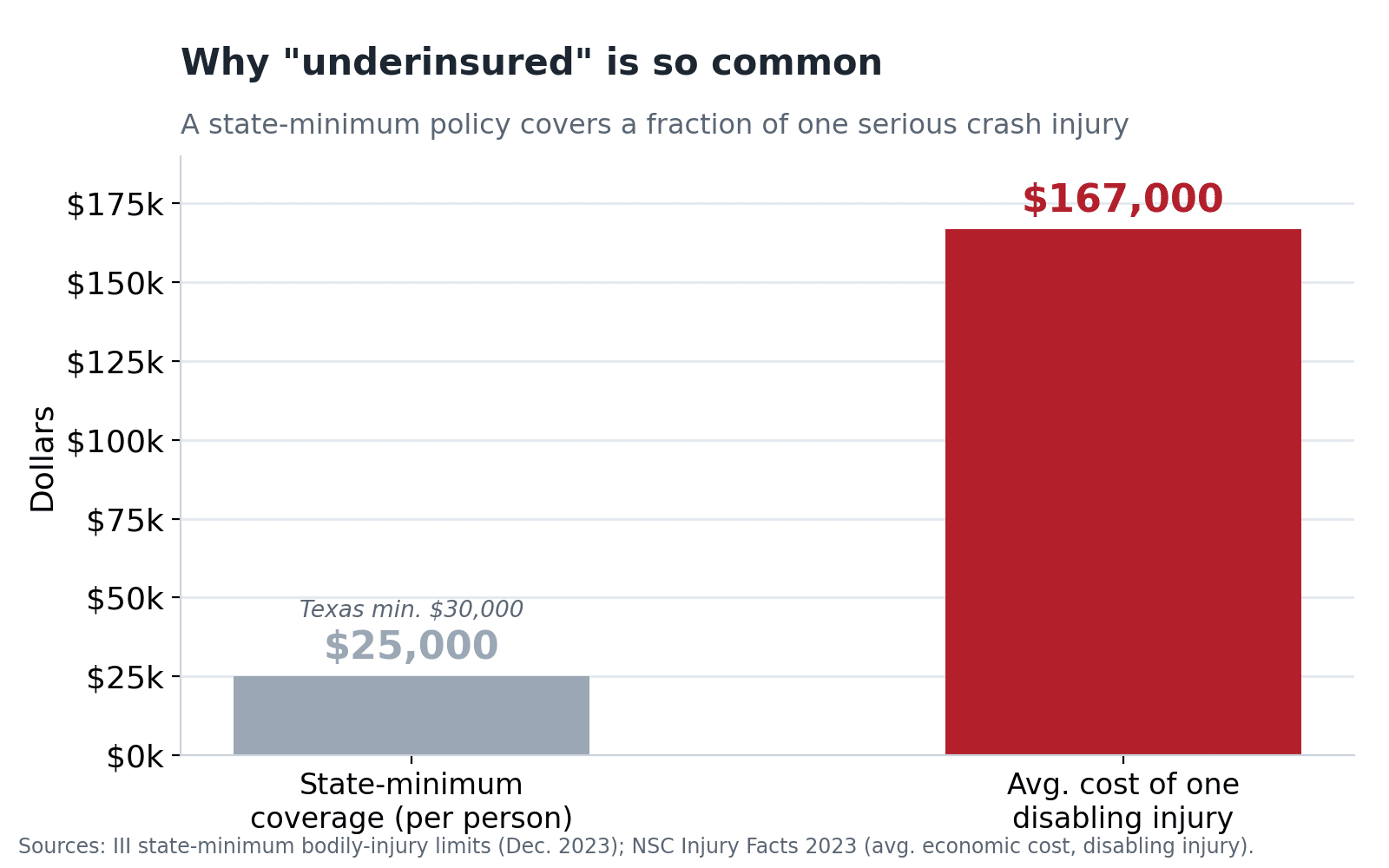
In most of the states we serve, a driver only has to carry $25,000 in bodily-injury coverage per person ($30,000 in Texas). But the National Safety Council puts the average economic cost of a single disabling crash injury at about $167,000 — and that is before pain, suffering, and lost future earnings. A bare-minimum policy can be exhausted by one ambulance ride and a single surgery. When that happens, your UIM coverage steps in to pay the gap between the at-fault driver’s limits and what your injuries are actually worth.
How Common Are Uninsured Drivers?
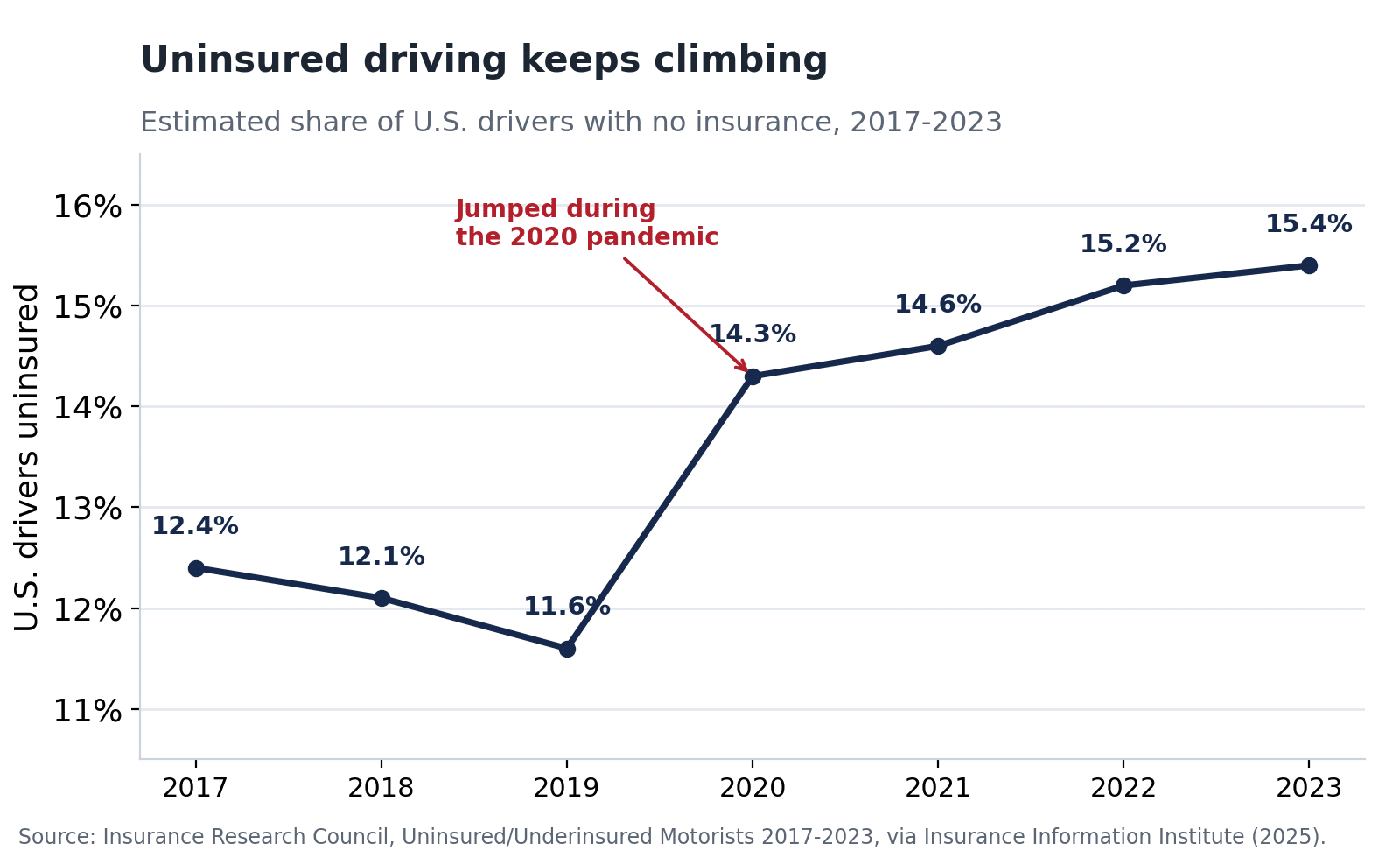
Very common — and the problem is getting worse. Nationally, the share of uninsured drivers rose from 11.6% in 2019 to 15.4% in 2023, with a sharp jump during the 2020 pandemic. That means a large share of seriously injured people discover, often weeks later, that the driver who hurt them has no way to pay.
That is why we tell every client the same thing: do not assume your case is over just because the other driver has no insurance. If you carry UM/UIM coverage — and most people do — you have a claim. The fight simply moves from the other driver’s insurer to your own.
Why Is My Own Insurance Company Fighting Me?
Because a UM/UIM claim is a first-party claim — you are asking your own insurer to pay you — the company you’ve paid premiums to for years suddenly behaves like the opposing side. It still owes you a legal duty of good faith, but it also has a direct financial incentive to dispute who was at fault, downplay your injuries, question your medical treatment, and delay paying. People are often shocked by how adversarial their own insurer becomes.
This is the core difference between a UM/UIM claim and an ordinary injury claim. In a normal case, your insurer is on your side against the other driver’s company. In a UM/UIM case, your insurer is the one writing the check, so every dollar it pays you comes out of its own pocket. That changes the dynamic completely — and it is exactly why having your own lawyer matters even though it is “your” insurance company.
The law does put limits on this behavior. Your insurer owes you a duty to handle your claim reasonably and in good faith. When an insurer denies a valid claim, drags its feet without justification, or makes a lowball offer with no reasonable basis, that can rise to the level of bad faith — which in many states exposes the insurer to additional damages beyond the policy limits. Recognizing and documenting bad-faith conduct is part of how we hold your insurer accountable.
What Traps Can Destroy a UM/UIM Claim?
UM/UIM claims are quietly lost to technical traps far more often than they are lost on the merits. These are non-obvious rules buried in your policy and in state law, and missing even one can wipe out coverage you already paid for.
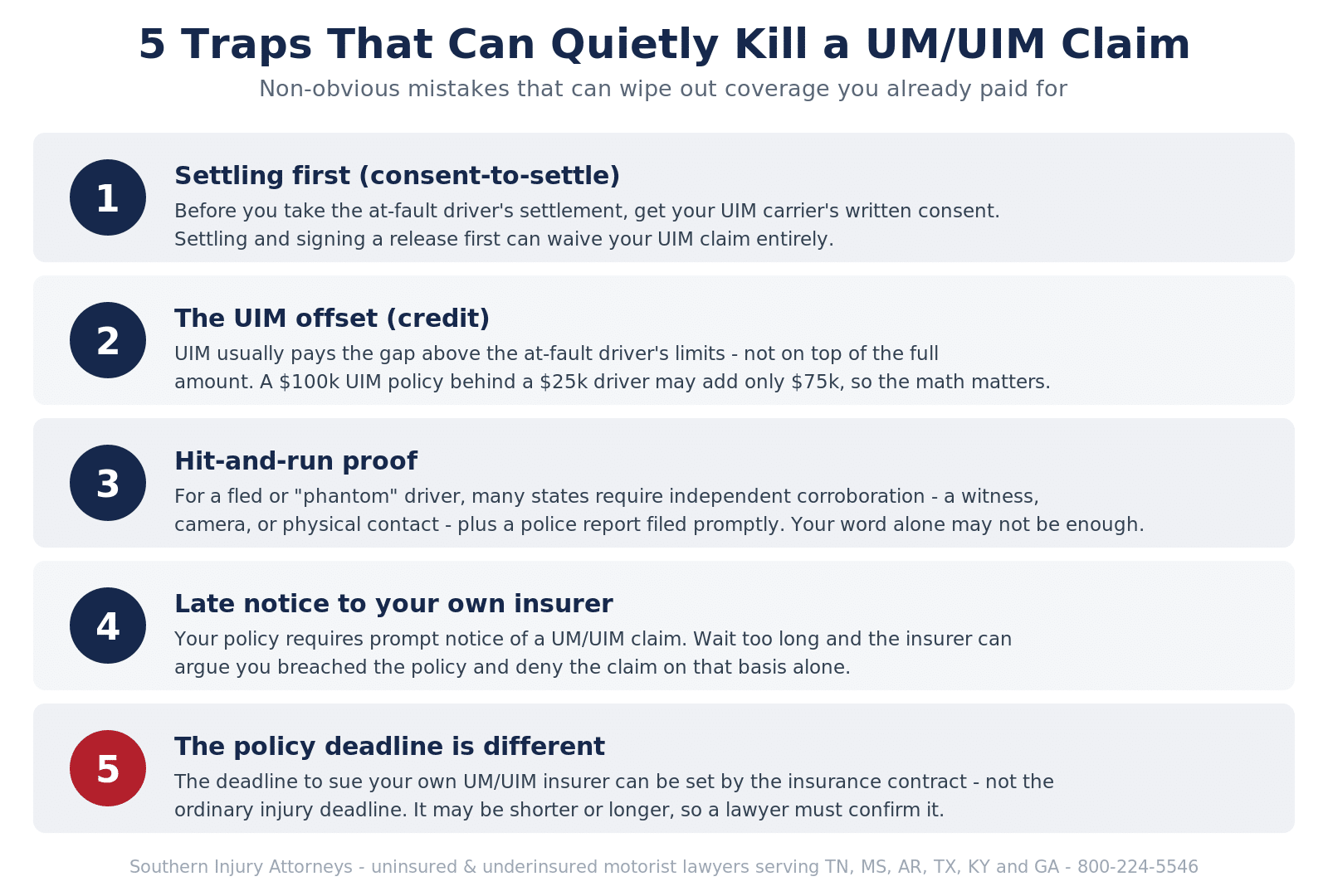
The five that destroy the most claims are:
- Consent-to-settle. Before you accept a settlement from the at-fault driver’s insurer, you usually must notify your UIM carrier and get its written consent. Settling and signing a release first can waive your UIM claim, because it destroys your insurer’s right to go after the at-fault driver. This is the single most damaging — and most common — mistake.
- The UIM offset (credit). UIM typically pays the gap above the at-fault driver’s limits, not on top of the full amount. A $100,000 UIM policy behind a $25,000 driver may add only $75,000 — so understanding the math is essential to valuing your claim.
- Hit-and-run corroboration. For a fled or “phantom” driver, many states require independent corroboration — a witness, a camera, or physical contact — plus a police report filed promptly. Your testimony alone may not be enough.
- Prompt notice. Your policy requires you to notify your own insurer promptly of a UM/UIM claim. Wait too long and the insurer can argue you breached the policy and deny the claim on that basis alone.
- The policy deadline. The deadline to sue your own UM/UIM insurer can be governed by the insurance contract rather than the ordinary injury statute of limitations. It may be shorter or longer, so a lawyer must confirm exactly which deadline applies to you.
Can I “Stack” My UM/UIM Coverage?
Sometimes, yes. Stacking means combining UM/UIM limits across multiple vehicles or multiple policies to increase the total coverage available to you. For example, if you insure three vehicles each with $50,000 in UM coverage, in a state that allows stacking you may be able to access up to $150,000 rather than just $50,000. Some states and policies permit stacking, some restrict it, and many policies contain “anti-stacking” language. Whether you can stack — and how much coverage that unlocks — depends on your state’s law and the wording of your policy, which is one of the first things we review.
What If It Was a Hit-and-Run?
A hit-and-run is exactly what uninsured motorist coverage is for. When the driver who hit you fled the scene or was a “phantom” vehicle that ran you off the road and was never identified, UM coverage treats that unknown driver as uninsured and pays your claim. But hit-and-run UM claims come with their own rules: many states require either physical contact with the unknown vehicle or independent evidence corroborating that it existed and caused the crash — a witness, surveillance or dashcam footage — and a police report filed promptly, often within a day or two. That is why calling 911 and reporting the crash immediately is so important after a hit-and-run.
What If I Was Partly at Fault?
You can usually still recover. Being partly at fault does not erase a UM/UIM claim — but because the claim still rests on the other driver’s negligence, your state’s comparative-fault rule applies and can reduce your recovery by your share of the blame.
| State | Rule | What it means for you |
|---|---|---|
| Tennessee | Modified — 50% bar (McIntyre v. Balentine, 833 S.W.2d 52 (Tenn. 1992)) | You can recover only if you are less than 50% at fault; your award is reduced by your share. |
| Mississippi | Pure comparative (Miss. Code § 11-7-15) | You can recover even if you are mostly at fault; the award is reduced by your percentage. |
| Arkansas | Modified — 50% bar (Ark. Code § 16-64-122) | Barred only if your fault is equal to or greater than the other party’s; otherwise reduced by your share. |
| Texas | Modified — 51% bar (Tex. Civ. Prac. & Rem. Code § 33.001) | You can recover unless your responsibility is greater than 50%; you may still recover at exactly 50%. |
| Kentucky | Pure comparative (KRS § 411.182) | You can recover even if you are largely at fault; the award is reduced by your percentage. |
| Georgia | Modified — 50% bar (O.C.G.A. § 51-12-33) | You can recover only if you are less than 50% at fault; your award is reduced by your share. |
Comparative-fault rules are applied to the facts of each case. Because insurers use fault arguments to cut payouts, how the case is investigated and presented can change your recovery significantly.
How Much Is a UM/UIM Claim Worth?
The honest answer: your coverage limit is the ceiling. Unlike a claim against an at-fault driver — whose assets can sometimes be reached — a UM/UIM claim can pay no more than the UM/UIM limits on your policy (plus any additional coverage you can stack). Within that ceiling, value turns on the severity of your injuries, the full cost of past and future medical care, your lost earnings, and the available limits.
This is also why the type of crash matters. A high-speed head-on collision or a rollover tends to cause far more serious injuries — and therefore larger claims — than a low-speed fender-bender, while the available coverage stays the same. When an uninsured or underinsured driver causes a rear-end crash, an intersection collision, a pedestrian injury, or a drunk-driving wreck, your UM/UIM coverage is what funds the recovery. And in a fatal crash, the family can pursue wrongful death damages through the same coverage. Getting the value right means proving the full extent of the injuries and identifying every layer of coverage available.
What to Do After a Crash With an Uninsured or Hit-and-Run Driver
- Call 911 and get the police report. An official report is critical, especially in a hit-and-run, where it can be the corroboration your UM claim requires.
- Get medical care immediately, even if you feel okay — some serious injuries are masked by adrenaline, and a treatment gap is the first thing an insurer attacks.
- Document the scene, the damage, and any witnesses — photos of the vehicles and scene, and the names and numbers of anyone who saw what happened, especially after a hit-and-run.
- Notify your own insurer promptly. Your policy has a notice requirement, and a UM/UIM claim depends on reporting the crash to your own company in time.
- Do not settle with — or sign a release for — the at-fault driver before getting your UIM carrier’s consent. Settling first can waive your UIM claim entirely.
- Be careful giving your own insurer a recorded statement. Remember that on a UM/UIM claim your insurer is now the adversary; talk to a lawyer before giving a recorded statement.
- Call a UM/UIM lawyer. The consent, notice, and deadline rules are easy to miss, and an early mistake can cost you the entire claim.
Our Results in Serious Auto Accident Cases
Every case is different, but our results reflect how hard we fight for crash victims:
- Six-figure recovery — Our client was stopped in traffic when an 18-wheeler failed to stop in time and rear-ended them.
- Six-figure settlement — An 18-wheeler pushed our client into a barrier wall, causing her injuries.
- $175,000 settlement — Our client’s Mercedes was rear-ended and caught fire; even with minimal medical treatment, we recovered $175,000.
Prior results do not guarantee a similar outcome. Every case depends on its own facts.
Why Choose Southern Injury Attorneys
We are a contingency-fee injury firm that handles uninsured and underinsured motorist claims for serious car accident victims, with attorneys licensed in Tennessee, Mississippi, Arkansas, Texas, Kentucky, and Georgia. A UM/UIM claim is a fight with your own insurance company, so we treat it like the adversarial claim it is — proving fault, documenting the full extent of your injuries, protecting your consent-to-settle rights, and meeting every notice and policy deadline. Because an uninsured driver can be behind any kind of crash, we also handle the underlying wreck, from rear-end and intersection collisions to head-on, rollover, pedestrian, and drunk-driving cases. You pay nothing unless we win.
Headquarters: 5050 Poplar Ave, Ste 920, Memphis, TN 38157, with offices in Dallas, Houston, and Atlanta. Consultations are free and handled by phone anywhere we practice: 800-224-5546. If your crash happened in Memphis, see our dedicated Memphis uninsured motorist accident lawyer page; in Atlanta, see our Atlanta uninsured motorist lawyer page.
Deadlines to File a UM/UIM Claim
There are really two deadlines to watch. The first is the ordinary statute of limitations on the underlying crash, which is a motor-vehicle injury case. The second — and the one people miss — is that the deadline to pursue your own UM/UIM coverage can be set by your insurance policy, and it may be different from the tort deadline.
| State | Injury filing deadline | Statute |
|---|---|---|
| Tennessee | 1 year | Tenn. Code § 28-3-104 |
| Mississippi | 3 years | Miss. Code § 15-1-49 |
| Arkansas | 3 years | Ark. Code § 16-56-105 |
| Texas | 2 years | Tex. Civ. Prac. & Rem. Code § 16.003 |
| Kentucky | 2 years | KRS § 304.39-230 |
| Georgia | 2 years | O.C.G.A. § 9-3-33 |
The deadlines above are the tort deadlines for suing the at-fault driver. The deadline to pursue your own insurer for UM/UIM benefits can run on a separate clock — sometimes longer (a breach-of-contract claim may not accrue until the insurer denies your claim) and sometimes shorter, where the policy imposes its own suit deadline. Because these rules vary by state and by policy, the safest course is to talk to a lawyer right away and confirm exactly which deadlines apply to your claim.
We serve crash victims throughout Tennessee, Mississippi, Arkansas, Texas, Kentucky, and Georgia.
Uninsured & Underinsured Motorist FAQs
What is uninsured motorist coverage?
Uninsured motorist (UM) coverage is part of your own auto policy that pays for your injuries when the at-fault driver had no insurance, including a hit-and-run or phantom driver. It steps into the shoes of the missing insurance and pays you up to your UM limits. It usually covers you, your household members, and passengers, whether you were driving, riding, or struck as a pedestrian.
Do I have to sue my own insurance company?
Often you do not have to file a lawsuit at all — many UM/UIM claims settle. But because the money comes from your own insurer, the claim is adversarial, and if the company refuses to pay what your claim is worth, the next step is a lawsuit or arbitration against your own insurer. That is normal for UM/UIM claims and does not mean you did anything wrong; it is simply how this coverage is enforced.
What’s the difference between UM and UIM?
Uninsured motorist (UM) coverage applies when the at-fault driver had no insurance at all, including a hit-and-run. Underinsured motorist (UIM) coverage applies when the at-fault driver had insurance, but not enough to cover your damages. UIM typically pays the gap above the at-fault driver’s limits rather than on top of the full amount. Both are first-party claims against your own policy.
The driver who hit me had no insurance — what can I do?
If you carry uninsured motorist coverage — and most drivers do, because insurers must offer it and you can usually only decline it in writing — you can make a UM claim against your own policy. It pays your medical bills, lost wages, and pain and suffering up to your UM limits, just as the at-fault driver’s policy would have. Do not assume your case is over because the other driver had nothing.
Does UM cover a hit-and-run?
Yes. A hit-and-run or unidentified “phantom” driver is treated as uninsured, so UM coverage applies. Many states require independent corroboration that the unknown vehicle existed and caused the crash — such as a witness, camera footage, or physical contact — and a police report filed promptly. That is why it is critical to call 911 and report a hit-and-run right away.
Will a UM claim raise my insurance rates?
Generally, a not-at-fault claim should not raise your rates, and many states limit an insurer’s ability to surcharge you for an accident that was not your fault. Practices vary by insurer and state, however, so there is no absolute guarantee. Either way, the protection you paid for is there to be used, and fear of a rate increase is not a good reason to leave a serious injury uncompensated.
Can I settle with the other driver and still claim UIM?
Only if you follow the consent-to-settle rule. Before you accept a settlement from the at-fault driver’s insurer, you usually must notify your UIM carrier and get its written consent. If you settle and sign a release first, you can waive your UIM claim, because settling destroys your insurer’s right to recover from the at-fault driver. Always get UIM consent in writing before settling.
Can I stack my UM coverage?
Sometimes. Stacking combines UM/UIM limits across multiple vehicles or policies to increase the total coverage available. Some states and policies allow it, others restrict it, and many policies contain anti-stacking language. Whether you can stack, and how much coverage it unlocks, depends on your state’s law and your specific policy, which is one of the first things a lawyer reviews.
How long do I have to file a UM/UIM claim?
There are two deadlines. The tort deadline on the underlying crash ranges from one year in Tennessee to three years in Mississippi and Arkansas, with two years in Texas, Kentucky, and Georgia. But the deadline to pursue your own insurer for UM/UIM benefits can be set by your insurance contract and differ from the tort deadline — sometimes longer, sometimes shorter. Because the rules vary, confirm your deadline with a lawyer immediately.
What is a UM/UIM claim worth?
Your UM/UIM coverage limit is the ceiling on what you can recover, plus any coverage you can stack. Within that limit, value depends on the severity of your injuries, the full cost of past and future medical care, lost earnings, and the available coverage. This is why the type and severity of the crash matter so much, and why proving the full extent of the injuries is essential.
What if my insurer acts in bad faith?
Your insurer owes you a duty to handle your claim reasonably and in good faith. If it denies a valid claim, delays without justification, or makes a lowball offer with no reasonable basis, that can be bad faith. In many states, bad-faith conduct exposes the insurer to additional damages beyond the policy limits. Documenting unreasonable conduct is part of how a lawyer holds your own insurer accountable.
How much does a UM lawyer cost?
Nothing up front. We work on a contingency fee, so our fee comes out of the recovery and you owe nothing unless we win. Consultations are always free. Because a UM/UIM claim is a fight with your own insurer over technical rules, having a lawyer who handles these claims can be the difference between a denied claim and a full recovery.
Talk to an Uninsured Motorist Lawyer — Free
If you were hurt by a driver with no insurance, too little insurance, or one who fled the scene, your own UM/UIM coverage may be the key to your recovery — but the consent, notice, and deadline rules have to be handled correctly and quickly. Get a free, no-obligation consultation with attorneys licensed in Tennessee, Mississippi, Arkansas, Texas, Kentucky, and Georgia. Call 800-224-5546 — no fee unless you win. You can also contact us online.
This page is general legal information, not legal advice. UM/UIM rules vary by state and by the terms of your policy, and every case is different. Contacting us does not create an attorney-client relationship.

