

The Modern Delivery Ecosystem
The modern delivery landscape is a complex ecosystem of different vehicle types, employment models, and regulatory frameworks. Understanding these distinctions is crucial for determining liability in an accident. The primary categories include:
- Commercial Vans and Trucks: This category includes the familiar vehicles operated by giants like Amazon, FedEx, and UPS. These vehicles are typically owned or leased by the company or its contractors and are subject to a mix of federal and state regulations, depending on their size and weight.
- Food Delivery Services: Companies like DoorDash, Uber Eats, and Grubhub rely on a vast network of gig economy drivers using their personal vehicles. This model creates significant legal challenges in establishing company liability.
- Courier Services: These services, which can range from local businesses to national operations, often use a mix of employee drivers and independent contractors.
- Gig Economy Delivery: Beyond food delivery, companies like Amazon Flex, Instacart, and Shipt utilize independent contractors using their own vehicles for a wide range of delivery services.
Scale and Growth of Delivery
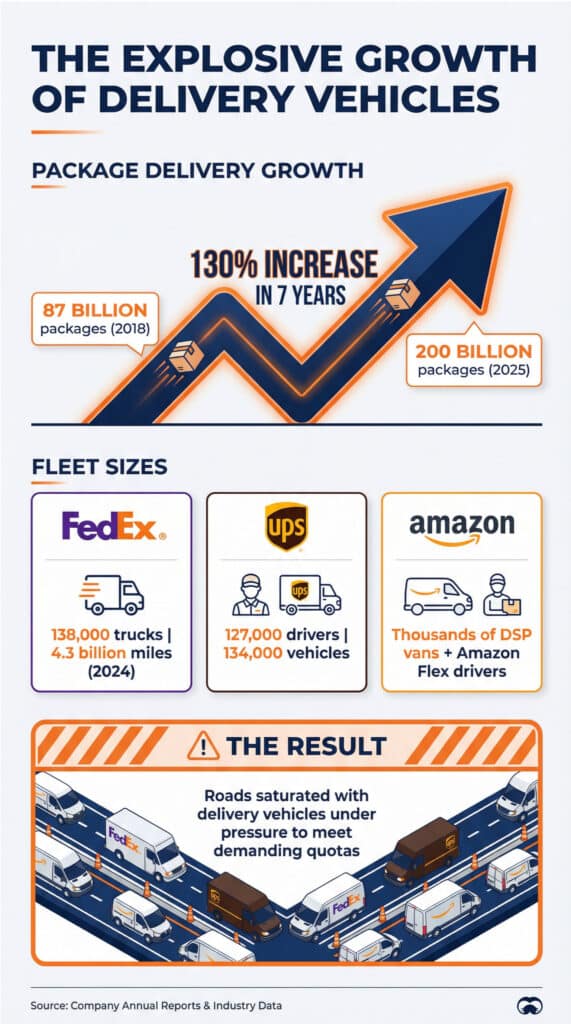
The sheer scale of the delivery industry is staggering and continues to grow at an exponential rate. The number of packages delivered annually is projected to exceed 200 billion by 2025, more than doubling the 87 billion packages delivered in 2018. This explosive growth has flooded our roads with delivery vehicles:
- FedEx operates a fleet of over 138,000 trucks, with its drivers covering more than 4.3 billion miles in 2024 alone 3.
- UPS boasts a force of 127,000 drivers and 134,000 vehicles, delivering 6.4 billion packages in 2021 4.
- Amazon utilizes a complex and ever-expanding network of its own branded vans, Delivery Service Partners (DSPs), and Amazon Flex gig workers, making it a dominant presence on our roads.
This relentless pressure to deliver has created a culture where speed is often prioritized over safety, with devastating consequences.
Why These Vehicles Are More Dangerous
Delivery vehicles, particularly the light commercial vans that have become so prevalent, pose a unique and heightened danger to other road users for several reasons:
- Size and Weight Disparity: The significant size and weight difference between a delivery van and a standard passenger car means that in a collision, the occupants of the smaller vehicle are far more likely to suffer serious or fatal injuries.
- Blind Spots: Large delivery vans have substantial blind spots, particularly on the driver’s side, which increases the risk of pedestrian and cyclist accidents by as much as 70%, according to the Insurance Institute for Highway Safety (IIHS) 5.
- Regulatory Gaps: Many of the smaller delivery vans, those with a gross vehicle weight rating (GVWR) under 10,000 pounds, fall outside the purview of many federal safety regulations, creating a dangerous gap in oversight.
Lack of Safety Features: A shocking number of delivery vans lack critical safety features that are standard in most new passenger vehicles. The IIHS has found that equipping these vans with four key safety features—front crash prevention, lane departure prevention, blind spot detection, and intelligent speed assistance—could prevent or mitigate nearly 4 out of 10 fatal crashes involving such vehicles 5.
Delivery vehicle accidents are rarely simple incidents. They are often the result of a combination of factors, ranging from driver error to systemic company negligence. A thorough investigation is necessary to uncover all contributing causes and hold all responsible parties accountable.
Driver Negligence & Human Factors

- Driver Fatigue: The pressure to meet demanding delivery quotas often leads to drivers working dangerously long hours, and driver fatigue is one of the most dangerous and pervasive problems in the delivery industry. Federal Hours of Service (HOS) regulations (49 CFR 395) are in place to prevent this, limiting commercial drivers to 11 hours of driving within a 14-hour on-duty window, followed by a mandatory 10-hour off-duty period 6. These regulations also require drivers to take a 30-minute break after 8 cumulative hours of driving and limit drivers to a maximum of 60 hours on duty in 7 consecutive days or 70 hours in 8 consecutive days. However, violations of these regulations are rampant in the delivery industry, particularly among companies that use independent contractors or DSPs.
The danger of driver fatigue cannot be overstated. Research from the Centers for Disease Control and Prevention (CDC) has shown that after 17 consecutive hours awake, a driver’s cognitive impairment is equivalent to having a blood alcohol content (BAC) of 0.05%. After 24 hours awake, that rises to a BAC of 0.10%, which is above the legal limit for driving 7. The effects of fatigue include slower reaction times, impaired judgment, decreased awareness of the surrounding environment, and an increased risk of falling asleep at the wheel. The Federal Motor Carrier Safety Administration estimates that driver fatigue is a contributing factor in approximately 13% of all commercial motor vehicle crashes.
Compounding the problem is the fact that many of the smaller delivery vans, those with a gross vehicle weight rating (GVWR) under 10,000 pounds, fall outside the scope of federal HOS regulations. This creates a dangerous regulatory gap where drivers can work unlimited hours without any federal oversight. Even when HOS regulations do apply, enforcement can be lax, and companies often pressure drivers to falsify their logs or find ways to circumvent the rules. This is why obtaining and analyzing electronic logging device (ELD) data is so critical in these cases. ELDs automatically record a driver’s hours of service, making it much more difficult for drivers and companies to hide violations.
- Distracted Driving: Delivery drivers are particularly susceptible to distracted driving, and the nature of their work makes this problem especially acute. Unlike most drivers, who may occasionally glance at their phone or GPS, delivery drivers are constantly interacting with multiple devices and systems as part of their job. They must use GPS devices to navigate to unfamiliar addresses, dispatch apps to receive new delivery assignments, customer information systems to confirm delivery details, and often their own phones to communicate with customers or dispatchers. This creates a trifecta of cognitive, visual, and manual distractions that takes their attention away from the road.

The statistics on distracted driving are sobering. The National Highway Traffic Safety Administration (NHTSA) reports that distracted driving claimed 3,308 lives in 2022. When a driver takes their eyes off the road for just five seconds while traveling at 55 mph, they cover the length of a football field blindfolded. For delivery drivers who are constantly interacting with devices, the risk is exponentially higher. In many of the delivery vehicle accident cases we handle, a thorough investigation reveals that the driver was using their phone, GPS, or dispatch app at the time of the crash. This evidence can be obtained through subpoenas for the driver’s phone records, the company’s telematics data, and the data from the vehicle’s event data recorder (EDR).
- Speeding and Reckless Behavior: The relentless pressure to meet quotas can incentivize drivers to speed, make unsafe lane changes, and engage in other forms of reckless driving.
- Inadequate Training: Many delivery drivers are thrown behind the wheel of a large, unfamiliar vehicle with minimal training. They may lack the skills to safely operate a cargo-laden van, especially in adverse weather conditions or tight urban environments.
Company-Level Negligence
In many cases, the negligence of the delivery company is a primary driver of accidents. This can manifest in several ways:
- Poor Vehicle Maintenance: Companies that prioritize profits over safety may cut corners on vehicle maintenance, leading to accidents caused by faulty brakes, worn tires, or other mechanical failures.
- Unsecured or Overloaded Cargo: Improperly loaded or secured cargo can shift during transit, affecting the vehicle’s stability and leading to a loss of control. Overloading a vehicle beyond its weight limit can also significantly increase braking distances.
- Unrealistic Delivery Schedules and Quotas: The root cause of much driver negligence can be traced back to the unrealistic demands placed on them by their employers. When companies set quotas that are impossible to meet safely, they are creating a foreseeable risk of accidents. This is perhaps the most insidious form of company negligence because it creates a systemic pressure that incentivizes drivers to cut corners on safety. Amazon, for example, has been widely criticized for its demanding delivery quotas, which can require drivers to deliver up to 300 packages per day, often in a 10-hour shift. This works out to less than two minutes per delivery, including driving time, finding parking, locating the address, and delivering the package.
These unrealistic quotas create a culture where speed is prioritized over safety. Drivers are constantly racing against the clock, knowing that if they fall behind, they may face disciplinary action or lose their job. This pressure leads to speeding, running red lights and stop signs, making unsafe lane changes, and skipping required breaks. It also contributes to driver fatigue, as drivers may feel compelled to work longer hours to meet their quotas. In many cases, the quotas are so demanding that it is simply impossible to meet them while complying with all traffic laws and safety regulations.
From a legal standpoint, when a company sets quotas that are impossible to meet safely, and a driver causes an accident while trying to meet those quotas, the company can be held liable for negligent entrustment and for creating a dangerous work environment. This is a powerful legal theory that allows victims to hold the company accountable for the systemic pressures that led to the accident. In the landmark Shannon Shaw v. Amazon case, evidence of Amazon’s demanding delivery quotas and its sophisticated monitoring systems was a key factor in the jury’s decision to award $44.6 million, including $30 million in punitive damages 8.
- Negligent Hiring, Training, and Supervision: Companies have a legal responsibility to hire qualified drivers, provide them with adequate training, and supervise their performance. When they fail to do so, and an accident occurs, they can be held liable for negligent hiring, training, or supervision. These are three distinct but related legal theories that can be used to hold a company accountable for putting a dangerous driver on the road.
Negligent Hiring occurs when a company fails to conduct a proper background check and hires a driver with a history of accidents, traffic violations, or other red flags. For example, if a company hires a driver who has multiple DUI convictions or a history of reckless driving, and that driver causes an accident, the company can be held liable for negligent hiring. The FMCSA requires motor carriers to conduct thorough background checks on all drivers, including obtaining their driving record from every state where they have held a license for the past three years. Companies that fail to conduct these checks, or that ignore red flags in a driver’s history, are exposing the public to a foreseeable risk of harm.
Negligent Training occurs when a company fails to provide adequate training to its drivers. This is a particular problem in the delivery industry, where many drivers are hired with little to no experience operating large commercial vehicles. A driver who has only ever driven a passenger car may not understand how to safely operate a cargo van that is top-heavy, has large blind spots, and requires a much longer braking distance. Companies have a responsibility to provide comprehensive training that covers not only the basics of operating the vehicle, but also defensive driving techniques, how to handle adverse weather conditions, and how to safely load and secure cargo.
Negligent Supervision occurs when a company fails to properly monitor and supervise its drivers. This can include failing to review driver logs for HOS violations, ignoring complaints about a driver’s unsafe behavior, or failing to take corrective action when a driver is involved in multiple accidents or receives multiple traffic citations. Companies that have sophisticated telematics systems that track driver behavior in real-time have an even greater responsibility to intervene when they see dangerous patterns. If a company knows or should have known that a driver is engaging in unsafe behavior, and they fail to take action, they can be held liable for negligent supervision.
Environmental & External Factors
While driver and company negligence are often the primary causes of delivery vehicle accidents, environmental and external factors can also play a significant role. These include:
- Blind Spots: As previously mentioned, the large blind spots on delivery vans are a major contributing factor to accidents, particularly those involving pedestrians and cyclists.
- Inclement Weather: Rain, ice, snow, and fog can all make it more difficult to operate a large vehicle safely.
- Road Hazards: Potholes, construction zones, and other road hazards can be particularly dangerous for delivery vehicles, which may be top-heavy or have a high center of gravity.

Identifying All Responsible Parties
In a delivery vehicle accident case, there may be multiple parties who share liability for the victim’s injuries. These can include:
- The Driver: The most obvious defendant is the driver of the delivery vehicle. If they were negligent (e.g., speeding, distracted, or fatigued), they can be held personally liable for the accident.
- The Delivery Company: The company that employs the driver, such as FedEx or UPS, can be held vicariously liable for the driver’s negligence under the doctrine of respondeat superior (let the master answer). They can also be held directly liable for their own negligence, such as negligent hiring, training, or supervision.
- Third-Party Logistics (3PL) Companies: Many large retailers use 3PLs to manage their shipping and logistics. These companies can also be held liable if their negligence contributed to the accident.
- Vehicle Owners and Lessors: The company that owns or leases the delivery vehicle can be held liable if the accident was caused by a mechanical failure or defect that they knew or should have known about.
- Cargo Loaders: If the accident was caused by improperly loaded or secured cargo, the company that loaded the cargo can be held liable.
- Vehicle and Parts Manufacturers: If the accident was caused by a defect in the vehicle or one of its parts, the manufacturer can be held liable under product liability laws.
- Government Entities: In some cases, a government entity can be held liable if the accident was caused by a dangerous road condition, such as a poorly designed intersection or a lack of proper signage.
The Employee vs. Independent Contractor Issue
One of the most common tactics used by delivery companies to avoid liability is to classify their drivers as independent contractors rather than employees. This is the model used by companies like Amazon with their Delivery Service Partner (DSP) program and by gig economy companies like DoorDash and Uber Eats. The legal distinction is critical: if a driver is an employee, the company is automatically liable for their negligence. If they are an independent contractor, the company can argue that they are not responsible.
However, this is not a get-out-of-jail-free card for these companies. Courts are increasingly willing to look past the “independent contractor” label and examine the reality of the relationship. If the company exercises a significant degree of control over the driver’s work, they can still be held liable. This was the central issue in the landmark 2023 South Carolina case of Shannon Shaw v. Amazon. In that case, a jury awarded a staggering $44.6 million verdict against Amazon, including $30 million in punitive damages, after finding that the company’s extensive control over its DSP driver was sufficient to establish vicarious liability 8.
Federal FMCSA Regulations & Negligence Standards
The Federal Motor Carrier Safety Administration (FMCSA) has established a comprehensive set of safety regulations for commercial motor vehicles. These regulations, found in Title 49 of the Code of Federal Regulations, cover everything from hours of service and vehicle maintenance to driver qualifications and drug and alcohol testing. When a delivery company or driver violates these regulations, and that violation leads to an accident, it can be considered negligence per se. This is a powerful legal doctrine that means the violation itself is enough to prove negligence, without the need for further evidence of carelessness.
For example, if an investigation reveals that a driver exceeded the legal hours of service limits, and their fatigue caused the accident, the company can be held automatically liable. This is why obtaining and analyzing a driver’s electronic logging device (ELD) data is so critical in these cases.
State Negligence Laws & Comparative Fault
In addition to federal regulations, delivery vehicle accident cases are also governed by state negligence laws. Most states follow some form of comparative negligence, which means that a victim’s recovery can be reduced if they are found to be partially at fault for the accident. The specific rules vary by state. Some states follow a “pure” comparative negligence rule, where a victim can recover damages even if they are 99% at fault. Other states follow a “modified” comparative negligence rule, where a victim can only recover damages if they are 50% or less at fault.
Insurance companies are masters at exploiting these laws to shift blame and reduce their payouts. They will often try to argue that the victim was partially or entirely at fault for the accident, even when the evidence clearly shows otherwise. This is why it is so important to have an experienced attorney on your side who can build a strong case and fight back against these tactics.
The immense size and weight of delivery vehicles, even the smaller light commercial vans, mean that when they collide with a passenger car, motorcycle, or pedestrian, the results are often catastrophic. The victims of these accidents are frequently left with life-altering injuries that require extensive medical treatment and long-term care.
Common Injuries in Delivery Vehicle Accidents
Some of the most common and devastating injuries we see in delivery vehicle accident cases include:
- Spinal Cord Injuries: The force of a collision with a delivery truck can easily cause damage to the spinal cord, leading to partial or complete paralysis.
- Traumatic Brain Injuries (TBIs): Head trauma is common in these accidents, and can result in a wide range of cognitive, physical, and emotional impairments.
- Amputations: The crushing force of a delivery vehicle can cause injuries so severe that a limb must be amputated.
- Internal Injuries: The impact of a crash can cause serious damage to internal organs, leading to internal bleeding and other life-threatening complications.
- Wrongful Death: Tragically, many delivery vehicle accidents are fatal. In these cases, the surviving family members can file a wrongful death claim to seek justice for their loved one.
Recoverable Damages
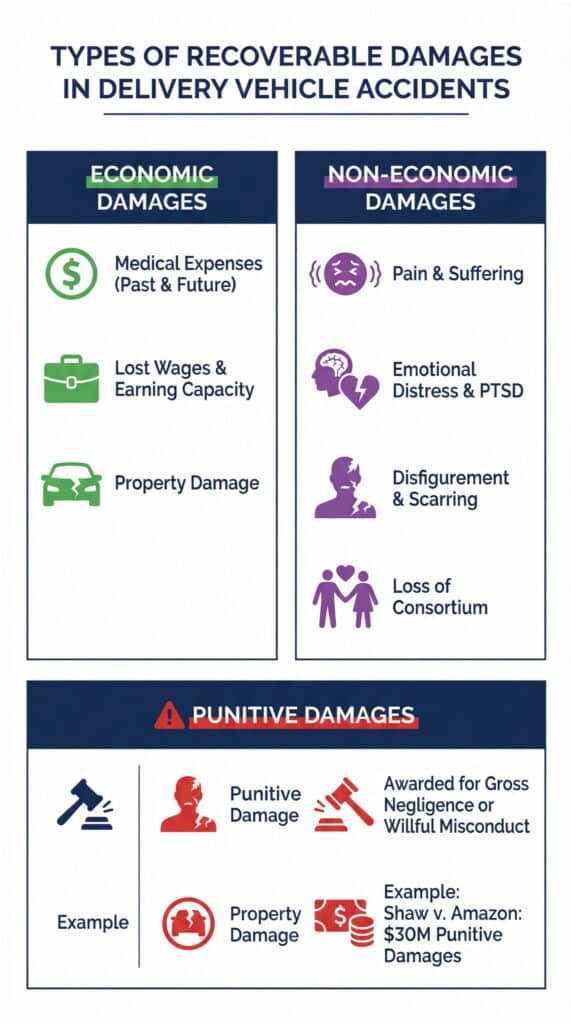
If you have been injured in a delivery vehicle accident, you may be entitled to recover a wide range of damages to compensate you for your losses. The goal of compensatory damages is to make you whole again, to the extent that money can do so. In cases involving serious injuries, these damages can be substantial. Understanding the full scope of recoverable damages is critical to ensuring that you receive fair compensation.
Economic Damages
Economic damages are those that have a specific dollar value and can be calculated with reasonable precision. These include:
- Medical Expenses: This includes all of your past and future medical bills related to the accident. Past medical expenses include emergency room treatment, hospitalization, surgery, diagnostic tests, prescription medications, physical therapy, and any other medical care you have received to date. Future medical expenses include the cost of ongoing treatment, rehabilitation, future surgeries, long-term care, and any medical equipment or home modifications you may need. In cases involving catastrophic injuries, such as spinal cord injuries or traumatic brain injuries, future medical expenses can easily run into the millions of dollars. An experienced attorney will work with medical experts and life care planners to accurately calculate these future costs.
- Lost Wages and Earning Capacity: If your injuries have prevented you from working, you can recover your lost wages for the time you have been unable to work. This includes not only your base salary, but also any bonuses, commissions, or other benefits you would have earned. If your ability to earn a living has been permanently affected by your injuries, you can also recover damages for your diminished earning capacity. This is the difference between what you were able to earn before the accident and what you are able to earn now. For example, if you were a construction worker earning $60,000 per year, and your injuries prevent you from returning to that type of work, you may be able to recover the present value of the difference between your former earning capacity and your current earning capacity over your remaining work life. Calculating diminished earning capacity requires the testimony of a vocational expert and an economist.
- Property Damage: If your vehicle was damaged or destroyed in the accident, you can recover the cost of repairs or the fair market value of the vehicle if it was totaled. You can also recover the cost of a rental vehicle while your car is being repaired.
Non-Economic Damages
Non-economic damages are those that do not have a specific dollar value and are more subjective in nature. These include:
- Pain and Suffering: This is compensation for the physical pain and discomfort you have endured as a result of your injuries. It includes not only the pain you experienced immediately after the accident, but also any ongoing or chronic pain you continue to experience. Pain and suffering damages are often calculated using a multiplier method, where your economic damages are multiplied by a factor (typically between 1.5 and 5) based on the severity of your injuries.
- Emotional Distress: In addition to physical pain, you may also be entitled to compensation for the emotional and psychological trauma caused by the accident. This can include anxiety, depression, post-traumatic stress disorder (PTSD), fear, and loss of enjoyment of life. The emotional impact of a serious accident can be just as debilitating as the physical injuries, and you deserve to be compensated for this harm.
- Disfigurement and Scarring: If the accident has left you with permanent scarring or disfigurement, you can recover damages for the physical and emotional impact of these injuries. This is particularly important in cases involving facial scarring or injuries that affect your appearance and self-esteem.
- Loss of Consortium: If your injuries have affected your relationship with your spouse, they may be able to recover damages for loss of consortium. This includes the loss of companionship, affection, sexual relations, and the services your spouse provided to the household.
Punitive Damages
- Punitive Damages: In cases where the defendant’s conduct was particularly egregious, such as a company that knowingly puts a dangerous driver on the road or sets quotas that make accidents inevitable, you may be able to recover punitive damages. Unlike compensatory damages, which are intended to compensate you for your losses, punitive damages are intended to punish the defendant and deter similar conduct in the future. The $30 million punitive damages award in the Shannon Shaw v. Amazon case is a powerful example of this 8. Punitive damages are not available in every case, and the standards for awarding them vary by state. However, in cases involving gross negligence or willful misconduct, they can be a powerful tool for holding corporate defendants accountable.
Settlement Examples
While every case is unique, and past results do not guarantee future outcomes, looking at real-world settlement examples can provide some insight into the potential value of a delivery vehicle accident claim:
- $950,000 for multiple fractures in an Amazon delivery accident.
- $2.7 million for paralysis in a UPS intersection collision.
- $3.1 million in a wrongful death case involving a FedEx truck.
- $14.41 million in actual damages plus $30 million in punitive damages in the landmark South Carolina case against Amazon 8.

- Prioritize Safety: Your first priority should always be your safety and the safety of others. If you are able, move your vehicle to a safe location off the road to avoid further collisions. Check on the other parties involved in the accident, but do not move anyone who is seriously injured unless they are in immediate danger.
- Call 911: Immediately call 911 to report the accident and request emergency medical assistance. A police report will be a critical piece of evidence in your case, and it is essential to have your injuries evaluated by a medical professional as soon as possible, even if you do not think you are seriously hurt.
- Document the Scene: If you are physically able, use your smartphone to document the scene of the accident. Take pictures and videos of the vehicles involved, the damage to each vehicle, the license plates, any skid marks on the road, and the surrounding area. It is also a good idea to take pictures of any visible injuries you have sustained.
- Gather Information: Exchange information with the other driver, including their name, address, phone number, driver’s license number, and insurance information. Be sure to also get the name of the delivery company they work for and any identifying information on the vehicle, such as a vehicle number or DOT number.
- Identify Witnesses: If there were any witnesses to the accident, get their names and contact information. Their testimony can be invaluable in proving what happened.
- Do Not Admit Fault: It is essential that you do not admit fault or apologize for the accident, even if you think you may have been partially to blame. Anything you say can be used against you by the insurance company.
- Seek Medical Attention: Even if you do not feel seriously injured, it is crucial to seek medical attention as soon as possible after the accident. Some serious injuries, such as internal bleeding or a traumatic brain injury, may not have immediate symptoms. A medical record will also be a critical piece of evidence in your case.
- Do Not Speak to the Insurance Company: The delivery company’s insurance adjuster may contact you shortly after the accident and try to get you to give a recorded statement or sign a medical authorization. Do not speak to them or sign anything without first consulting with an experienced personal injury attorney. The insurance company is not on your side, and their goal is to pay you as little as possible.
- Contact an Experienced Attorney: The most important step you can take to protect your rights after a delivery vehicle accident is to contact an experienced personal injury attorney who specializes in these types of cases. The sooner you have an attorney on your side, the better. They can handle all communication with the insurance company, conduct a thorough investigation, and ensure that you receive the full and fair compensation you deserve.

Initial Consultation & Case Evaluation
The first step is to schedule a free consultation with an experienced personal injury attorney. During this meeting, you will discuss the details of your case, and the attorney will evaluate its strengths and weaknesses. If they believe you have a valid claim, they will explain your legal options and what you can expect moving forward.
The Investigation Phase
Once you have retained an attorney, they will immediately launch a thorough investigation into the accident. This is a critical phase of the case, as the evidence gathered will form the foundation of your claim. The investigation will typically involve:
- Obtaining Official Reports: Your attorney will obtain the police report, any accident reconstruction reports, and any other official documentation related to the crash.
- Gathering Evidence from the Scene: This may include photos and videos of the accident scene, witness statements, and any available surveillance footage.
- Preserving Evidence from the Delivery Vehicle: Your attorney will immediately send a spoliation letter to the delivery company, demanding that they preserve the vehicle and all of its data. This is a critical step because delivery companies often have policies of quickly repairing or disposing of vehicles involved in accidents, which can destroy crucial evidence. The spoliation letter will demand preservation of:
- The vehicle itself, including all mechanical components, tires, brakes, and safety systems
- Electronic Logging Device (ELD) data showing the driver’s hours of service
- Event Data Recorder (EDR) or “black box” data showing the vehicle’s speed, braking, and other parameters in the seconds before the crash
- Onboard camera footage, including forward-facing cameras and driver-facing cameras
- GPS and telematics data showing the vehicle’s route and the driver’s behavior
- Maintenance records for the vehicle
- Any other electronic data stored in the vehicle’s systems
- Subpoenaing Company Records: Your attorney will subpoena a wide range of records from the delivery company to build a comprehensive picture of the company’s negligence. These records can include:
- The driver’s complete employment file, including their application, background check, driving record, and any disciplinary actions
- All training records showing what training the driver received and when
- The driver’s complete driving history, including any accidents, violations, or complaints
- The company’s policies and procedures for hiring, training, and supervising drivers
- The company’s delivery quotas and performance metrics
- All communications between the company and the driver, including messages sent through dispatch apps
- The company’s complete maintenance records for the vehicle, including inspection reports and repair records
- The company’s safety policies and any safety violations or citations
- Internal communications and emails discussing the accident or the company’s safety practices
- Data from the company’s telematics and monitoring systems showing the driver’s behavior and performance
- Hiring Expert Witnesses: In many cases, it is necessary to hire expert witnesses to help prove your case. These may include accident reconstructionists, human factors experts, and medical experts who can testify to the extent of your injuries and your long-term prognosis.
Liability Analysis
Once the investigation is complete, your attorney will analyze all of the evidence to determine who is liable for your injuries. This will involve a detailed analysis of the driver’s actions, the company’s policies and procedures, and any applicable federal and state regulations.
Damage Calculation
Your attorney will also work to calculate the full extent of your damages. This will include not only your past and future medical bills and lost wages, but also your pain and suffering, emotional distress, and any other losses you have suffered as a result of the accident.
Settlement Negotiations vs. Trial
Once your attorney has built a strong case, they will send a demand letter to the insurance company, outlining your damages and demanding a fair settlement. In some cases, the insurance company will make a reasonable offer, and the case can be settled out of court. However, in many delivery vehicle accident cases, the insurance company will refuse to offer a fair settlement, and it will be necessary to file a lawsuit and take the case to trial.
Delivery companies and their insurers are known for their aggressive litigation tactics. They have vast resources and will do everything they can to minimize their liability and pay you as little as possible. This is why it is so important to have an attorney who is not afraid to take your case to trial. At Southern Injury Attorneys, we prepare every case as if it is going to trial. This aggressive approach often convinces the insurance company to offer a fair settlement, but if they don’t, we are always ready to fight for our clients in court.
Delivery companies have developed sophisticated corporate structures designed to limit their liability in the event of an accident. Understanding these structures is key to holding the right parties accountable. An experienced attorney knows how to navigate these complex corporate webs and pierce the corporate veil to ensure that victims receive the compensation they deserve.
FedEx & UPS Models (Direct Liability)
FedEx and UPS, the legacy giants of the delivery industry, have traditionally operated on a more straightforward model. While they do use some contractors, a significant portion of their drivers are direct employees, and the company owns or leases the vast majority of its vehicle fleet. This direct relationship makes it much easier to establish vicarious liability. When a FedEx or UPS employee causes an accident while on the job, the company is generally held responsible. Their direct control over their drivers and vehicles also makes them clearly subject to FMCSA regulations.
Amazon’s Liability Shield (& How to Pierce It)
Amazon has built its delivery empire on a foundation of contractual loopholes and liability shields. The company has gone to great lengths to distance itself from the drivers who deliver its packages, creating a multi-layered network of contractors and subcontractors:
- Delivery Service Partners (DSPs): The core of Amazon’s last-mile delivery network is its DSP program. These are supposedly independent businesses that Amazon contracts with to deliver packages. However, the reality is that Amazon exerts a tremendous amount of control over these DSPs, from the branding on their vans to the routes their drivers take. This control is the key to piercing the corporate veil and holding Amazon liable.
- Amazon Flex: For even greater flexibility, Amazon uses its Flex program, which is essentially a gig economy platform for delivery drivers. Flex drivers use their own vehicles and are paid per delivery. This creates an even greater degree of separation between Amazon and the driver, but it does not eliminate the company’s potential liability.
- Third-Party Carriers: Amazon also contracts with a wide range of third-party carriers, from small local courier services to large national trucking companies.

The key to holding Amazon accountable is to demonstrate that despite its attempts to distance itself, the company maintains a high degree of control over its drivers. This was the strategy that led to the landmark $44.6 million verdict in the Shannon Shaw v. Amazon case in South Carolina in 2023. This case is a watershed moment in delivery vehicle accident litigation and provides a roadmap for holding Amazon liable despite its complex corporate structure.
In the Shaw case, Shannon Shaw was severely injured when an Amazon delivery van ran a stop sign and T-boned her vehicle. The driver worked for an Amazon Delivery Service Partner (DSP), not directly for Amazon. Amazon’s legal team argued that the company should not be held liable because the driver was an independent contractor. However, the plaintiff’s attorneys were able to present overwhelming evidence of Amazon’s control over the DSP and the driver. This evidence included:
- Amazon owned the van that was involved in the accident and leased it to the DSP.
- Amazon designed the driver’s route and assigned the specific packages to be delivered.
- Amazon required the driver to use its proprietary “Mentor” app, which tracked the driver’s location, speed, and behavior in real-time.
- Amazon set the delivery quotas and monitored the driver’s performance against those quotas.
- Amazon had the power to terminate the DSP’s contract if performance standards were not met.
- Amazon required the vans to be branded with Amazon’s logo, creating the appearance that the driver was an Amazon employee.
The jury found that this level of control was sufficient to establish vicarious liability, meaning that Amazon was legally responsible for the driver’s negligence. The jury awarded Shannon Shaw $14.41 million in actual damages for her injuries, which included a traumatic brain injury and other serious harm. In addition, the jury awarded $30 million in punitive damages, finding that Amazon’s conduct in creating this liability shield while maintaining such extensive control was sufficiently egregious to warrant punishment 8. This verdict sends a clear message to Amazon and other delivery companies that they cannot hide behind corporate structures while maintaining day-to-day control over their drivers.
Food Delivery Services (DoorDash, Uber Eats, Grubhub)
Food delivery services operate on a similar independent contractor model to Amazon Flex. The drivers are considered gig workers, and they use their own vehicles. This can make it challenging to hold the company liable, but it is not impossible. In some cases, it may be possible to argue that the company was negligent in its hiring or supervision of the driver, or that the driver was acting as an agent of the company.
The Key to Breaking the Corporate Veil
Piercing the corporate veil is a legal doctrine that allows courts to disregard the corporate structure and hold the parent company directly liable. To do this, it is necessary to show that the parent company is not just a passive investor, but is actively involved in the day-to-day operations of the subsidiary or contractor. The more control the parent company exerts, the more likely it is that a court will be willing to pierce the corporate veil. This is why a thorough investigation is so critical in these cases. An experienced attorney will know what evidence to look for to prove that the parent company was pulling the strings all along.

