

Reviewed by Larry Peters, Attorney — licensed in TN, MS, AR, TX, KY & GA · Updated June 2026Quick AnswerIn Tennessee, you generally have one year from the date of a Chattanooga truck accident to file an injury claim (Tenn. Code § 28-3-104). Southern Injury Attorneys helps truck accident victims in Chattanooga and across Hamilton County pursue full compensation for medical bills, lost wages, and pain and suffering — with no fee unless we win.
Chattanooga Truck Accident Lawyer
By: Attorney Larry “Jimmy” Peters | Updated: July 2026
Written and legally reviewed by Larry “Jimmy” Peters, founding attorney of Southern Injury Attorneys. Licensed in Tennessee (BPR #37889), Mississippi, Arkansas, Texas, Kentucky and Georgia.
Scope of this page: commercial truck and 18-wheeler crash claims on the I-24 and I-75 corridors through Hamilton County — federal safety rules, multiple defendants and the one-year Tennessee deadline. Reviewed July 2026 against the Tennessee Code, the Chattanooga Police Department’s 2024 Annual Report and published court and trauma-system sources. Sources are named in the text so you can check them yourself.
| Chattanooga truck accident claims at a glance | |
|---|---|
| Filing deadline | One year from the date of the injury — Tenn. Code Ann. §28-3-104(a)(1). It stretches to two years when the at-fault driver is criminally charged over the same conduct (§28-3-104(a)(2)). |
| Fault rule | Modified comparative fault with a 50% bar — McIntyre v. Balentine, 833 S.W.2d 52 (Tenn. 1992). Your recovery drops by your share of the blame, and at 50% or more you recover nothing. |
| The Chattanooga corridor | Chattanooga sits at the I-24 / I-75 junction, and I-24 runs through the Ridge Cut blasted through Missionary Ridge east of downtown — a curving, graded stretch that local reporting has repeatedly tied to overturned tractor-trailers and long interstate closures. |
| Federal rules in play | Interstate carriers answer to the Federal Motor Carrier Safety Regulations — hours-of-service limits, electronic logging device data, driver qualification files and maintenance records. Much of that data is overwritten on a schedule, so a preservation letter goes out early. |
| Who can be on the hook | The driver, the motor carrier, a broker or shipper, a maintenance contractor, a cargo loader or a parts manufacturer — often several at once, each with its own insurer. |
| Minimum auto liability | $25,000 / $50,000 / $25,000. The property-damage floor rose from $15,000 to $25,000 for split-limit policies issued or renewed after Dec. 31, 2022 (Tenn. Code Ann. §55-12-102). |
| Uninsured & underinsured | Insurers must offer UM/UIM at limits matching your bodily-injury liability limits unless you reduce or reject it in a signed writing — Tenn. Code Ann. §56-7-1201. |
| Where the case is filed | Hamilton County Circuit Court sits at 625 Georgia Avenue, Chattanooga. A case that belongs in federal court goes to the U.S. District Court for the Eastern District of Tennessee, Southern Division at Chattanooga, covering Hamilton plus Bledsoe, Bradley, McMinn, Marion, Meigs, Polk, Rhea and Sequatchie counties (28 U.S.C. §123(a)). |
| Where the badly hurt go | Erlanger (Baroness Hospital, 975 E. Third Street) is a Level I Trauma Center and the sole tertiary-care provider for a four-state region covering southeast Tennessee, north Georgia, north Alabama and western North Carolina. |
| What it costs to ask | Nothing up front. We work on a contingency fee — no fee unless we win — and the case review is free: 800-224-5546. |
In short: A truck case is not a bigger car case. Interstate carriers keep hours-of-service logs, ELD data, driver qualification files and maintenance records that are destroyed on a schedule, so the preservation letter is the first real deadline — long before the one-year filing deadline in §28-3-104(a)(1). Chattanooga sits at the I-24/I-75 junction, and the Ridge Cut through Missionary Ridge has a long record of overturned tractor-trailers.
By Larry “Jimmy” Peters, Managing Attorney Licensed in Tennessee, Mississippi, Arkansas, Texas, Kentucky, and Georgia
Pay Nothing Unless YOU Win
Schedule A Free Consultation
When a fully loaded 80,000-pound semi-truck collides with a passenger vehicle on the busy highways of Chattanooga, the consequences are often catastrophic. The sheer size and weight of commercial trucks mean that these accidents can cause life-altering injuries, devastating financial losses, and unimaginable grief for families. If you or a loved one has been involved in a truck accident in Chattanooga, Hamilton County, or anywhere in the surrounding East Tennessee region, you need a legal team that understands the complexities of these cases and is prepared to fight aggressively for the compensation you deserve.
Chattanooga sits at the crossroads of America’s freight network. The convergence of Interstate 75 and Interstate 24 creates one of the busiest trucking corridors in the Southeast, with thousands of semi-trucks, tractor-trailers, and commercial vehicles passing through our city every single day. This constant flow of heavy freight traffic, combined with challenging terrain and congested interchanges, makes Chattanooga a hotspot for serious truck accidents. When these crashes happen, the results are often far more severe than typical car accidents, and the legal process to obtain fair compensation is significantly more complex.
Call or Text 423-270-6929 (24/7) for a Free Consultation. No Fee Unless We Win.
At Southern Injury Attorneys, we understand what you’re going through. A truck accident can turn your entire life upside down in a matter of seconds. You may be dealing with serious injuries, mounting medical bills, lost income, and the stress of not knowing how you’ll provide for your family. The trucking company and their insurance carriers have teams of lawyers and investigators working to minimize their liability and pay you as little as possible. You deserve someone in your corner who will fight just as hard for you.
Why Chattanooga Truck Accident Victims Choose Us:
What We Offer | What It Means For You |
|---|---|
$15+ Million Recovered | Since founding in 2022, we have recovered over $15 million for our clients—and our results have doubled or more every year. |
Fast Investigation | We move quickly to preserve critical evidence before it disappears, including black box data, driver logs, and maintenance records. |
We Handle Insurers | Our team deals with the insurance companies so you can focus on your recovery and your family. |
Truck Cases Are Different | We have the experience and resources to handle the unique challenges of commercial vehicle accidents, including federal regulations and multiple liable parties. |
Local Chattanooga Focus | We know the roads, the courts, the hospitals, and the community. We understand the local factors that contribute to truck accidents in our area. |
Multi-State Licensed Team | Our attorneys are licensed in Tennessee, Arkansas, Texas, Kentucky, and Mississippi—giving us the reach to handle complex interstate trucking cases. |
No Fee Unless We Win | You pay us nothing unless we recover compensation for you. Our contingency fee arrangement means we’re invested in your success. |
What You Should Do Next
If you’ve been in a truck accident in Chattanooga, here are the three most important steps you should take right now:
- Get Medical Attention: Your health is the top priority. See a doctor immediately, even if you don’t think you’re seriously injured. Many truck accident injuries, including traumatic brain injuries and internal bleeding, may not show symptoms right away. Getting prompt medical care also creates important documentation of your injuries.
- Don’t Talk to the Insurance Company: Avoid giving any statements to the trucking company’s insurer. They are not on your side. Insurance adjusters are trained to get you to say things that can be used to reduce or deny your claim. Politely decline to give a recorded statement and refer them to your attorney.
Call Us: Contact Southern Injury Attorneys for a free, no-obligation consultation to discuss your case. The sooner you call, the sooner we can begin preserving evidence and building your case. Evidence in truck accident cases can disappear quickly, so time is of the essence.
Table of Contents
Quick Answers Box
Do I need a lawyer for a truck accident?
Yes. Truck accident cases are far more complex than typical car accidents. They often involve multiple liable parties, federal regulations, higher insurance limits, and aggressive defense tactics. An experienced Chattanooga truck accident lawyer can level the playing field, conduct a thorough investigation, preserve critical evidence, and fight for the full compensation you deserve.
How much is a Chattanooga truck accident case worth?
The value of your case depends on many factors, including the severity of your injuries, your medical expenses, lost wages, future care needs, and the impact on your quality of life. Truck accident cases often involve higher policy limits, which means more compensation may be available. We can provide a more accurate assessment after reviewing the specific details of your case.
Who can be liable besides the driver?
In addition to the truck driver, other parties may be held responsible for your injuries. These can include the trucking company (for negligent hiring, training, or supervision), the owner of the truck or trailer, the company that loaded the cargo, the maintenance company, the manufacturer of a defective truck part, or even a freight broker. Identifying all liable parties is crucial to maximizing your recovery.
How long do I have to file in Tennessee?
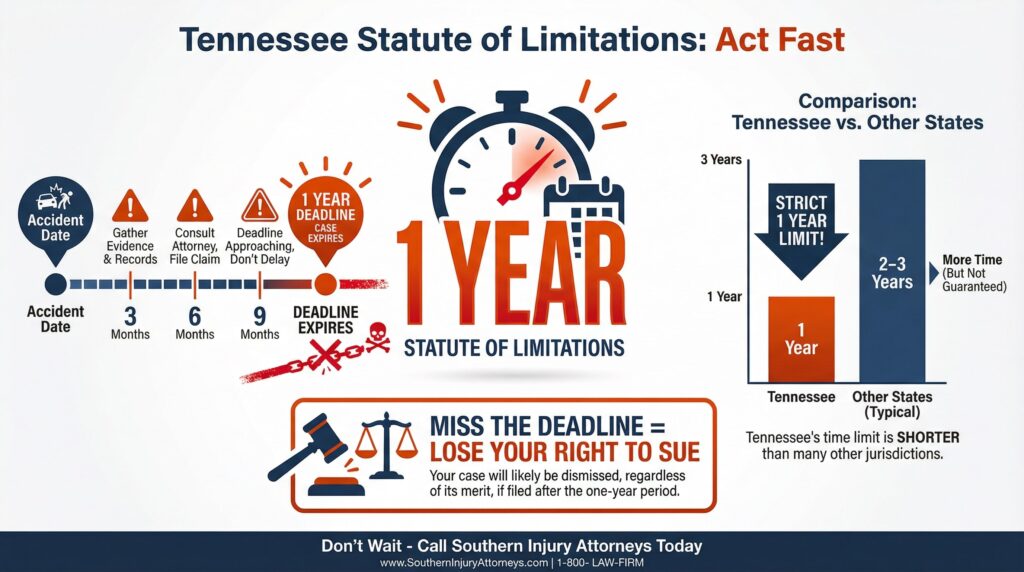
In Tennessee, the statute of limitations for personal injury cases is generally one year from the date of the accident [1]. This is one of the shortest deadlines in the country, so it is crucial to act quickly to preserve your legal rights. Missing this deadline typically means losing your right to sue.
What evidence matters most?
Critical evidence in a truck accident case includes the truck’s electronic logging device (ELD) data, the “black box” or electronic control module (ECM) data, driver’s logs and hours-of-service records, maintenance and inspection records, dispatch communications, dash cam footage, witness statements, and the police report. This evidence can be lost or destroyed if not preserved quickly.
What if I’m partially at fault?
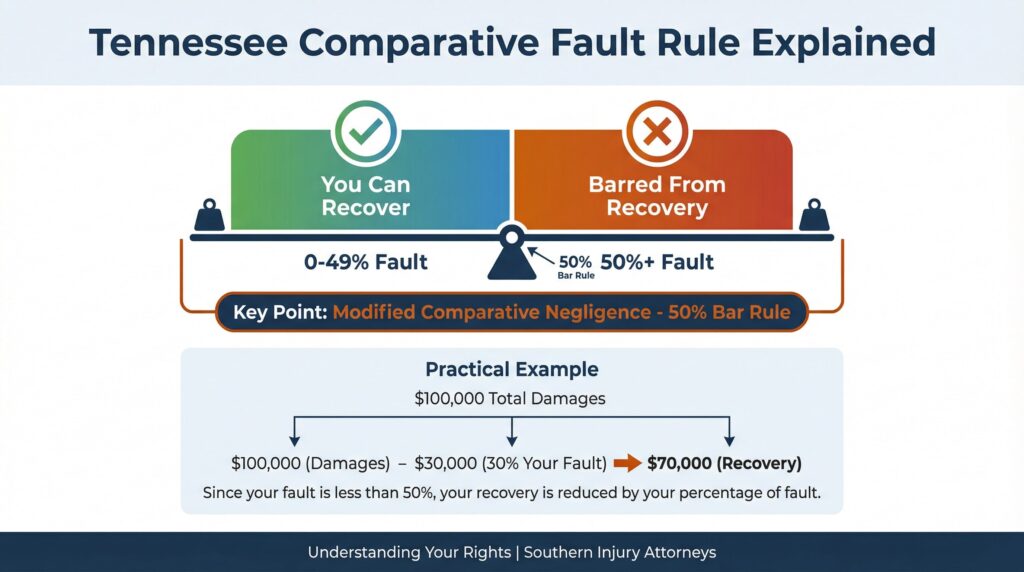
Tennessee follows a modified comparative fault rule. This means you can still recover damages as long as you are less than 50% at fault for the accident. Your recovery will be reduced by your percentage of fault [2]. For example, if you are found to be 20% at fault and your damages are $100,000, you would recover $80,000.
What are the minimum insurance requirements for trucks?
Federal law requires commercial trucks engaged in interstate commerce to carry a minimum of $750,000 in liability insurance for non-hazardous freight. Trucks carrying hazardous materials may be required to carry up to $5 million in coverage [4]. This is significantly higher than the minimum insurance required for passenger vehicles.
How is a truck accident different from a car accident?
Truck accidents differ from car accidents in several key ways: the injuries are typically more severe due to the size and weight of trucks; there are often multiple liable parties; trucking companies are subject to extensive federal regulations; there are higher insurance limits; and the trucking industry has sophisticated legal and investigative resources to defend against claims.
What should I do if the trucking company’s insurer calls me?
Do not give a recorded statement. Politely decline and tell them to contact your attorney. Insurance adjusters are trained to ask questions designed to minimize your claim or shift blame to you. Anything you say can be used against you later.
Can I still file a claim if my loved one died in a truck accident?
Yes. If you have lost a loved one in a truck accident, you may be able to file a wrongful death lawsuit. This can help you recover compensation for funeral and burial expenses, medical bills incurred before death, loss of income and financial support, loss of companionship and consortium, and pain and suffering experienced by your loved one before death.
Why Truck Accident Cases Are Different

The Size and Weight Factor
A fully loaded tractor-trailer can weigh up to 80,000 pounds, which is roughly 20 to 30 times heavier than the average passenger car and even more compared to motorcycles. This enormous weight disparity means that when a truck collides with a smaller vehicle, the occupants of that vehicle absorb the vast majority of the impact force. The laws of physics are simply not in your favor. This is why truck accidents so often result in catastrophic injuries or fatalities, even at relatively low speeds.
Multiple Potentially Liable Parties
Unlike a typical car accident where there is usually one at-fault driver, truck accidents can involve numerous potentially liable parties. The truck driver may be at fault for negligent driving, but the trucking company may also be liable for negligent hiring, inadequate training, or pressuring drivers to violate hours-of-service regulations. The company that loaded the cargo may be liable if the load was improperly secured. The maintenance company may be liable if they failed to properly inspect or repair the truck. The manufacturer of a truck component may be liable if a defective part contributed to the accident. Identifying all of these parties and their respective insurance policies is crucial to maximizing your recovery.
Federal Regulations
The trucking industry is subject to extensive federal regulations administered by the Federal Motor Carrier Safety Administration (FMCSA). These regulations govern everything from driver qualifications and hours of service to vehicle maintenance and cargo securement. When a trucking company or driver violates these regulations, it can be powerful evidence of negligence. However, understanding and applying these regulations requires specialized knowledge that most personal injury lawyers simply don’t have.
Higher Insurance Limits
Federal law requires commercial trucks to carry significantly higher insurance limits than passenger vehicles. For trucks carrying non-hazardous freight, the minimum is $750,000, and for trucks carrying hazardous materials, the minimum can be as high as $5 million [4]. While this means there is often more money available to compensate victims, it also means that insurance companies will fight harder to avoid paying out large claims.
Sophisticated Defense Resources
Trucking companies and their insurers have significant resources to defend against claims. They often have rapid response teams that are dispatched to accident scenes within hours to begin gathering evidence and protecting the company’s interests. They employ experienced defense attorneys, accident reconstructionists, and other experts. They know how to make evidence disappear and how to shift blame to the victim. To have a fair chance against these resources, you need an attorney who has experience handling truck accident cases and who is prepared to fight back.
Why Acting Fast Matters
Time is of the essence after a truck accident. Critical evidence can be lost or destroyed in a matter of days or even hours. The truck’s electronic logging device (ELD) may only store data for a limited period before it is overwritten. The truck’s “black box” or electronic control module (ECM) can be reset or the data can be lost if the truck is repaired or returned to service. Dispatch communications, driver logs, and maintenance records can be “lost” or destroyed. Witnesses’ memories fade, and physical evidence at the scene can be cleaned up or altered.
It is crucial to have an experienced legal team on your side as soon as possible after a truck accident. One of the first things we do is send a spoliation letter to the trucking company and all other potentially liable parties, demanding that they preserve all evidence related to the accident. This puts them on notice that they have a legal obligation to preserve evidence, and if they destroy it, they can face serious consequences.
Areas We Serve
Accidents We Handle
Chattanooga and Tennessee Truck Crash Risk
Chattanooga and the state of Tennessee see a significant amount of truck traffic, which unfortunately translates to a substantial number of truck-related crashes each year. Understanding the scope of this problem helps illustrate why truck accident cases are so important and why victims need experienced legal representation.
Tennessee Statewide Truck Crash Statistics
According to the Tennessee Department of Safety and Homeland Security’s 2023 Crash Facts report on large trucks [5]:
Statistic | 2023 Data |
|---|---|
Total TCA Reportable Crashes Involving Large Trucks | 12,858 |
Fatalities Resulting from Large Truck Crashes | 163 |
Proportion of All Crashes Involving Large Trucks | 1 in 14 |
Proportion of Large Truck Crashes on Interstates | 1 in 4 |
Proportion of Highway Fatalities Involving Large Trucks | 1 in 8 |
These numbers are sobering. In Tennessee, one person was killed in a crash involving a large truck approximately every 2 days, 5 hours, and 44 minutes in 2023. Large trucks are involved in a disproportionate share of fatal accidents on our highways.
Top Driver Conditions in Large Truck Crashes
The 2023 Tennessee Crash Facts report also identified the top driver conditions contributing to large truck crashes [5]:
For Large Truck Drivers:
- Apparently Fatigued
- Under the Influence of Drugs/Alcohol
- Apparently Asleep
For Other Drivers Involved in Crashes with Large Trucks:
- Under the Influence of Drugs/Alcohol
- Apparently Fatigued
- Apparently Asleep
Driver fatigue is a leading cause of truck accidents, which is why federal hours-of-service regulations are so important and why violations of those regulations can be powerful evidence of negligence.
Top Driver Actions in Large Truck Crashes
The report also identified the top driver actions contributing to crashes [5]:
For Large Truck Drivers:
- Failure to Keep in Proper Lane
- Following Improperly
- Improper Lane Changing
For Other Drivers:
- Failure to Yield Right of Way
- Following Improperly
- Failure to Keep in Proper Lane
Hamilton County Crash Context
While specific truck accident statistics for Hamilton County are not separately reported, the county experiences significant overall traffic crash activity. According to preliminary 2024 data from the Tennessee Department of Safety, Hamilton County recorded approximately 10,538 total crashes, including 35 fatal crashes and 2,555 injury crashes. Given that Chattanooga sits at the intersection of two major interstate highways with heavy truck traffic, a significant portion of these crashes involve commercial vehicles.
Chattanooga Hotspots and Why They Matter

The I-24/I-75 Split
The interchange where I-24 and I-75 meet is notorious among truckers and local drivers alike. The Tennessee Department of Transportation (TDOT) has identified this area as one of the worst freight bottlenecks in the state [3]. In fact, the I-75 northbound segment in Hamilton County from the Georgia state line to the I-24/I-75 interchange was ranked as the #1 freight bottleneck in Tennessee in the 2022 TDOT Statewide Freight Bottleneck Study.
The problems with this interchange are multifaceted. Traffic from two major interstates converges and diverges in a relatively short distance, requiring frequent lane changes and merging maneuvers. During peak hours, traffic often slows dramatically, creating dangerous speed differentials between vehicles. Trucks, with their longer stopping distances and limited maneuverability, are particularly vulnerable in these conditions. A sudden slowdown can lead to rear-end collisions, and the constant lane changing increases the risk of sideswipe accidents.
Consider this scenario: A driver is traveling northbound on I-75, approaching the split. Traffic ahead suddenly slows due to congestion. The driver in a passenger car is able to brake in time, but the fully loaded semi-truck behind them cannot stop quickly enough. The result is a devastating rear-end collision, potentially an underride accident where the car slides under the truck’s trailer.
The Ridge Cut and Missionary Ridge Area
Interstate 24 passes through Missionary Ridge via a section known as the “Ridge Cut.” This area presents unique challenges for truck traffic due to its steep grades and sharp curves. Trucks traveling downhill must carefully manage their speed and brakes to avoid losing control. A truck with fatigued brakes or an inexperienced driver can easily become a runaway vehicle on these grades.
The Ridge Cut is also prone to congestion, particularly during rush hour. When traffic backs up on a steep grade, trucks must work harder to maintain their position, and the risk of rollback or loss of control increases. The combination of challenging terrain and heavy traffic makes this one of the most dangerous stretches of highway in the Chattanooga area for truck accidents.
US-27 Corridor
US-27 runs through the heart of Chattanooga and serves as a major route for local and regional freight traffic. Unlike the interstates, US-27 has numerous intersections, traffic signals, and access points, which increases the potential for conflicts between trucks and other vehicles. Wide-turn accidents, where a truck swings into an adjacent lane while making a turn, are common on this type of roadway. So are accidents involving trucks entering or exiting driveways and parking lots.
Other High-Risk Areas
Other areas in and around Chattanooga that see elevated truck accident risk include:
- I-24 near US-27: Another area of merging traffic and congestion.
- Rossville Boulevard: A busy commercial corridor with heavy truck traffic.
- Brainerd Road: A major arterial with numerous businesses and access points.
- Lee Highway: Connects Chattanooga to communities to the east and sees significant commercial traffic.
- Highway 153: A busy route connecting Hixson and other northern suburbs to downtown Chattanooga.
Nearby Communities Affected
Truck accidents don’t just happen in Chattanooga proper. The surrounding communities of Hamilton County and beyond are also affected by the heavy truck traffic in the region. These include East Ridge, Hixson, Red Bank, Ooltewah, Collegedale, Soddy-Daisy, Signal Mountain, and Lookout Mountain. Additionally, because Chattanooga is so close to the Georgia border, cross-border accidents are not uncommon. These cases can involve complex jurisdictional issues that require an attorney with experience handling multi-state matters.
Local Medical Resources
Victims of truck accidents in Chattanooga typically receive treatment at one of the area’s major hospitals, including Erlanger Medical Center (the region’s Level I trauma center), CHI Memorial Hospital, and Parkridge Medical Center. These facilities have the resources to treat serious trauma injuries, but the medical bills can quickly become overwhelming. Understanding how to document your medical treatment and expenses is crucial to your case.
Common Types of Truck Accidents

Rear-End Underride Accidents
Underride accidents are among the most deadly types of truck crashes. They occur when a smaller vehicle collides with the rear or side of a truck and slides underneath the trailer. Because the trailer rides higher off the ground than the hood of most passenger vehicles, the car’s safety features (crumple zones, airbags) are bypassed, and the passenger compartment can be crushed or sheared off. These accidents often result in decapitation, severe head trauma, or death.
What causes them: Sudden stops by the truck, inadequate lighting or reflectors on the trailer, driver inattention, following too closely.
What evidence proves it: Damage patterns on the vehicles, the presence or absence of underride guards, lighting and reflector compliance, truck driver’s actions before the crash.
Common injuries: Traumatic brain injury, decapitation, severe lacerations, spinal cord injury, death.
Jackknife Accidents
A jackknife accident occurs when the trailer of a semi-truck swings out to the side, forming a 90-degree angle (or sharper) with the cab, resembling a folding pocket knife. This typically happens when the truck’s drive wheels lock up during braking, causing the trailer to swing around. A jackknifed truck can sweep across multiple lanes of traffic, striking other vehicles and causing multi-car pileups.
What causes them: Sudden braking, wet or icy roads, improper braking technique, brake failure, empty or lightly loaded trailers.
What evidence proves it: Skid marks, truck speed data, brake inspection records, weather conditions, driver training records.
Common injuries: Multiple trauma injuries, crush injuries, traumatic brain injury, spinal injuries.
Wide-Turn Accidents
Due to their length, semi-trucks require significantly more space to make turns than passenger vehicles. When making a right turn, truck drivers often swing wide to the left first, or they may need to use multiple lanes to complete the turn. This creates a dangerous situation where other vehicles can become trapped between the truck and the curb, or they can be sideswiped by the swinging trailer.
What causes them: Driver inexperience, failure to check mirrors, failure to signal, attempting to turn from the wrong lane, other drivers attempting to pass on the right.
What evidence proves it: Witness statements, traffic camera footage, damage patterns, driver training records.
Common injuries: Crush injuries, broken bones, soft tissue injuries, head injuries.
Rollover Accidents
Rollover accidents occur when a truck tips over onto its side or roof. These accidents can be caused by a variety of factors, including taking a curve too fast, sudden steering maneuvers, high winds, uneven road surfaces, or improperly loaded cargo that shifts during transport. A rolling truck can crush vehicles in adjacent lanes and spill its cargo onto the roadway, creating additional hazards.
What causes them: Excessive speed, improper cargo loading, sudden maneuvers, high winds, road defects, top-heavy loads.
What evidence proves it: Speed data, cargo loading records, weight tickets, weather data, road condition reports.
Common injuries: Crush injuries, traumatic brain injury, spinal cord injury, burns (if hazardous materials are involved), death.
Load Shift and Cargo Spill Accidents
When cargo is not properly loaded and secured, it can shift during transport, causing the truck to become unbalanced and difficult to control. In extreme cases, the cargo can spill onto the roadway, creating obstacles for other drivers. Improperly secured cargo can also fall off the truck and strike other vehicles directly.
What causes them: Improper loading, inadequate securement, failure to follow cargo securement regulations, overloading.
What evidence proves it: Cargo loading records, bills of lading, weight tickets, post-accident cargo inspection, driver’s pre-trip inspection records.
Common injuries: Varies widely depending on the nature of the accident and cargo involved.
Tire Blowout Accidents
Truck tires are subjected to enormous stress, carrying heavy loads over long distances at highway speeds. When a tire fails, the driver can lose control of the vehicle, and the debris from the blown tire can strike other vehicles. Tire blowouts are often caused by inadequate maintenance, overloading, or manufacturing defects.
What causes them: Underinflation, overloading, worn tread, manufacturing defects, road hazards, inadequate maintenance.
What evidence proves it: Tire inspection records, maintenance logs, tire manufacturer data, load weight records.
Common injuries: Varies depending on the resulting accident; can include injuries from debris strikes.
Runaway Truck and Grade-Related Accidents
The mountainous terrain around Chattanooga, including the grades on I-24 through Missionary Ridge, presents unique challenges for truck drivers. Trucks traveling downhill must carefully manage their speed using engine braking and their service brakes. If the brakes overheat and fade, or if the driver loses control, the truck can become a runaway vehicle, unable to stop. Runaway truck ramps are provided on some grades, but not all drivers are able to reach them in time.
What causes them: Brake fade from overheating, improper use of engine braking, excessive speed on grades, brake failure, driver inexperience.
What evidence proves it: Brake inspection records, driver training records, speed data, evidence of brake overheating.
Common injuries: Severe trauma from high-speed collisions, often fatal.
Work Zone Accidents
Construction and work zones are particularly dangerous areas for truck accidents. Lane shifts, reduced speeds, and the presence of workers and equipment create a complex environment that requires heightened attention. Truck drivers who are fatigued, distracted, or unfamiliar with the area may fail to navigate work zones safely.
What causes them: Driver inattention, failure to slow down, inadequate work zone signage, sudden lane changes.
What evidence proves it: Work zone configuration records, signage placement, driver logs, witness statements.
Common injuries: Varies; can involve injuries to both vehicle occupants and road workers.
Night Crashes
A significant portion of truck accidents occur at night, when visibility is reduced and driver fatigue is more likely. Trucks may have inadequate lighting or reflectors, making them difficult to see. Drivers of both trucks and passenger vehicles may be drowsy or have impaired night vision.
What causes them: Reduced visibility, driver fatigue, inadequate truck lighting, impaired drivers.
What evidence proves it: Lighting inspection records, driver logs, time of accident, toxicology reports.
Common injuries: Varies depending on the type of collision.
Multi-Vehicle Pileups
On busy highways like I-24 and I-75, a single truck accident can quickly escalate into a multi-vehicle pileup involving dozens of cars and trucks. These accidents are often triggered by sudden stops, reduced visibility (due to fog, smoke, or weather), or a jackknifed truck blocking the roadway. The resulting chain-reaction collisions can cause widespread injuries and fatalities.
What causes them: Initial triggering event (truck accident, sudden stop), reduced visibility, following too closely, high traffic volume.
What evidence proves it: Accident reconstruction, witness statements, traffic camera footage, vehicle damage patterns.
Common injuries: Wide range of injuries across multiple victims; often includes fatalities.
Common Injuries and Medical Reality

Traumatic Brain Injuries (TBI)
Traumatic brain injuries are among the most serious and life-altering injuries that can result from a truck accident. A TBI occurs when a sudden trauma causes damage to the brain, either from a direct blow to the head or from the brain being shaken violently inside the skull. Even a seemingly minor head injury can have long-term consequences.
Symptoms of TBI can include headaches, confusion, memory problems, difficulty concentrating, mood changes, sleep disturbances, dizziness, and sensory problems. In severe cases, TBI can result in permanent cognitive impairment, personality changes, and the inability to work or live independently.
Spinal Cord Injuries
Damage to the spinal cord can result in partial or complete paralysis, depending on the location and severity of the injury. Injuries to the cervical (neck) region of the spine can cause quadriplegia (paralysis of all four limbs), while injuries to the thoracic or lumbar regions can cause paraplegia (paralysis of the lower body). Spinal cord injuries often require a lifetime of medical care, including surgeries, rehabilitation, assistive devices, and home modifications.
Fractures and Broken Bones
The impact of a truck accident can easily break bones throughout the body. Common fractures include broken legs, arms, ribs, pelvis, and vertebrae. Compound fractures, where the bone breaks through the skin, are particularly serious and carry a high risk of infection. Many fractures require surgical repair with plates, screws, or rods, followed by extensive physical therapy.
Internal Injuries
The blunt force trauma of a truck accident can cause damage to internal organs, including the liver, spleen, kidneys, and lungs. Internal bleeding can be life-threatening if not diagnosed and treated promptly. Because internal injuries may not be immediately apparent, it is crucial to seek medical attention after any truck accident, even if you feel fine initially.
Amputations
In severe truck accidents, victims may suffer traumatic amputations, where a limb is severed in the accident, or they may require surgical amputation due to the extent of their injuries. The loss of a limb has profound physical, emotional, and financial consequences, requiring prosthetics, rehabilitation, and often career changes.
Burns
Truck accidents involving fuel spills, hazardous materials, or vehicle fires can result in severe burns. Burn injuries are extremely painful and often require multiple surgeries, skin grafts, and long-term treatment. Severe burns can cause permanent disfigurement and scarring.
Soft Tissue Injuries
Soft tissue injuries, including whiplash, sprains, strains, and contusions, are common in truck accidents. While these injuries may seem less serious than broken bones or brain injuries, they can still cause significant pain and disability, and they may require ongoing treatment.
Post-Traumatic Stress Disorder (PTSD)
The psychological trauma of a truck accident can be just as debilitating as the physical injuries. Many truck accident victims develop PTSD, characterized by flashbacks, nightmares, anxiety, depression, and avoidance of situations that remind them of the accident. PTSD can significantly impact quality of life and may require ongoing mental health treatment.
What to Document: A Practical Checklist
After a truck accident, it is crucial to keep detailed records of your injuries and medical treatment. This documentation will be essential to proving your damages and obtaining fair compensation. Here is a checklist of what you should document:
Category | What to Document |
|---|---|
Symptoms | Keep a daily journal of your symptoms, including pain levels (on a scale of 1-10), location of pain, limitations on your daily activities, sleep problems, mood changes, and any other effects of the accident. |
Medical Appointments | Keep a record of all your doctor’s appointments, including the date, time, provider name, purpose of the visit, and what was discussed or recommended. |
Medications | Keep a list of all medications you are taking, including the name, dosage, frequency, prescribing doctor, and any side effects you experience. |
Medical Bills | Keep copies of all medical bills and explanation of benefits (EOB) statements from your insurance company. |
Missed Work | Keep track of any time you have missed from work, including the dates, the number of hours missed, and the amount of income you have lost. Get documentation from your employer if possible. |
Impact on Daily Life | Document how your injuries have affected your ability to perform daily activities, such as household chores, childcare, hobbies, and social activities. |
Photographs | Take photographs of your injuries at regular intervals to document their progression and healing. |
Liability: Who Can Be Held Responsible

The Truck Driver
The truck driver is often the most obvious potentially liable party. Drivers can be held liable for negligent driving behaviors such as:
- Speeding: Driving too fast for conditions or exceeding the speed limit.
- Distracted Driving: Using a cell phone, eating, adjusting the radio, or other distractions.
- Fatigued Driving: Driving while drowsy or in violation of hours-of-service regulations.
- Impaired Driving: Driving under the influence of alcohol, drugs, or certain medications.
- Aggressive Driving: Tailgating, unsafe lane changes, road rage.
- Failure to Obey Traffic Laws: Running red lights, failing to yield, improper turns.
The Trucking Company (Motor Carrier)
The trucking company that employs the driver (or contracts with them) can also be held liable under several legal theories:
- Vicarious Liability (Respondeat Superior): Employers are generally liable for the negligent acts of their employees committed within the scope of employment.
- Negligent Hiring: Failing to properly screen drivers for safety issues, criminal history, or driving record problems.
- Negligent Training: Failing to provide adequate training on safe driving practices, cargo securement, hours-of-service compliance, etc.
- Negligent Supervision: Failing to monitor drivers for compliance with safety regulations and company policies.
- Negligent Retention: Continuing to employ a driver with known safety issues.
- Negligent Entrustment: Allowing an unqualified or unsafe driver to operate a truck.
- Pressure to Violate Regulations: Encouraging or pressuring drivers to violate hours-of-service rules or other safety regulations to meet delivery deadlines.
The Owner of the Truck or Trailer
In some cases, the truck or trailer involved in the accident may be owned by a different entity than the trucking company operating it. The owner may be held liable if they failed to properly maintain the vehicle or if they knew or should have known that the vehicle was unsafe.
The Maintenance Company
If the trucking company outsources vehicle maintenance to a third-party company, that maintenance company can be held liable if their negligent maintenance contributed to the accident. This could include failing to properly inspect the vehicle, failing to repair known defects, or performing repairs incorrectly.
The Shipper or Loader
The company that loaded the cargo onto the truck can be held liable if the cargo was improperly loaded or secured. An improperly loaded truck can be unbalanced, making it more prone to rollovers or loss of control. Cargo that is not properly secured can shift during transport or fall off the truck entirely.
The Freight Broker
Freight brokers are intermediaries who connect shippers with trucking companies. In some cases, brokers can be held liable if they negligently selected an unsafe carrier or if they were aware of safety issues with the carrier they selected.
The Manufacturer of a Defective Part
If the accident was caused by a defective truck component, such as faulty brakes, a defective tire, or a malfunctioning steering system, the manufacturer of that component can be held liable under product liability law. These cases require expert analysis to identify the defect and prove that it caused the accident.
Government Entities
In rare cases, a government entity may be held liable if a dangerous road condition contributed to the accident. This could include poorly designed interchanges, inadequate signage, or failure to maintain the roadway. However, claims against government entities are subject to special notice requirements and shorter deadlines, so it is important to consult with an attorney promptly if you believe a road defect contributed to your accident.
How We Prove Liability
Our firm has the resources and experience to conduct a thorough investigation into your accident to identify all potentially liable parties and gather the evidence needed to prove their negligence. Our investigation may include:
Evidence Type | What It Can Show |
|---|---|
Truck’s Black Box (ECM/EDR) Data | Speed, braking, steering inputs, engine data in the moments before the crash. |
Electronic Logging Device (ELD) Data | Driver’s hours of service, compliance with rest requirements. |
Driver’s Logs and Employment Records | Driving history, training records, prior violations, employment history. |
Truck’s Maintenance Records | Inspection history, repairs performed, known defects. |
Dispatch Communications | Pressure to meet deadlines, driver’s reported condition. |
Bills of Lading and Cargo Records | What was being transported, how it was loaded, weight. |
Witness Statements | What witnesses saw and heard before, during, and after the crash. |
Police Reports | Officer’s observations, citations issued, preliminary fault assessment. |
Accident Reconstruction | Expert analysis of how the accident occurred based on physical evidence. |
Medical Records | Documentation of your injuries and their cause. |
Federal Trucking Regulations Explained
The Federal Motor Carrier Safety Administration (FMCSA) has established a comprehensive set of regulations to promote the safe operation of commercial motor vehicles on our nation’s highways. These regulations, found in Title 49 of the Code of Federal Regulations, cover virtually every aspect of trucking operations. When trucking companies or drivers violate these regulations, it can be powerful evidence of negligence in a truck accident case.
Hours-of-Service Regulations
Driver fatigue is one of the leading causes of truck accidents. To combat this problem, the FMCSA has established strict limits on the number of hours a truck driver can drive and work before they must take a rest break. The current hours-of-service rules for property-carrying drivers include:
- 11-Hour Driving Limit: A driver may drive a maximum of 11 hours after 10 consecutive hours off duty.
- 14-Hour Limit: A driver may not drive beyond the 14th consecutive hour after coming on duty, following 10 consecutive hours off duty.
- 30-Minute Break: A driver must take a 30-minute break after 8 cumulative hours of driving without at least a 30-minute interruption.
- 60/70-Hour Limit: A driver may not drive after 60/70 hours on duty in 7/8 consecutive days. A driver may restart a 7/8 consecutive day period after taking 34 or more consecutive hours off duty.
Violations of these rules are common and can be proven through electronic logging device data and driver logs.
Electronic Logging Devices (ELDs)
Since December 2017, most commercial motor vehicles have been required to use electronic logging devices (ELDs) to record driver hours of service. ELDs automatically record driving time based on the vehicle’s engine data, making it much more difficult for drivers to falsify their logs (a practice that was common with paper logs). ELD data is crucial evidence in truck accident cases, as it can show whether the driver was in compliance with hours-of-service regulations at the time of the accident.
Vehicle Maintenance and Inspection Requirements
Trucking companies are required to systematically inspect, repair, and maintain all commercial motor vehicles under their control. This includes:
- Pre-Trip Inspections: Drivers must conduct a pre-trip inspection of their vehicle before each trip to identify any safety defects.
- Post-Trip Inspections: Drivers must prepare a written report at the end of each day’s work on the condition of the vehicle.
- Periodic Inspections: Vehicles must undergo a thorough annual inspection by a qualified inspector.
- Repair Requirements: Any safety defects identified must be repaired before the vehicle is operated.
Failure to properly maintain a truck can lead to brake failures, tire blowouts, steering problems, and other mechanical issues that cause accidents.
Drug and Alcohol Testing
Truck drivers are subject to drug and alcohol testing under FMCSA regulations. This includes:
- Pre-Employment Testing: Drivers must pass a drug test before being hired.
- Random Testing: Drivers are subject to random drug and alcohol testing throughout their employment.
- Post-Accident Testing: Drivers must be tested after certain types of accidents.
- Reasonable Suspicion Testing: Drivers must be tested if a supervisor has reasonable suspicion that they are impaired.
- Return-to-Duty and Follow-Up Testing: Drivers who have violated drug and alcohol rules must pass testing before returning to duty and are subject to follow-up testing.
Weight Limits and Cargo Securement
Federal regulations limit the gross weight of commercial motor vehicles to 80,000 pounds (with some exceptions). There are also limits on the weight that can be carried on individual axles. Overweight trucks are more difficult to stop and control, and they cause more damage to roads and bridges.
Cargo securement regulations specify how different types of cargo must be loaded and secured to prevent shifting or falling during transport. Improperly secured cargo can cause the truck to become unbalanced, leading to rollovers or loss of control.
Driver Qualification Standards
The FMCSA has established minimum qualification standards for commercial motor vehicle drivers. These include:
- Age Requirements: Generally, drivers must be at least 21 years old to drive in interstate commerce.
- Medical Certification: Drivers must pass a physical examination and obtain a medical certificate.
- Commercial Driver’s License (CDL): Drivers must hold a valid CDL with the appropriate endorsements for the type of vehicle they are operating.
- English Language Proficiency: Drivers must be able to read and speak English sufficiently to communicate with the public and understand traffic signs and signals.
- Driving Record: Drivers must not be disqualified due to certain violations or conditions.
Trucking companies are required to maintain a driver qualification file for each driver, documenting their compliance with these standards.
Evidence Preservation and Investigation Playbook
After a truck accident, the clock starts ticking immediately. Critical evidence can be lost, destroyed, or overwritten in a matter of days or even hours. Trucking companies know this, and they often have rapid response teams that are dispatched to accident scenes to begin protecting their interests before victims even have a chance to hire an attorney. To level the playing field, you need a legal team that knows how to act quickly and aggressively to preserve evidence.
The Spoliation Letter
One of the first things we do after being retained on a truck accident case is send a spoliation letter (also called a preservation letter or litigation hold letter) to the trucking company and all other potentially liable parties. This letter puts them on formal notice of their legal obligation to preserve all evidence related to the accident. It specifically identifies the types of evidence that must be preserved, including:
- Electronic logging device (ELD) data
- Electronic control module (ECM) or “black box” data
- Dash cam and other video footage
- Driver logs and records
- Dispatch communications
- Maintenance and inspection records
- Driver qualification files
- Cargo and loading records
- Insurance policies
- Any other documents or data related to the accident
If a party destroys evidence after receiving a spoliation letter, they can face serious consequences, including adverse inference instructions (where the jury is told they can assume the destroyed evidence was unfavorable to the party that destroyed it) or even sanctions.
Electronic Data We Pursue
Modern commercial trucks are equipped with sophisticated electronic systems that record a wealth of data about the vehicle’s operation. This data can be invaluable in reconstructing how an accident occurred and proving negligence.
Electronic Logging Device (ELD): Records the driver’s hours of service, including driving time, on-duty time, and off-duty time. Can show whether the driver was in compliance with hours-of-service regulations.
Electronic Control Module (ECM) / Event Data Recorder (EDR): Often called the truck’s “black box,” this device records data about the vehicle’s operation, including speed, braking, throttle position, engine RPM, and other parameters. Some ECMs record data continuously, while others only record data in the moments before and after a “hard event” like a collision or sudden braking.
Dash Cameras: Many trucks are equipped with forward-facing and/or driver-facing cameras that record video footage. This footage can show exactly what happened in the moments leading up to an accident.
GPS and Telematics Data: Many trucking companies use GPS tracking and telematics systems to monitor their vehicles. This data can show the truck’s route, speed, and location history.
Other Critical Evidence
Qualcomm/Dispatch Messages: Communications between the driver and the trucking company’s dispatcher can reveal important information, such as whether the driver was being pressured to meet a deadline, whether the driver reported any problems with the truck, or whether the driver mentioned being tired.
Bills of Lading and Load Tickets: These documents show what cargo was being transported, how much it weighed, and who loaded it. They can be important in cases involving overloading or improper cargo securement.
Scale/Weigh Station Records: Records from weigh stations can show whether the truck was overweight at the time of the accident.
Post-Trip Inspection Reports: Drivers are required to complete a post-trip inspection report at the end of each day. These reports can show whether the driver identified any safety defects with the vehicle.
Maintenance and Repair Records: The truck’s maintenance history can reveal whether there were known defects that were not repaired, whether required inspections were performed, and whether the truck was properly maintained.
Driver Qualification File: This file contains information about the driver’s qualifications, including their driving record, training history, medical certification, and employment history.
Witness Statements: Eyewitnesses to the accident can provide valuable information about what they saw and heard. It’s important to identify and interview witnesses as soon as possible, while their memories are still fresh.
911 Calls and CAD Reports: The 911 calls made after the accident and the computer-aided dispatch (CAD) reports can provide information about the initial reports of the accident and the response.
Police Report: The investigating officer’s report will contain their observations about the accident scene, statements from the parties and witnesses, any citations issued, and their preliminary assessment of fault.
Scene Inspection and Accident Reconstruction: In serious cases, we work with accident reconstruction experts to inspect the accident scene, analyze the physical evidence, and reconstruct how the accident occurred.
What You Should NOT Do
While we work to preserve evidence and build your case, there are some things you should avoid doing that could harm your claim:
Do not give a recorded statement to the insurance company. Insurance adjusters are trained to ask questions designed to get you to say things that can be used to minimize your claim or shift blame to you. Politely decline and tell them to contact your attorney.
Do not sign any documents from the insurance company without first speaking to an attorney. The insurance company may try to get you to sign a release or settlement agreement before you understand the full extent of your injuries and damages.
Do not post anything about the accident on social media. Insurance companies routinely monitor claimants’ social media accounts looking for posts that can be used against them. Even innocent posts can be taken out of context. It’s best to avoid posting anything about the accident, your injuries, or your activities until your case is resolved.
Do not discuss your case with anyone other than your attorney. Anything you say to others could potentially be used against you.
What Your Chattanooga Truck Accident Case May Be Worth
One of the most common questions we hear from truck accident victims is, “How much is my case worth?” While it’s impossible to give an exact figure without a thorough review of your specific case, we can provide some general information about the types of damages that may be available and the factors that influence case value.
Categories of Damages
Damages in a truck accident case can generally be divided into two main categories: economic damages and non-economic damages.
Economic Damages are the tangible, quantifiable financial losses you have suffered as a result of the accident. These include:
Type of Economic Damage | Description |
|---|---|
Medical Expenses | All costs related to your medical treatment, including hospital bills, doctor visits, surgery, medication, physical therapy, medical equipment, and any other healthcare costs. This includes both past expenses and estimated future medical costs. |
Lost Wages | Income you have lost because you were unable to work due to your injuries. This includes wages, salary, bonuses, commissions, and other compensation. |
Loss of Earning Capacity | If your injuries prevent you from returning to your previous job or from working at all, you may be entitled to compensation for your reduced ability to earn income in the future. |
Property Damage | The cost to repair or replace your vehicle and any other personal property damaged in the accident. |
Out-of-Pocket Expenses | Other expenses related to the accident, such as transportation to medical appointments, home modifications, and hiring help for household tasks you can no longer perform. |
Non-Economic Damages are the intangible losses that are more difficult to quantify but are no less real. These include:
Type of Non-Economic Damage | Description |
|---|---|
Pain and Suffering | Compensation for the physical pain and discomfort you have experienced and will continue to experience as a result of your injuries. |
Emotional Distress | Compensation for the psychological impact of the accident, including anxiety, depression, fear, and post-traumatic stress disorder (PTSD). |
Loss of Enjoyment of Life | Compensation for the ways in which your injuries have diminished your ability to enjoy life’s activities, hobbies, and pleasures. |
Disfigurement and Scarring | Compensation for permanent scarring or disfigurement resulting from your injuries. |
Loss of Consortium | Compensation for the impact of your injuries on your relationship with your spouse, including loss of companionship, affection, and intimacy. (This is typically a separate claim brought by the spouse.) |
Hypothetical Value Ranges
To give you a general sense of how truck accident case values can vary, here are some hypothetical examples. Please note that these are for illustrative purposes only and do not represent a prediction of what your case may be worth.
Severity Level | Description | Hypothetical Value Range |
|---|---|---|
Minor to Moderate | Soft tissue injuries, minor fractures, full recovery expected within months. | $50,000 – $250,000 |
Moderate to Severe | Significant fractures, herniated discs, moderate TBI, extended recovery, some permanent limitations. | $250,000 – $1,000,000 |
Severe to Catastrophic | Spinal cord injury, severe TBI, amputation, permanent disability, need for ongoing care. | $1,000,000 – $10,000,000+ |
Wrongful Death | Loss of a loved one, depending on the decedent’s age, earning capacity, and family situation. | $1,000,000 – $10,000,000+ |
Important Disclaimer: The actual value of your case will depend on the specific facts and circumstances, including the severity of your injuries, the strength of the evidence of liability, the amount of insurance coverage available, and many other factors. We can provide a more accurate assessment after reviewing the details of your case.
Why Trucking Cases Can Involve Higher Policy Limits
 As mentioned earlier, federal law requires commercial trucks engaged in interstate commerce to carry a minimum of $750,000 in liability insurance for non-hazardous freight, and up to $5 million for trucks carrying hazardous materials [4]. Many trucking companies carry even higher limits to protect themselves from large verdicts.
This is significantly higher than the minimum insurance required for passenger vehicles in Tennessee, which is only $25,000 per person and $50,000 per accident for bodily injury liability. This means that in a truck accident case, there is often significantly more insurance coverage available to compensate victims for their injuries and losses.
However, higher policy limits also mean that insurance companies will fight harder to avoid paying out large claims. They will deploy their best adjusters, hire experienced defense attorneys, and use every tactic available to minimize their exposure. This is why it’s so important to have an experienced truck accident attorney on your side who knows how to fight back.
Settlement Timeline
Pre-Suit Settlement: Many truck accident cases are resolved through negotiation with the insurance company without the need to file a lawsuit. This process typically begins after you have reached maximum medical improvement (MMI), meaning your condition has stabilized and your doctors can provide an opinion on your long-term prognosis. We will prepare a comprehensive demand package documenting your injuries, treatment, and damages, and present it to the insurance company. If they make a fair offer, we can settle the case. If not, we are prepared to file a lawsuit.
Litigation: If a fair settlement cannot be reached through negotiation, we will file a lawsuit on your behalf. The litigation process includes discovery (where both sides exchange information and take depositions), motions, and potentially a trial. Litigation can take anywhere from several months to several years, depending on the complexity of the case and the court’s schedule. However, many cases settle during the litigation process, often after discovery has revealed the strength of the evidence.
Tennessee Law Basics

Statute of Limitations
The statute of limitations is the deadline for filing a lawsuit. In Tennessee, the statute of limitations for personal injury cases is generally one year from the date of the accident [1]. This is one of the shortest statutes of limitations in the country.
If you do not file a lawsuit within this one-year period, you will almost certainly lose your right to pursue compensation through the courts. There are very limited exceptions to this rule, so it is crucial to contact an attorney as soon as possible after a truck accident to ensure your rights are protected.
For wrongful death cases, the statute of limitations is also generally one year from the date of death.
Comparative Fault

- You can recover damages as long as your fault for the accident is less than 50%.
- If you are found to be 50% or more at fault, you are barred from recovering any damages.
- If you are less than 50% at fault, your damages will be reduced by your percentage of fault.
For example, if you are found to be 20% at fault for the accident and your total damages are $500,000, your recovery would be reduced by 20%, and you would receive $400,000.
Insurance companies often try to shift blame to the victim to reduce their payout or avoid liability altogether. This is why it’s important to have an attorney who can effectively counter these tactics and present the strongest possible case for your innocence.
Non-Economic Damages Caps
Wrongful Death Claims
If you have lost a loved one in a truck accident, you may be able to file a wrongful death lawsuit. In Tennessee, wrongful death claims are typically brought by the surviving spouse, children, or next of kin of the deceased. Damages in a wrongful death case can include:
- Funeral and burial expenses
- Medical expenses incurred before death
- Loss of the decedent’s income and earning capacity
- Loss of companionship, guidance, and consortium
- Pain and suffering experienced by the decedent before death
- Punitive damages in cases of egregious misconduct
What To Do After a Truck Accident in Chattanooga

Step 1: Ensure Safety and Call 911
Your first priority is safety. If you are able to move, get yourself and any passengers to a safe location away from traffic. Turn on your hazard lights if your vehicle is still operable. Call 911 immediately to report the accident and request medical assistance if anyone is injured. Even if you don’t think you’re seriously hurt, it’s important to have emergency responders assess the situation.
Step 2: Seek Medical Attention
Even if you feel fine after the accident, you should seek medical attention as soon as possible. Many serious injuries, including traumatic brain injuries and internal bleeding, may not show symptoms immediately. A medical evaluation will document your condition and create important records for your case. Follow all of your doctor’s recommendations and attend all follow-up appointments.
Step 3: Document the Scene
If you are physically able to do so, document the accident scene as thoroughly as possible. Take photographs and videos of:
- All vehicles involved, including damage from multiple angles
- The truck’s license plate, DOT number, and company name
- Skid marks, debris, and road conditions
- Traffic signs and signals
- Weather and lighting conditions
- Any visible injuries you have sustained
Step 4: Exchange Information
Get the following information from the truck driver:
- Full name and contact information
- Driver’s license number
- Name of their employer (the trucking company)
- Insurance information
- Truck’s license plate number and DOT number
Also get contact information from any witnesses to the accident.
Step 5: Do Not Admit Fault
Be careful about what you say at the accident scene. Do not apologize or admit fault, even if you think you may have contributed to the accident. Statements like “I’m sorry” or “I didn’t see you” can be used against you later. Stick to the facts when speaking with police and other parties.
Step 6: File a Police Report
Make sure a police report is filed for the accident. The responding officer will document the scene, interview parties and witnesses, and may issue citations. Request a copy of the police report for your records.
Step 7: Do Not Give Statements to Insurance Companies
You will likely receive calls from the trucking company’s insurance adjuster very quickly after the accident. They may seem friendly and concerned, but remember that their job is to minimize the amount the insurance company pays out. Politely decline to give a recorded statement and tell them to contact your attorney. Do not sign any documents they send you.
Step 8: Avoid Social Media
Do not post anything about the accident on social media. Insurance companies routinely monitor claimants’ social media accounts, and even innocent posts can be taken out of context and used against you. It’s best to stay off social media entirely or at least avoid any posts related to the accident, your injuries, or your activities.
Step 9: Keep Detailed Records
Start a file to keep all of your accident-related documents organized. This should include:
- Medical bills and records
- Police report
- Correspondence with insurance companies
- Receipts for out-of-pocket expenses
- Documentation of missed work
- Your symptom journal
Step 10: Contact an Experienced Truck Accident Lawyer
Contact Southern Injury Attorneys as soon as possible to discuss your case. The sooner you have an attorney on your side, the sooner we can begin preserving evidence, investigating the accident, and building your case. Our initial consultation is free, and we work on a contingency fee basis, which means you pay nothing unless we recover compensation for you.
Call or Text 423-270-6929 now.
Why Choose Southern Injury Attorneys
When you’re facing the aftermath of a serious truck accident, you need more than just any lawyer. You need a legal team with the experience, resources, and determination to take on the trucking industry and fight for the compensation you deserve. Here’s why Chattanooga truck accident victims choose Southern Injury Attorneys:
Our Track Record
Since founding Southern Injury Attorneys in 2022, we have recovered over $15 million for our clients—and our results have doubled or more every year. This rapid growth reflects our commitment to aggressive representation and our ability to deliver results for truck accident victims and their families.
Meet Our Legal Team
Attorney | Licenses | Role |
|---|---|---|
Larry “Jimmy” Peters | Tennessee, Arkansas, Texas, Kentucky | Managing Attorney |
Ethan D. Sandifer | Tennessee, Arkansas, Mississippi | Attorney |
Andrew H. Williamson | Tennessee | Attorney |
Our multi-state licensing gives us the ability to handle complex interstate trucking cases that cross state lines—a common occurrence given Chattanooga’s location at the intersection of major freight corridors.
What Our Clients Say
“This team is incredible! From the first consultation, I felt reassured that I was in the right hands. My lawyer took the time to really understand how the accident impacted my life and was always just a phone call away when I had questions. When it came time to negotiate, they were tough and got results. I finally feel like I got what I should get from this.”
—Kenneth J. ★★★★★
“They actually cared about me and not just my case. Answered my calls, explained stuff easy. My settlement came out way better than what insurance first offered.”
—Renee R. ★★★★★
“Peter and Ayah did an outstanding job! They were extremely knowledgeable and diligent! Highly recommend!”
—Eric M. ★★★★★
“They are very good! I love how they communicate with others, how they talk to each other—they are a good law firm!”
—China L. ★★★★★
Speed and Evidence Preservation
We understand that evidence in truck accident cases can disappear quickly. That’s why we move fast to send spoliation letters, obtain black box data, secure driver logs, and preserve all other critical evidence before it can be lost or destroyed. Our rapid response can make the difference between a strong case and a weak one.
Experience with Commercial Vehicle Cases
Truck accident cases are fundamentally different from car accident cases. They involve federal regulations, multiple potentially liable parties, higher insurance limits, and sophisticated defense tactics. Our attorneys have the specialized knowledge and experience needed to navigate these complexities and build the strongest possible case.
Willingness to Litigate
While we always try to resolve cases efficiently through negotiation, we are never afraid to take a case to trial if that’s what it takes to get a fair result. Insurance companies know which lawyers are willing to go to court and which ones will settle for less to avoid litigation. Our reputation for being willing to fight gives us leverage in negotiations.
Client Communication
We know how stressful it is to be involved in a legal case, especially when you’re also dealing with injuries and recovery. That’s why we prioritize communication with our clients. We will keep you informed about the progress of your case, explain your options in plain English, and be available to answer your questions.
Contingency Fee Arrangement
We work on a contingency fee basis, which means you pay us nothing unless we recover compensation for you. There are no upfront costs or hourly fees. Our fee is a percentage of the recovery we obtain for you. This arrangement ensures that we are fully invested in your success and that quality legal representation is accessible to everyone, regardless of their financial situation.
Local Knowledge
We know Chattanooga. We know the roads where truck accidents happen, the courts where cases are heard, and the local factors that contribute to these accidents. This local knowledge gives us an advantage in building and presenting your case.
What Working With Us Looks Like
When you hire Southern Injury Attorneys to handle your truck accident case, here’s what you can expect:
- Free Initial Consultation: We’ll meet with you (in person, by phone, or by video) to discuss your accident, answer your questions, and explain your legal options. There’s no obligation and no cost for this initial consultation.
- Investigation: We’ll immediately begin investigating your accident. This includes sending spoliation letters, obtaining evidence from the trucking company, interviewing witnesses, reviewing police reports, and working with experts as needed.
- Medical Documentation: We’ll help ensure that your injuries are properly documented and that you’re getting the medical treatment you need. We can also help you find doctors if you don’t have one.
- Claim Preparation: Once you’ve reached maximum medical improvement, we’ll prepare a comprehensive demand package documenting your injuries, treatment, and damages.
- Negotiation: We’ll negotiate aggressively with the insurance company to try to reach a fair settlement. We’ll keep you informed throughout this process and will not settle your case without your approval.
- Litigation (If Necessary): If the insurance company refuses to offer a fair settlement, we’re prepared to file a lawsuit and take your case to trial. We’ll handle all aspects of the litigation process, from filing the complaint to presenting your case to a jury.
- Resolution: Our goal is to resolve your case as efficiently as possible while still obtaining the maximum compensation you deserve. Whether through settlement or verdict, we’ll fight for the best possible outcome for you.
Contact a Chattanooga Truck Accident Lawyer Today
If you or a loved one has been injured in a truck accident in Chattanooga, Hamilton County, or anywhere in the East Tennessee region, you need an experienced and aggressive legal team on your side. The trucking companies and their insurers have vast resources to defend against your claim. You deserve someone who will fight just as hard for you.
At Southern Injury Attorneys, we have the knowledge, experience, and determination to take on the trucking industry and fight for the compensation you deserve. We understand what you’re going through, and we’re here to help.
Call or Text 423-270-6929 now for a free, no-obligation consultation.
Evidence disappears quickly. Deadlines are short. The trucking company’s team is already working to protect their interests. Don’t wait. Call us today and let us start working for you.
No Fee Unless We Win.
References
[1]: Tennessee Code § 28-3-104 – Personal Tort Actions. https://law.justia.com/codes/tennessee/title-28/chapter-3/part-1/section-28-3-104/
[2]: Tennessee Code § 20-1-119 – Comparative Fault. https://law.justia.com/codes/tennessee/title-20/chapter-1/section-20-1-119/
[3]: 2022 Tennessee Statewide Freight Bottleneck Study, Tennessee Department of Transportation. https://www.tn.gov/content/dam/tn/tdot/freight-and-logistics/Final%20Bottleneck%20Analysis%2011-8-22.pdf
[4]: Insurance Filing Requirements, Federal Motor Carrier Safety Administration. https://www.fmcsa.dot.gov/registration/insurance-filing-requirements
[5]: 2023 Crash Facts – Large Trucks, Tennessee Department of Safety and Homeland Security. https://www.tn.gov/content/dam/tn/safety/documents/crash_stats/crash_facts/2023/Large_Truck.pdf
Get Answers To Your Most Asked Questions
How long does a truck accident settlement take in Chattanooga?
The timeline for resolving a truck accident case varies significantly depending on the complexity of the case, the severity of your injuries, and whether a lawsuit is necessary. Simple cases with clear liability and moderate injuries might settle in 6-12 months. More complex cases, especially those involving serious injuries or disputed liability, can take 1-3 years or longer if litigation is required.
What if the trucking company says the driver is an independent contractor?
Trucking companies sometimes try to avoid liability by claiming their drivers are independent contractors rather than employees. However, this defense often fails. Courts look at the actual relationship between the company and driver, not just what they call it. Factors like who controls the driver’s schedule, who owns the truck, and who sets the routes are considered. Even if the driver is truly an independent contractor, the trucking company may still be liable under other theories.
Can I sue the broker or shipper?
In some cases, yes. Freight brokers can be held liable if they negligently selected an unsafe carrier or failed to verify the carrier’s safety record. Shippers can be liable if they improperly loaded cargo or failed to disclose hazardous materials. These are complex claims that require careful investigation and legal analysis.
What is an ELD and why does it matter?
An Electronic Logging Device (ELD) is a device that automatically records a truck driver’s hours of service by connecting to the truck’s engine. ELDs replaced paper logs, which were easy to falsify. ELD data is crucial evidence in truck accident cases because it can show whether the driver was complying with hours-of-service regulations or was driving while fatigued.
Most truck accident cases settle without going to trial. However, if the insurance company refuses to offer a fair settlement, going to court may be necessary to get the compensation you deserve. Our attorneys are experienced trial lawyers who are prepared to take your case to court if needed.
What if I was hit by a dump truck, garbage truck, or box truck?
Accidents involving these types of commercial vehicles can also result in serious injuries and complex legal claims. While they may not be subject to all the same federal regulations as interstate semi-trucks, they are still commercial vehicles with potentially multiple liable parties and higher insurance limits than passenger cars.
What if the crash happened on I-24 near the Ridge Cut?
The Ridge Cut area on I-24 is known for its challenging terrain and heavy truck traffic. Accidents in this area may involve factors like steep grades, brake failure, or runaway trucks. Our attorneys are familiar with this area and the unique factors that contribute to accidents there.
How much insurance do semi-trucks carry?
Federal law requires interstate commercial trucks to carry a minimum of $750,000 in liability insurance for non-hazardous freight and up to $5 million for hazardous materials. Many trucking companies carry higher limits. This means there is often significantly more insurance coverage available in truck accident cases than in typical car accident cases.
What evidence proves driver fatigue?
Evidence of driver fatigue can include ELD data showing hours-of-service violations, the driver’s logs, testimony about the driver’s schedule and sleep patterns, witness observations of the driver appearing drowsy, and expert testimony. Fatigue is a leading cause of truck accidents and a common violation of federal regulations.
Can my family sue for wrongful death?
Yes. If you have lost a loved one in a truck accident, you may be able to file a wrongful death lawsuit. In Tennessee, these claims are typically brought by the surviving spouse, children, or next of kin. Damages can include funeral expenses, lost income, loss of companionship, and pain and suffering experienced before death.
Who is liable if the truck driver was speeding?
If the truck driver was speeding, they can be held liable for negligence. The trucking company may also be liable under the doctrine of respondeat superior (employer liability for employee actions) or for negligent supervision if they knew or should have known the driver had a history of speeding.
What if the truck driver was texting or using a cell phone?
Distracted driving, including cell phone use, is a form of negligence. If the driver was texting or using a phone at the time of the accident, they can be held liable. Evidence of phone use can be obtained through phone records and data from the phone itself.
Can I sue if the truck’s brakes failed?
Yes. If the accident was caused by brake failure, multiple parties could be liable, including the trucking company (for inadequate maintenance), the maintenance company (if maintenance was outsourced), or the brake manufacturer (if there was a defect). An investigation will be needed to determine the cause of the brake failure.
What if the cargo fell off the truck and caused the accident?
If improperly secured cargo caused the accident, the company that loaded the cargo may be liable. The trucking company may also be liable for failing to properly inspect the load. Cargo securement is governed by federal regulations, and violations can be evidence of negligence.
Can I sue a government entity if a road defect contributed to the accident?
In some cases, yes, but claims against government entities are subject to special rules, including shorter notice deadlines and caps on damages. If you believe a road defect contributed to your accident, it’s important to consult with an attorney immediately.
What if the trucking company’s insurance isn’t enough to cover my damages?
If your damages exceed the trucking company’s insurance limits, there may be other sources of recovery. This could include insurance from other liable parties (such as the cargo loader or maintenance company), the trucking company’s own assets, or your own underinsured motorist coverage.
Will my health insurance cover my medical bills after a truck accident?
Your health insurance may cover your medical bills initially, but if you recover compensation from the at-fault party, your health insurer may have a right to be reimbursed (subrogation). An attorney can help negotiate these liens to maximize your net recovery.
What if I don’t have health insurance?
If you don’t have health insurance, you may still be able to get medical treatment. Some doctors will treat accident victims on a lien basis, meaning they agree to wait for payment until your case is resolved. We can help connect you with medical providers who work with accident victims.
How are truck accident settlements paid out?
Settlements are typically paid as a lump sum. From this amount, your attorney’s fees and any case expenses are deducted, along with any medical liens or other obligations. The remainder is paid to you. In some cases, structured settlements (paid over time) may be an option.
Will I have to pay taxes on my settlement?
Generally, compensation for physical injuries is not taxable under federal law. However, there are exceptions, such as for punitive damages or interest. You should consult with a tax professional for advice specific to your situation.
How soon after the accident should I contact a lawyer?
As soon as possible. Evidence in truck accident cases can disappear quickly, and there are strict deadlines for filing claims. Contacting a lawyer immediately allows us to begin preserving evidence and protecting your rights.
What happens during the investigation of a truck accident?
Our investigation may include sending spoliation letters, obtaining ELD and black box data, reviewing driver logs and maintenance records, interviewing witnesses, analyzing the police report, inspecting the accident scene, and working with accident reconstruction experts.
How long does a truck accident lawsuit take?
If a lawsuit is filed, the litigation process can take anywhere from several months to several years. The timeline depends on factors like the complexity of the case, the court’s schedule, and whether the case settles during litigation or goes to trial.
What is discovery in a truck accident lawsuit?
Discovery is the phase of litigation where both sides exchange information and gather evidence. This includes written questions (interrogatories), requests for documents, and depositions (sworn testimony). Discovery can reveal important evidence about the trucking company’s practices and the driver’s history.
What happens at a truck accident trial?
At trial, both sides present their evidence and arguments to a judge or jury. This includes opening statements, witness testimony, presentation of documents and other evidence, cross-examination, and closing arguments. The jury (or judge) then decides liability and damages.
What should I do if I have a head injury after a truck accident?
Seek medical attention immediately. Head injuries can be serious even if symptoms seem mild at first. Follow all of your doctor’s recommendations, keep detailed records of your symptoms, and avoid activities that could worsen your condition.
Can I recover compensation for PTSD after a truck accident?
Yes. PTSD and other psychological injuries are compensable in Tennessee. You may need to see a mental health professional for diagnosis and treatment, and their records will be important evidence of your condition.
What if my injuries prevent me from returning to my job?
If your injuries prevent you from returning to your previous job, you may be entitled to compensation for lost earning capacity. This is the difference between what you could have earned and what you can now earn given your limitations. Vocational experts may be used to calculate this amount.
How are future medical expenses calculated?
Future medical expenses are typically calculated based on your doctors’ opinions about your ongoing treatment needs, combined with evidence of the cost of that treatment. Medical experts and life care planners may be used to project these costs.
What if my injuries get worse after I settle?
Once you sign a settlement release, you generally cannot go back and ask for more money, even if your injuries worsen. This is why it’s important to wait until you’ve reached maximum medical improvement and have a clear understanding of your long-term prognosis before settling.
What is an underride accident?
An underride accident occurs when a smaller vehicle slides underneath a truck’s trailer, either from the rear or the side. These accidents are often fatal because the car’s safety features are bypassed. Underride guards are required on the rear of trailers but are often inadequate.
What causes jackknife accidents?
Jackknife accidents occur when a truck’s trailer swings out to form a 90-degree angle with the cab. They are typically caused by sudden braking, slippery roads, or improper braking technique. A jackknifed truck can sweep across multiple lanes and cause multi-vehicle pileups.
What should I do if I’m in an accident with a truck carrying hazardous materials?
Move away from the scene if possible and call 911 immediately. Hazardous materials can pose serious health risks. Do not attempt to clean up any spills. Seek medical attention even if you don’t feel injured, as exposure to hazardous materials may not cause immediate symptoms.
Are accidents with delivery trucks (Amazon, FedEx, UPS) handled differently?
Accidents with delivery trucks are handled similarly to other commercial vehicle accidents, though the specific regulations and insurance arrangements may differ. These companies often use a mix of employees and independent contractors, which can affect liability analysis.
What if I was in an accident with a truck in a construction zone?
Construction zone accidents can involve additional liable parties, such as the construction company or the government entity responsible for the work zone. These cases require careful investigation to determine all contributing factors and responsible parties.
Should I accept the insurance company’s first offer?
Almost never. The first offer from an insurance company is typically far below the true value of your claim. They are hoping you will accept a quick, low settlement before you understand the full extent of your damages. Always consult with an attorney before accepting any settlement offer.
What if the trucking company offers to pay my medical bills directly?
Be cautious. While this may seem helpful, it could be a tactic to limit their liability. By paying your bills directly, they may try to control your treatment or obtain information about your medical condition. It’s better to handle medical bills through your own insurance and seek full compensation through a legal claim.
Can I still file a claim if I was partially at fault?
Yes, as long as you were less than 50% at fault. Tennessee’s comparative fault rule allows you to recover damages reduced by your percentage of fault. For example, if you were 30% at fault and your damages are $100,000, you could recover $70,000.
What if the truck driver fled the scene (hit and run)?
If the truck driver fled, your own uninsured/underinsured motorist coverage may provide compensation. We can also help investigate to try to identify the truck and driver. Hit and run is a crime, and the driver may face criminal charges if caught.
Should I give a recorded statement to my own insurance company?
Your own insurance policy may require you to cooperate with your insurer’s investigation. However, you should consult with an attorney before giving any recorded statement, even to your own insurance company, to ensure you don’t inadvertently say something that could harm your claim.
Where do truck accident cases in Chattanooga get filed?
Truck accident cases in Chattanooga are typically filed in the Circuit Court or General Sessions Court of Hamilton County, depending on the amount in controversy. Cases involving federal questions or parties from different states may be filed in or removed to the U.S. District Court for the Eastern District of Tennessee.
How do I get a copy of the police report for my accident?
Police reports for accidents in Chattanooga can be obtained from the Chattanooga Police Department or the Tennessee Highway Patrol, depending on which agency responded. We can help you obtain a copy of the report.
What hospitals treat truck accident victims in Chattanooga?
Major hospitals in Chattanooga include Erlanger Medical Center (the region’s Level I trauma center), CHI Memorial Hospital, and Parkridge Medical Center. The choice of hospital often depends on the severity of injuries and which facility is closest to the accident scene.
Can I still work while my truck accident case is pending?
If you are physically able to work, you should continue working. Your lost wages claim will be based on the income you actually lost due to your injuries. However, don’t push yourself to work if it could worsen your injuries or delay your recovery.
What if I can’t afford to pay for medical treatment while my case is pending?
There are options. Your health insurance may cover treatment. Some doctors will treat accident victims on a lien basis. We can help you find medical providers and explore options for getting the treatment you need while your case is pending.
Who can file a wrongful death lawsuit in Tennessee?
In Tennessee, wrongful death claims are typically filed by the surviving spouse. If there is no surviving spouse, the claim can be filed by the children or next of kin. In some cases, a personal representative of the estate may file the claim.
What damages are available in a wrongful death case?
Damages in a wrongful death case can include funeral and burial expenses, medical expenses incurred before death, loss of the decedent’s income and earning capacity, loss of companionship and consortium, pain and suffering experienced before death, and in some cases, punitive damages.
Is there a time limit for filing a wrongful death lawsuit?
Yes. In Tennessee, the statute of limitations for wrongful death claims is generally one year from the date of death. It’s important to consult with an attorney as soon as possible to ensure your claim is filed on time.
Can I recover punitive damages in a wrongful death case?
Punitive damages may be available in wrongful death cases involving particularly egregious conduct, such as drunk driving or intentional misconduct. These damages are meant to punish the wrongdoer and deter similar conduct in the future.
What if my loved one was partially at fault for the accident?
Tennessee’s comparative fault rule applies to wrongful death cases as well. If your loved one was partially at fault, the damages may be reduced by their percentage of fault. However, as long as they were less than 50% at fault, you can still recover.
A spoliation letter is a formal notice sent to the trucking company and other parties demanding that they preserve all evidence related to the accident. This puts them on legal notice that destroying evidence could result in serious consequences.
What is the truck’s “black box”?
The “black box” is a common term for the Electronic Control Module (ECM) or Event Data Recorder (EDR) in a truck. This device records data about the truck’s operation, including speed, braking, and engine performance, which can be crucial evidence in an accident case.
How do hours-of-service violations affect my case?
If the truck driver was violating hours-of-service regulations at the time of the accident, it can be strong evidence of negligence. It shows the driver was likely fatigued and that the trucking company may have been pressuring drivers to violate safety rules.
What if the truck was overweight?
Overweight trucks are harder to stop and control, and they cause more damage in accidents. If the truck was overweight, the trucking company and possibly the shipper can be held liable for violating weight regulations.
Can I sue if a tire blowout caused the accident?
Yes. Depending on the cause of the blowout, you may be able to sue the trucking company (for inadequate maintenance), the tire manufacturer (for a defect), or other parties. An investigation will be needed to determine the cause.
What role do expert witnesses play in truck accident cases?
Expert witnesses can be crucial in truck accident cases. Accident reconstructionists can explain how the accident occurred. Medical experts can testify about your injuries and prognosis. Economists can calculate your lost earning capacity. Trucking industry experts can explain regulations and industry practices.
What if the trucking company has gone out of business?
Even if the trucking company has gone out of business, you may still be able to recover compensation from their insurance company. There may also be other liable parties, such as the truck owner, maintenance company, or cargo loader.
How do I know if I have a good truck accident case?
A good truck accident case typically involves clear evidence of the other party’s negligence, significant injuries, and adequate insurance coverage. However, every case is different. The best way to evaluate your case is to consult with an experienced truck accident attorney.
What makes Southern Injury Attorneys different from other law firms?
We combine aggressive representation with personalized attention. We have the experience and resources to take on the trucking industry, but we also treat every client like family. We’re accessible, communicative, and genuinely invested in your recovery and your case.
How do I get started with my truck accident case?
Getting started is easy. Just call or text us at 423-270-6929 for a free consultation. We’ll listen to your story, answer your questions, and explain your options. There’s no obligation and no cost to find out how we can help.
What our clients say about Southern Injury Attorneys
★★★★★ Verified Google reviews · 4.8/5 average across 96 reviews
“My lawyer was always available to answer any questions and went above and beyond to make sure we got what we deserved! Everyone was so nice and made me feel like I was important!”
“I had a time-urgent issue and Jimmy was exceptionally prompt in helping me. He truly listened to my concerns — I didn’t feel like just another payday for him. My issue was resolved in my favor! 10/10 recommend!”
“This team is incredible! From the first consultation I felt reassured I was in the right hands. My lawyer took the time to understand how the accident impacted my life and was always a phone call away. When it came time to negotiate, they were tough and got results.”
“Great team that really cares about the clients they work with. Truly top dogs.”
“Attorney Williamson & Ayah were amazing during my case. I really appreciate them for being so patient with me and with the other party. I truly appreciate you guys!”
“They fought hard, got my medical bills covered, got me some money, and made the whole process way less stressful.”

About the author: Larry “Jimmy” Peters
Founder & Personal Injury Attorney, Southern Injury Attorneys
Licensed in Tennessee (BPR #37889), Mississippi, Arkansas (#2020103), Texas (#24113438), Kentucky, and Georgia (#936535).
Jimmy Peters founded Southern Injury Attorneys with one mission: maximizing compensation for people injured in car, truck, and premises-liability accidents across Tennessee and the Mid-South, including Chattanooga and Hamilton County. He and his team handle auto and 18-wheeler crashes, slip-and-fall and other injury claims on a contingency fee — no fee unless the firm wins — and he personally reviews the firm’s legal content for accuracy. ★ 4.8/5 from 96 verified Google reviews. If you were hurt in Chattanooga or anywhere in Hamilton County, the consultation is free.
Start your free case review
Tell us what happened and we will call you back — usually within minutes during business hours. Free consultation, no fee unless we win.

