


A fully loaded tractor-trailer can weigh 20 times more than the car next to it. When one of those rigs crashes on Interstate 40 or Interstate 55 near West Memphis, the people in the smaller vehicle almost always pay the price. Southern Injury Attorneys represents truck-accident victims throughout West Memphis and Crittenden County — and because our office is minutes away across the Mississippi River in Memphis, we can be at an I-40 crash scene while the evidence is still fresh. We take on the trucking companies and their insurers to recover the full value of your claim, and you pay nothing unless we win.

| Question | Arkansas answer |
|---|---|
| Deadline to file an injury claim | 3 years from the crash — Ark. Code Ann. §16-56-105 |
| Deadline for a wrongful-death claim | 3 years from the date of death — §16-62-102 |
| Fault rule | Modified comparative negligence, 50% bar — §16-64-122 |
| Minimum insurance | 25/50/25 liability; UM/UIM & PIP unless waived in writing |
| Where your case is filed | Crittenden County Circuit Court (Marion) or U.S. District Court, Eastern District of Arkansas |
| Governing safety rules | Federal Motor Carrier Safety Regulations (49 C.F.R.) — hours of service, ELD, inspection, maintenance |
- Interstate 40 through West Memphis is one of the busiest freight corridors in the country — the stretch between Little Rock and West Memphis carries 20,000+ trucks a day.
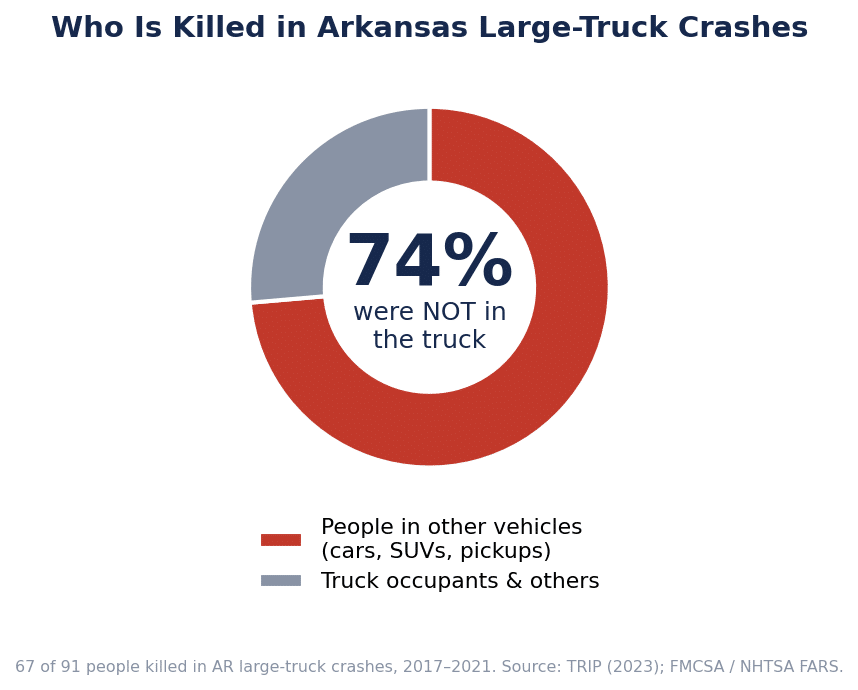
- Arkansas ranks 4th in the nation for large-truck fatalities, and about 3 out of 4 people killed in those crashes are in other vehicles, not the truck.
- A truck’s electronic logging device (ELD) and engine data can be overwritten in months — a preservation letter must go out quickly.
- Liability often extends beyond the driver to the motor carrier, broker, shipper, maintenance contractor, or cargo loader.
- Arkansas’s 50% fault bar means insurers will try to pin blame on you — how fault is documented can decide the whole case.
What Should I Do After a Truck Accident in West Memphis?
The hours after a truck crash shape everything that follows. If you are able, take these steps — and if your injuries prevent it, your lawyer can do much of this for you.
- Call 911 and get medical care. An Arkansas State Police or Crittenden County crash report and your medical records are the backbone of your claim. Adrenaline hides serious injuries, so be examined even if you feel “fine.”
- Document the scene. Photograph all vehicles, the truck’s USDOT and license numbers, the trailer, road conditions, skid marks, and your injuries. Get the trucking company’s name from the cab door.
- Get witness and driver information. Names, phone numbers, the driver’s CDL, and the carrier’s insurance details. Independent witnesses are powerful in truck cases.
- Do not give a recorded statement. The trucking company’s insurer may call within hours. Politely decline to be recorded and refer them to your attorney.
- Preserve evidence immediately. Contact a truck-accident lawyer right away so a spoliation (evidence-preservation) letter can be sent before the truck is repaired and its data is overwritten.
- Keep a recovery file. Save medical bills, mileage to appointments, proof of missed work, and a short daily note on your pain and limitations.
Why Are There So Many Truck Crashes Around West Memphis and I-40?
West Memphis is one of the most truck-heavy places in America. It sits where Interstate 40 — the main east-west freight artery in the United States — meets Interstate 55 and crosses the Mississippi River into Memphis, the home of one of the world’s largest cargo hubs. The I-40 segment between Little Rock and West Memphis alone moves more than 20,000 trucks every day. Statewide, combination trucks make up 34% of traffic on Arkansas’s rural highways — the third-highest share in the country (TRIP, 2023).
That concentration of heavy freight comes at a cost. Arkansas ranks fourth in the nation for large-truck fatalities per mile traveled. And when a rig and a passenger vehicle collide, physics decides who is hurt: across 2017–2021, of the people killed in Arkansas large-truck crashes, the large majority were occupants of other vehicles — not the truck.
Who Can Be Held Liable in a West Memphis Truck Accident?
One of the biggest differences between a truck case and a car case is the number of parties who may share responsibility. Identifying every liable party is how we reach the full layers of insurance coverage. Potentially responsible parties include:
- The truck driver — for speeding, fatigue, distraction, or impairment.
- The motor carrier (trucking company) — for negligent hiring, inadequate training, pushing drivers past federal hours-of-service limits, or unrealistic schedules.
- The owner of the truck or trailer — when it is leased or owned separately from the carrier.
- A maintenance or repair contractor — for brake, tire, or mechanical failures.
- The shipper or cargo loader — for unbalanced, overweight, or unsecured loads that cause rollovers or jackknifes.
- A broker — for hiring an unsafe or unqualified carrier.
- A parts manufacturer — when defective brakes, tires, or couplings contribute to the crash.
What Causes Most Large-Truck Crashes?
Most truck wrecks trace back to preventable failures rather than freak accidents. According to the National Highway Traffic Safety Administration, brake problems are a factor in roughly 29% of large-truck crashes, the most common mechanical cause. The Federal Motor Carrier Safety Administration reports that speeding contributes to about 23% of large-truck crashes. Layered on top of those are the human and industry pressures that define modern freight:
- Driver fatigue — exceeding federal hours-of-service limits to hit delivery deadlines.
- Distracted driving — phones and in-cab devices.
- Inadequate training — inexperienced drivers filling industry shortages.
- Poor maintenance — skipped pre-trip inspections, worn brakes and tires.
- Improper cargo loading — unbalanced or unsecured loads that trigger rollovers and jackknifes.
Each of these is also a potential violation of the federal safety rules — and each leaves a documentary trail in logs, inspection records, and maintenance files that we know how to demand.
How Is a Truck Accident Case Different From a Car Accident Case?
Treating a truck crash like a fender-bender is a costly mistake. Commercial trucks are governed by the Federal Motor Carrier Safety Regulations (FMCSRs), which require carriers to monitor driver hours with electronic logging devices, maintain inspection and maintenance records, screen and train drivers, and carry far higher insurance limits than ordinary drivers. A serious truck case can involve multiple insurance policies stacked together, several defense lawyers, and a “rapid response” team the carrier dispatches to the scene to build their defense before you have even left the hospital.
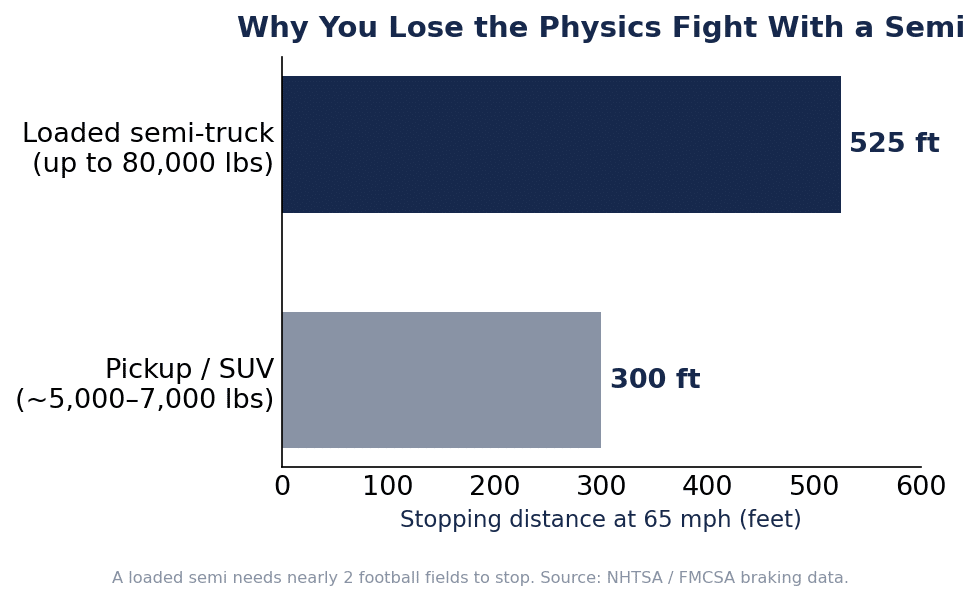
It also comes down to physics. A loaded semi can take nearly two football fields to stop, and it has enormous blind spots and a wide turning radius. Those limits are why crashes with cars are so often catastrophic — and why proving what the truck could and could not do is central to the case.
Why Do I Have to Act Fast to Preserve Evidence?
The most important evidence in a truck case lives inside the truck, and it does not last. The electronic logging device and engine control module (“black box”) record the driver’s hours, speed, braking, and throttle in the moments before impact — but that data can be overwritten in a matter of weeks or months, and a damaged truck can be repaired or scrapped. Carriers are only required to keep some records for limited periods. That is why we move quickly to send a spoliation letter demanding the company preserve the ELD data, driver logs, maintenance files, dash-cam footage, and the vehicle itself. The earlier we are involved, the more of this evidence survives.
What Is Arkansas’s Fault Rule, and What If I Was Partly to Blame?
Arkansas follows modified comparative negligence with a 50% bar (Ark. Code Ann. §16-64-122). You can recover damages as long as you are less than 50% at fault, but your award is reduced by your own percentage of fault. If your damages are $300,000 and you are found 10% at fault, you recover $270,000; if you are found 50% or more at fault, you recover nothing. Because so much rides on that line, trucking insurers work hard to shift blame onto the injured driver — making independent investigation, witness statements, and the truck’s own data critical to protecting your recovery.
How Long Do I Have to File a Truck Accident Claim in Arkansas?
In most cases you have three years from the date of the crash to file a personal-injury lawsuit (Ark. Code Ann. §16-56-105). If a truck crash takes a life, the family generally has three years from the date of death to bring a wrongful-death claim (§16-62-102). Waiting is risky for a different reason, too: the evidence that wins truck cases disappears long before the legal deadline. The right time to start is now.
What Is My West Memphis Truck Accident Case Worth?
There is no flat figure — value depends on the severity of your injuries, your medical needs, lost income and earning capacity, and the layers of insurance available. Because commercial trucks carry much higher coverage than ordinary cars, serious truck cases often support far larger recoveries than typical auto claims. Compensation in an Arkansas truck case can include:
- Past and future medical expenses, including surgery, rehabilitation, and in-home care
- Lost wages and reduced future earning capacity
- Pain, suffering, and loss of enjoyment of life
- Property damage
- Disfigurement and permanent disability
- In wrongful-death cases, funeral costs, lost financial support, and the family’s loss of companionship
What If the Trucking Company Is Based Out of State?
On I-40, most of the trucks belong to out-of-state and national carriers — and that does not weaken your case. A crash on the Arkansas side of the river is an Arkansas case, and we pursue the driver, the motor carrier, and their insurers wherever they are headquartered. Interstate trucking is governed by the same federal rules nationwide, and we are prepared to litigate in Crittenden County Circuit Court or the U.S. District Court for the Eastern District of Arkansas as the facts require.
What Are the Most Common Injuries in a Truck Accident?
Because a loaded tractor-trailer can outweigh a passenger car by 20 to 1, the injuries in a truck crash tend to be far more severe than in an ordinary collision — and they often require months or years of treatment. The injuries we see most in West Memphis truck cases include:
- Traumatic brain injuries (TBI) and concussions — sometimes with lasting cognitive effects.
- Spinal cord injuries and paralysis — herniated discs, nerve damage, and partial or complete paralysis.
- Broken bones and crush injuries — often requiring surgery and rehabilitation.
- Internal organ damage and internal bleeding — not always obvious at first.
- Amputations and loss of limb — in severe underride and crush crashes.
- Burns — from fuel fires in high-speed interstate collisions.
- Whiplash and soft-tissue injuries — common even in lower-speed truck impacts.
- Wrongful death — when a crash is fatal, surviving family can pursue a wrongful-death claim.
The more serious the injury, the more important it is to fully document future medical needs and lost earning capacity — areas where insurers routinely try to underpay.
What Types of Truck Accidents Do You Handle?
Different truck crashes fail in different ways, and each calls for a different investigation. We handle the full range, including:
- Jackknife accidents — when the trailer swings out of line with the cab.
- Underride collisions — when a smaller vehicle slides beneath the trailer; among the deadliest truck crashes.
- Rollovers — tied to speed, improper loading, or a high center of gravity.
- Tire blowouts and mechanical failures — from worn equipment or skipped inspections.
- Wide-turn and right-hook crashes — when a truck swings wide and traps a vehicle on its right.
- Rear-end and override crashes — when a heavy truck cannot stop in backed-up interstate traffic.
- Blind-spot (no-zone) crashes — sideswipes and lane-change collisions.
- Cargo and load-shift accidents — from unsecured or overloaded freight.
What Happens After You Hire Us? The Truck Accident Claim Process
Knowing what to expect makes the process far less stressful. While every case is different, a West Memphis truck claim generally moves through these stages:
- Investigation and evidence preservation. We send a spoliation letter, secure the ELD and black-box data, driver logs, and maintenance records, and often bring in an accident-reconstruction expert.
- Medical treatment and documentation. You focus on recovery while we gather your records and bills and build a complete picture of your injuries and future needs.
- Identifying every responsible party and policy. Driver, motor carrier, broker, shipper, and their insurers.
- Demand and negotiation. Once your treatment stabilizes, we present a detailed demand package and negotiate aggressively.
- Filing suit and discovery. If the insurer will not pay fairly, we file in Crittenden County Circuit Court or the Eastern District of Arkansas.
- Settlement or trial. Most cases settle, but we prepare every case to be tried.
Our Results in Serious Accident Cases
Southern Injury Attorneys has recovered six- and seven-figure results in serious motor-vehicle and trucking cases, including multiple six-figure truck-crash recoveries and a $175,000 result in a vehicle-fire claim. Past results do not guarantee a particular outcome, but they reflect how we prepare every case — built to try, which is what moves insurers to pay full value.
Why Choose Southern Injury Attorneys for Your West Memphis Truck Case?
We combine local reach with truck-specific experience. Our Arkansas-licensed attorneys handle crashes throughout Crittenden County, and our Memphis base puts us minutes from the I-40 corridor for fast scene investigation. We know how to read driver logs and ELD data, apply the federal motor-carrier rules, and identify every responsible party and policy. You pay nothing up front — we work on a contingency fee and only get paid if we recover for you.
West Memphis Truck Accident FAQs
How soon should I contact a lawyer after a West Memphis truck accident?
As soon as possible — ideally within days. The truck’s electronic data and maintenance records can be lost or overwritten quickly, and a preservation letter needs to reach the carrier before that happens.
The trucking company’s insurer already called me. Should I talk to them?
You can confirm basic facts, but do not give a recorded statement or accept a quick settlement before talking to a lawyer. Early offers are usually far below what serious injuries are worth, and recorded statements are used to argue you were at fault.
What is a “black box” and why does it matter in a truck case?
It is the truck’s engine control module and electronic logging device, which record speed, braking, throttle, and the driver’s hours before the crash. That data can prove the driver was speeding or violating hours-of-service limits — but only if it is preserved in time.
Can I still recover if I was partly at fault for the crash?
Yes, as long as you were less than 50% at fault under Arkansas’s modified comparative negligence rule. Your recovery is reduced by your percentage of fault, which is why how fault is documented matters so much.
Who pays my medical bills while my truck case is pending?
Your own PIP or medical-payments coverage, health insurance, and in some cases medical liens can cover treatment while the claim proceeds. We help coordinate this so you can focus on recovery.
My crash was on I-40 but the trucking company is in another state. Does that matter?
No. A crash on the Arkansas side is an Arkansas case. We pursue out-of-state carriers and their insurers under the same federal trucking regulations that apply nationwide.
How long does a truck accident case take to resolve?
It varies with the severity of injuries and whether the carrier disputes liability. Some resolve in months; serious cases that require full investigation and litigation can take longer. We move as efficiently as possible without leaving money on the table.
How much does it cost to hire Southern Injury Attorneys?
Nothing up front. We work on a contingency fee, so you pay attorney’s fees only if we recover compensation for you, and the consultation is free.
What is the average settlement for a truck accident in Arkansas?
There is no reliable “average,” and any lawyer who promises a number before reviewing your case should be viewed with caution. Truck settlements vary widely based on injury severity, available insurance, and how clearly fault is proven. Because commercial policies are large, serious truck cases often resolve for far more than typical car-accident claims.
What if a family member was killed in the truck crash?
Surviving family members can pursue a wrongful-death claim in Arkansas, generally within three years of the death (Ark. Code Ann. §16-62-102). It can recover funeral costs, lost financial support, and the family’s loss of companionship.
How is a truck accident investigated?
We preserve and analyze the truck’s electronic data, driver logs, and maintenance records, interview witnesses, obtain the police report and any dash-cam or surveillance footage, and often retain an accident-reconstruction expert.
What if more than one vehicle was involved?
Multi-vehicle pileups are common on I-40 and I-55. These cases require sorting out each driver’s and the carrier’s share of fault.
Do I still have a case if the truck driver wasn’t ticketed?
Yes. A citation is helpful evidence but is not required to win a civil claim. Fault is decided by the evidence, not by whether police issued a ticket.

