


Quick answer: A van accident is different from an ordinary car crash for two reasons. First, 15-passenger vans roll over easily — especially when full — and a single van crash can injure many people at once. Second, vans are usually owned by an organization, so the company that owns or operates the van — a church, school, shuttle service, employer, or a delivery company — is often liable, not just the driver, and that is where the insurance coverage is. Delivery-van crashes (Amazon and FedEx run on independent contractors) raise a separate question of whether the driver, the local delivery firm, or the brand is on the hook. The most important steps are to preserve the van, its tires, and the maintenance records, get the names of everyone who was hurt, and act fast — a publicly owned school or government van carries very short notice deadlines. Call 800-224-5546 for a free consultation — no fee unless you win.
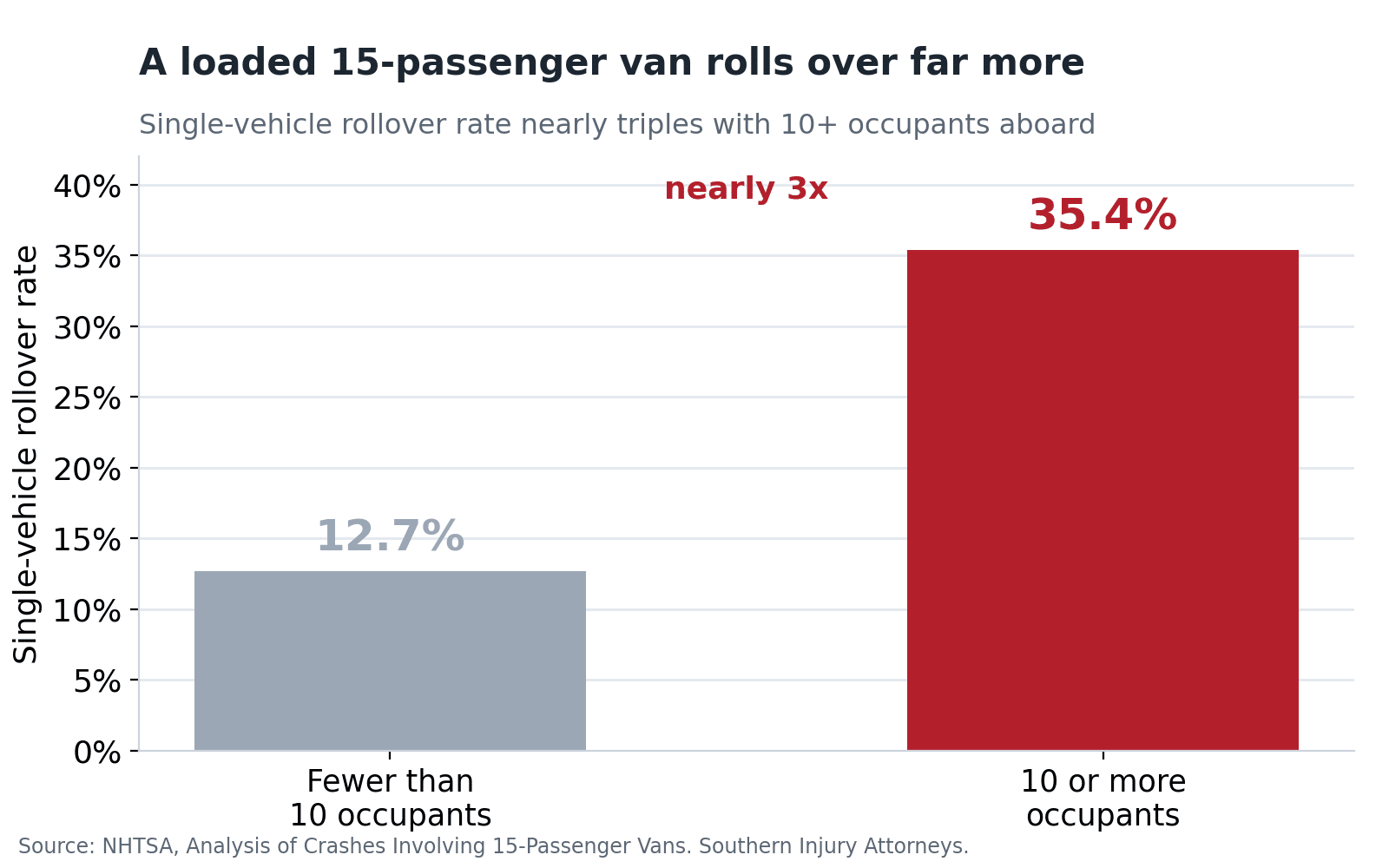
- 15-passenger vans roll over about three times more often when loaded — the single-vehicle rollover rate jumps from roughly 13% to 35% with 10 or more people aboard.
- One van crash can injure many people, who then share a limited pool of insurance — making it critical to find every defendant and every policy.
- The organization that owns or operates the van is usually liable — for negligent maintenance, driver selection and training, entrustment, and vicariously for its driver.
- Delivery-van crashes raise the Amazon/FedEx contractor question — the driver, the local contractor, and the brand may all be in play.
- Preserve the van and its maintenance records — and watch short government-van deadlines. Filing deadlines run one to three years, but a school or municipal van triggers far shorter notice deadlines.
Van Accident Claims at a Glance
| Question | Short answer |
|---|---|
| What makes a van crash different? | Vans roll over easily and injure many people at once — and the company that owns the van is often liable. |
| Why are 15-passenger vans dangerous? | Loading them raises the center of gravity, so the single-vehicle rollover rate nearly triples when full. |
| Who is usually liable? | The owner/operator organization (church, school, shuttle, employer) or a delivery company — not just the driver. |
| Can I sue Amazon or FedEx? | Maybe. They use independent contractors, so the driver, the local firm, or the brand may all be responsible. |
| What’s the most important first step? | Preserve the van, its tires, and the maintenance records, and get the names of everyone who was hurt. |
| How long do I have to file? | 1–3 years depending on the state — but a school or government van has a much shorter notice deadline. |
Van Accident Statistics
Sources: NHTSA, 15-Passenger Van Safety and NHTSA, Analysis of Crashes Involving 15-Passenger Vans; NHTSA FARS, Passenger Vehicles: 2023 Data (DOT HS 813 723).
A “van accident” is not one thing — it covers a church van full of teenagers, a 15-passenger shuttle, an employer’s work van, and the Amazon or FedEx delivery van on your street. What they share is that vans are big, top-heavy, and usually owned by an organization, and that combination changes everything about how the case is built and who pays. The single most dangerous fact is the rollover risk of a loaded 15-passenger van.
That is the hook of almost every serious van case: the danger is not constant. A 15-passenger van that is nearly empty handles reasonably, but as it fills with people and gear the weight rides higher and farther back, and its resistance to rolling over collapses. When one rolls, it rarely hurts just one person.
What Makes Van Accidents Different From Car Accidents?
Van crashes differ from ordinary car crashes in three ways that drive the value of the case: vans are large and top-heavy so they roll over and cause catastrophic injuries; one crash can injure many people at once, who then compete for a limited insurance fund; and the van is almost always owned by an organization, which means there is usually a company — not just a driver — that can be held responsible.
A two-car fender-bender is usually a fight between two drivers and two insurers. A van crash is rarely that simple. Because a loaded van carries ten, twelve, or fifteen people, a single rollover or collision can produce a dozen injured plaintiffs — and if the van’s coverage is limited, those victims may have to share it. Identifying every source of recovery, and every defendant, is what protects each victim’s share. And because the van belongs to a church, a school, a shuttle company, an employer, or a delivery company, the law lets you look past the driver to the organization that put that van and that driver on the road. That is usually where the meaningful insurance coverage is.
Why Are 15-Passenger Vans So Dangerous?
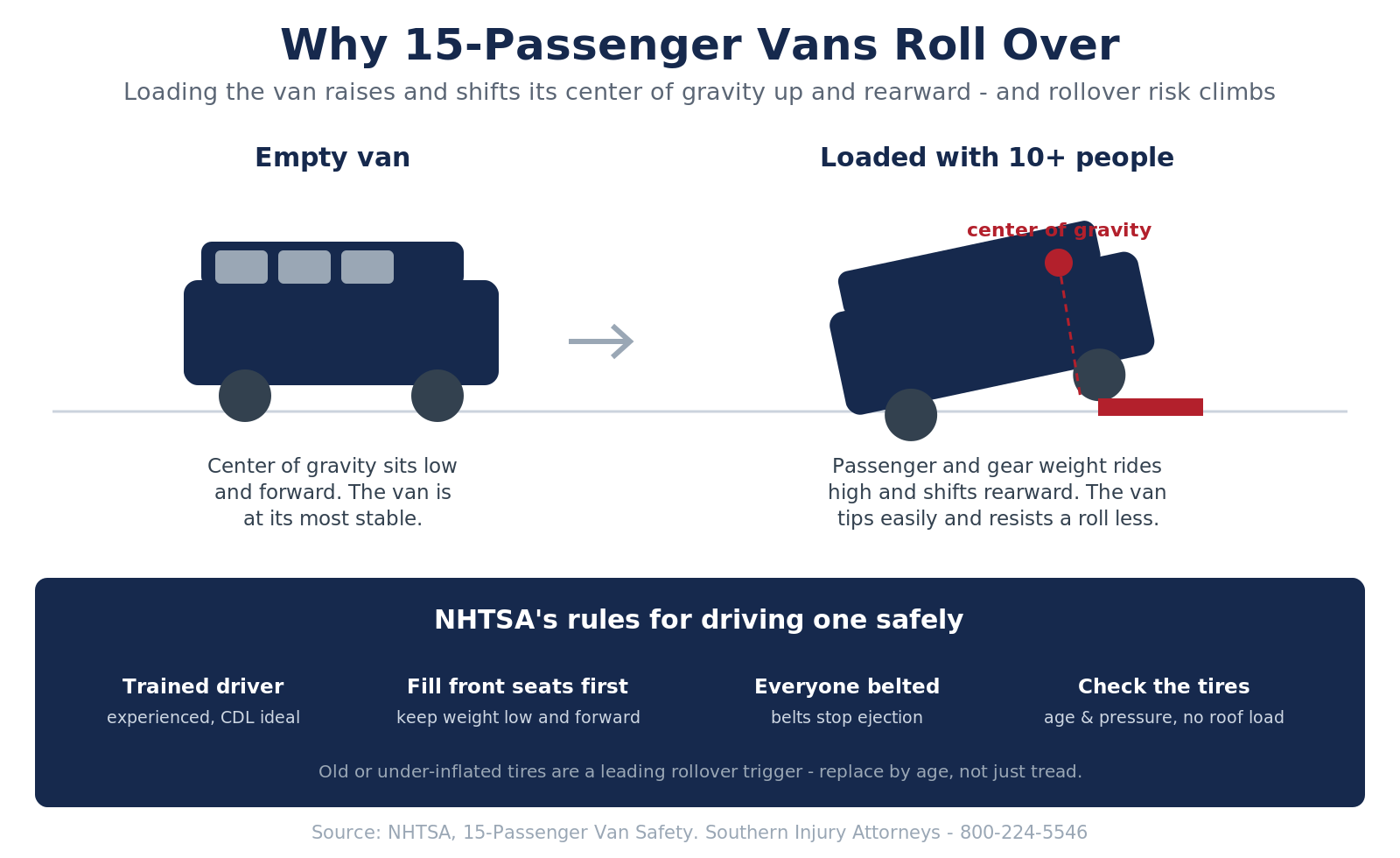
15-passenger vans are uniquely dangerous because their rollover risk rises as they fill up. Adding passengers and gear pushes the center of gravity higher and rearward, so a fully loaded van has far less resistance to rolling over. NHTSA has warned for years that the single-vehicle rollover rate is nearly three times higher when one of these vans carries 10 or more people (about 35% versus 13%).
The physics are unforgiving. A 15-passenger van is essentially a tall, narrow box. When it is loaded, the extra weight sits up high and behind the rear axle, raising the center of gravity exactly where you don’t want it. That is why NHTSA treats these vans as a special hazard and why they are so often driven badly: churches, schools, colleges, daycares, senior centers, and airport and hotel shuttles run them, frequently with untrained volunteer drivers and on old or underinflated tires.
The tires deserve special attention because they are a known failure point. NHTSA reports that 15-passenger van tires are often underinflated and used past their service life, and that fatal van rollovers most often involve a tire failure. Critically, the danger is about age, not just tread: many manufacturers recommend replacing tires roughly every six years regardless of how much tread is left, and tire makers cite about ten years as the maximum service life. A used van can carry a dangerously old spare. An old tire that lets go at highway speed can roll a loaded van in seconds.
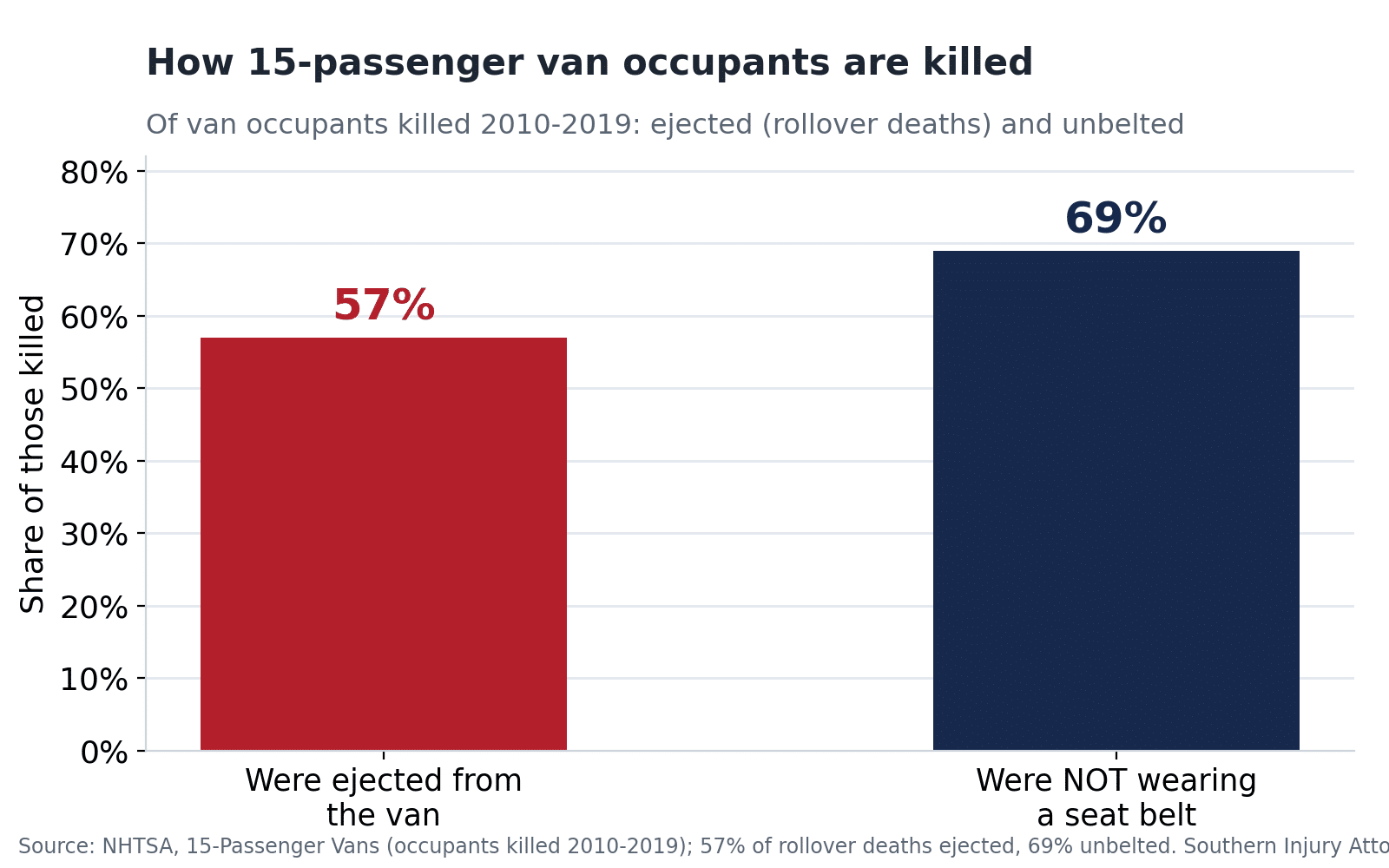
When a van does crash, how its occupants are hurt follows a grim pattern: most of those killed are not wearing seat belts, and in a rollover most of those killed are ejected. NHTSA found that of the 15-passenger van occupants killed in rollover crashes over a recent decade, 57 percent were ejected, and of all van occupants killed, 69 percent were not belted. An unrestrained occupant in a single-vehicle van crash is about four times more likely to be killed than a belted one.
NHTSA’s safety guidance follows directly from all of this: a 15-passenger van should be driven only by an experienced, properly licensed driver (a commercial driver’s license is ideal); the seats should be filled from the front to keep weight low and forward; every occupant must be belted; nothing should be loaded on the roof; and the tires must be the right age and pressure. When an organization ignores these basic rules, that failure is often the heart of the case.
Who Is Liable for a Van Accident?
In most van cases the best target is not the driver but the organization that owns or operates the van — a church, school, shuttle company, employer, or delivery company. That entity can be liable for negligent maintenance, negligent hiring, training, and supervision, negligent entrustment, and vicariously for its driver. Because the organization is where the real insurance is, finding and proving its responsibility is what turns a limited claim into a full recovery.
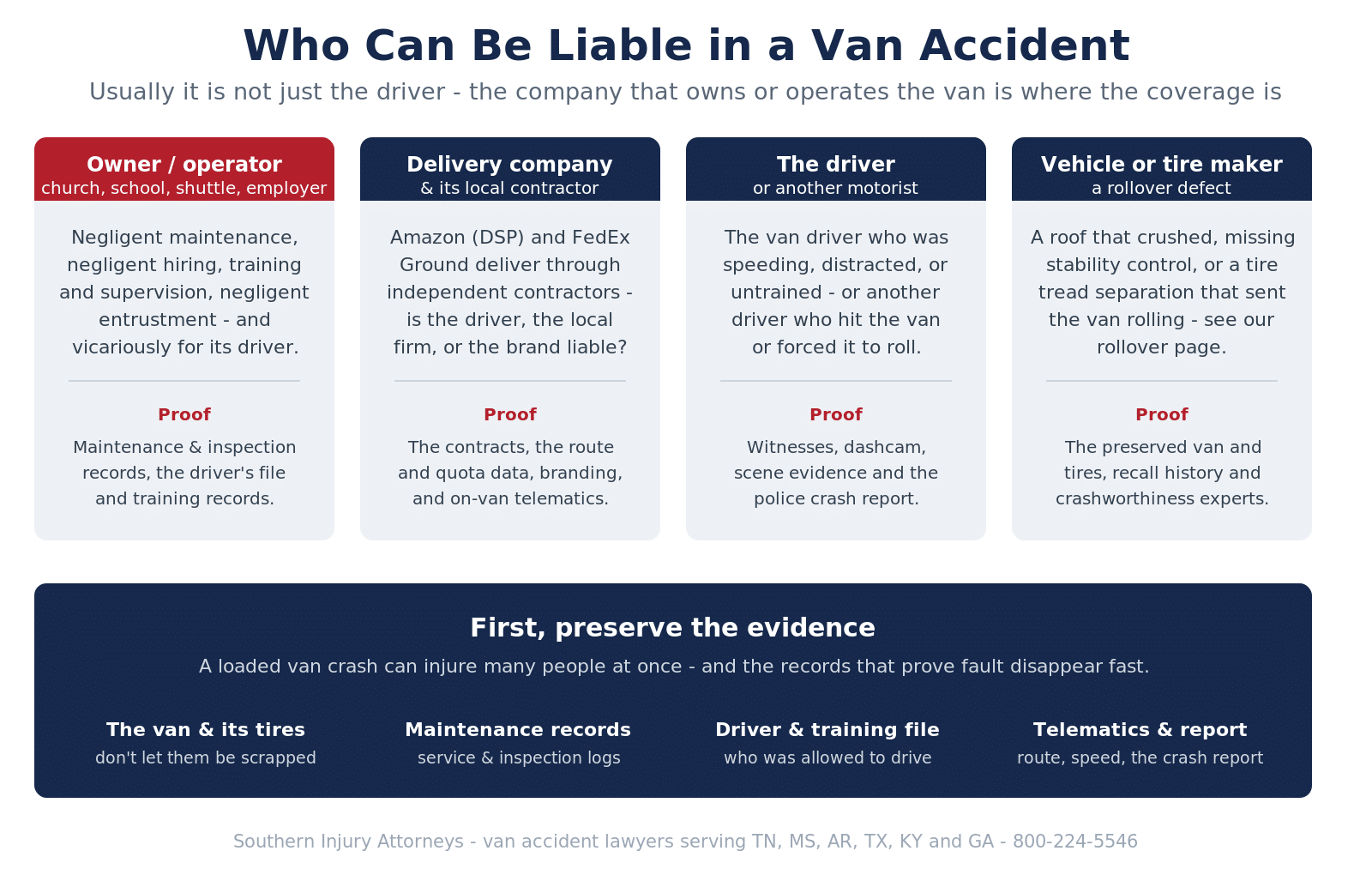
There are usually several possible defendants, and a strong van case often names more than one:
- The organization that owns or operates the van — the most important defendant in most cases. A church, school, college, shuttle company, senior center, or employer can be liable for failing to maintain the van (worn or aged tires, ignored recalls, bad brakes), for negligently selecting, training, or supervising the driver, for negligent entrustment (handing the keys to an unfit or untrained driver), and vicariously for the driver’s negligence on the job.
- A delivery company and its local contractor — Amazon and FedEx deliver through independent contractors, so the driver, the local delivery firm, and the national brand may each be responsible (see below).
- The driver — or another driver — the van driver who was speeding, distracted, fatigued, or simply not trained for the vehicle, or another motorist who struck the van or forced it off the road.
- The vehicle or tire manufacturer — when a defect caused or worsened a rollover (a roof that crushed, missing stability control, or a tire tread separation), there may be a product-liability claim. Those crashworthiness cases are covered in depth on our rollover accident lawyer page.
What proves these claims is evidence the organization controls — and it does not last. The van’s maintenance and inspection records, the driver’s personnel and training file, the van and its tires, on-board telematics (route, speed, braking), and the police crash report together show whether the company met its duties. Much of this can be lost or overwritten within weeks, which is why the first move in a serious van case is a letter demanding that the van, the tires, and the records be preserved.
Delivery Van Accidents (Amazon, FedEx, and Contractors)
If you were hit by an Amazon or FedEx delivery van, the hardest question is usually who is responsible — because neither company employs most of its drivers directly. Amazon delivers through Delivery Service Partners (DSPs) and FedEx Ground through independent service providers, both independent contractors. So the liable party may be the driver, the local delivery firm, or the national brand, and it takes investigation to pin it down.
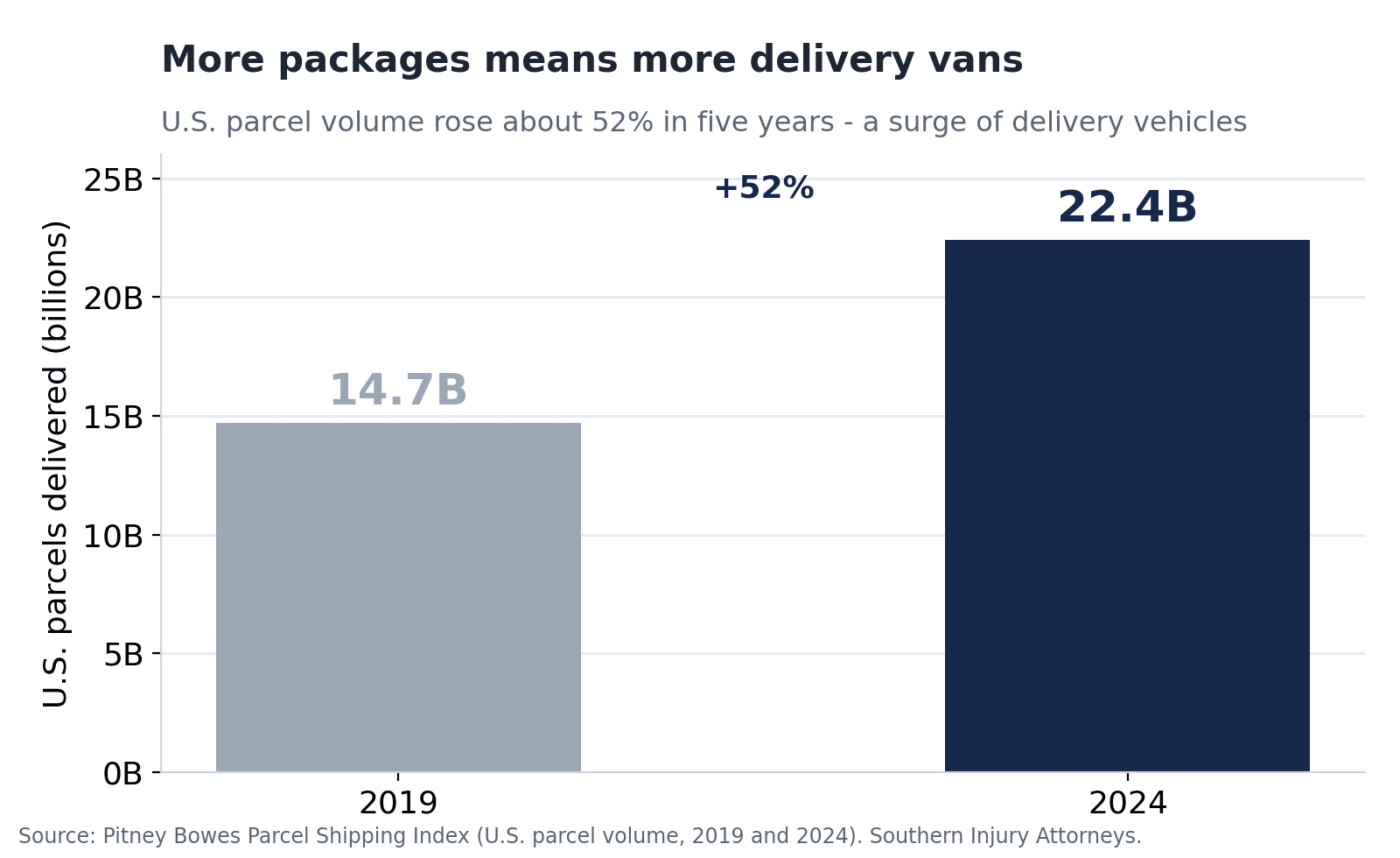
The explosion of online shopping put a flood of delivery vans on the road. U.S. parcel volume grew from about 14.7 billion packages in 2019 to roughly 22.4 billion in 2024 — about a 52 percent increase in five years — and Amazon alone delivered more than 6 billion of them. More vans, more miles, and more quota and rush pressure on drivers all translate into more crashes.
Here is the contractor puzzle. The driver who hit you may wear an Amazon or FedEx uniform and drive a branded van, but the company will say that driver actually works for an independent contractor — the local DSP or service provider — and that the contractor, not the brand, is responsible. That structure is deliberately built to shield the national company from liability. Whether it holds up depends on the facts: how much the brand controlled the route, the quotas, the schedule, the cameras, and the equipment. Because these contractors carry their own commercial policies (Amazon, for example, requires its DSPs to carry substantial commercial auto coverage), there is real insurance available — but you have to identify the right defendants and move quickly to preserve the delivery records, route and telematics data, and the contract that defines the relationship. For the heavier commercial-vehicle version of these cases, see our truck accident lawyer page.
Church, School, and Shuttle Van Accidents
Church, school, daycare, senior-center, and shuttle vans are where the 15-passenger rollover danger and the organizational-liability angle meet. These crashes are often multi-victim events, and the organization that ran the van can be liable for its own negligence — putting an untrained volunteer behind the wheel, skipping maintenance, or overloading the van. When the van is owned by a public school or government body, special short notice deadlines apply, so you have to act immediately.
The recurring fact pattern is heartbreaking and familiar: a loaded church or school van rolls on the highway, and many passengers are hurt at once. Two legal problems follow. First, the organization frequently created the danger — by entrusting a 15-passenger van to a volunteer with no special training, by running it on aged tires, or by loading it past safe limits. That is direct organizational negligence, on top of the organization’s vicarious responsibility for its driver. Second, when several people are seriously injured, they may have to share a limited insurance fund, which makes it essential to find every applicable policy — the organization’s auto and liability coverage, any umbrella policy, the driver’s coverage, and the injured passengers’ own underinsured-motorist coverage.
If the van belonged to a public school district, college, or city or county agency, a Tort Claims Act adds a notice-of-claim deadline that is usually far shorter than the normal statute of limitations — sometimes only a matter of months. These deadlines are strict, vary by state and by entity, and can quietly bar an otherwise strong claim. If a government-owned van was involved, talk to a lawyer right away.
What If the Van Rolled Over?
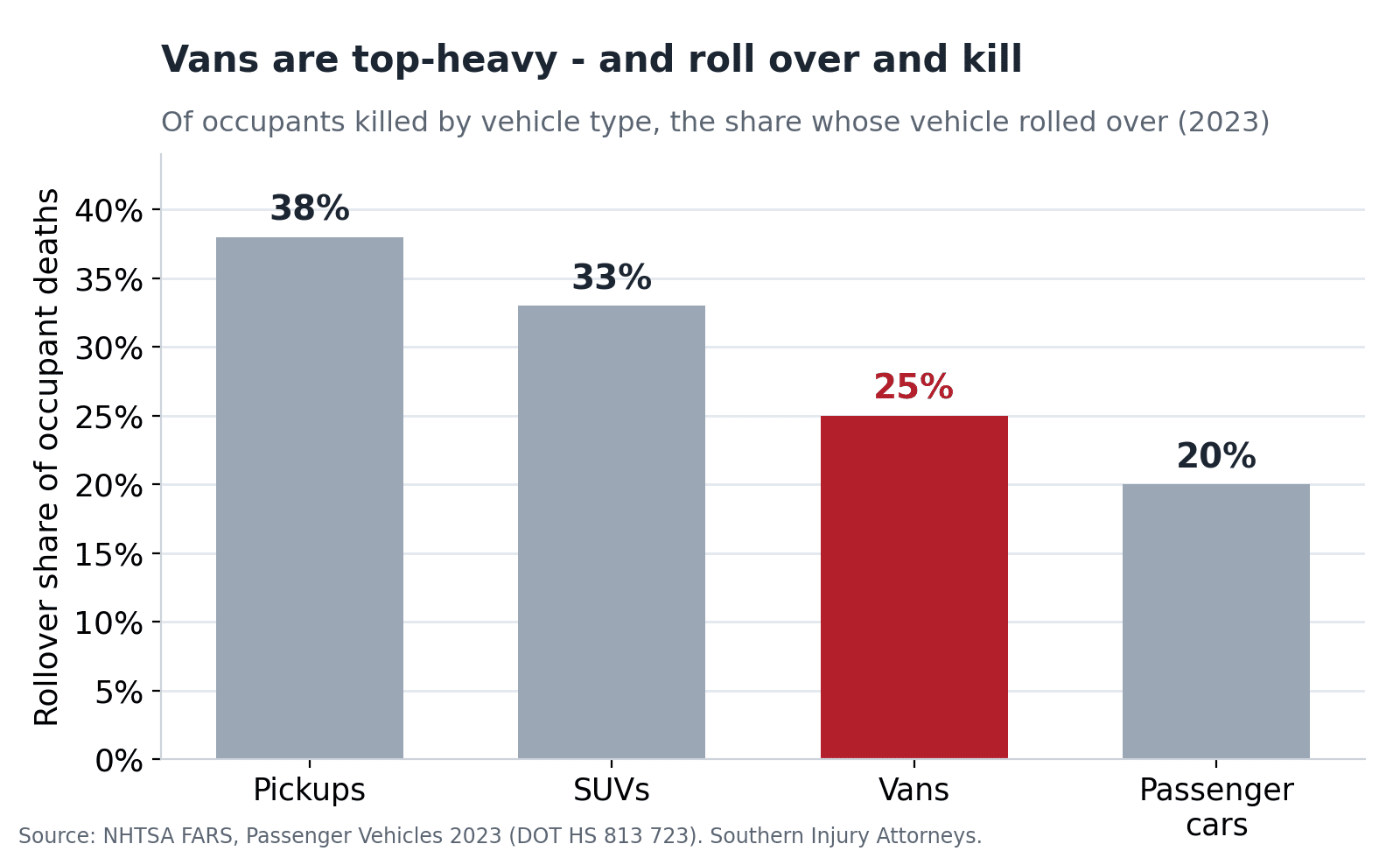
Many of the most serious van cases are rollovers, and the same crashworthiness questions that drive any rollover case apply here: did a roof crush in on the occupants, was electronic stability control missing or ineffective, did tires fail, and were occupants ejected because of defective latches or the absence of side-curtain airbags? When a defect caused or worsened the roll, there may be a product-liability claim against the vehicle or tire manufacturer in addition to the claim against the van’s owner. The most important step is the same in every rollover: do not let the van or its tires be repaired, scrapped, or sold — they are the evidence. For the full picture of rollover defect claims, how they are proven, and the deadlines that apply, see our dedicated rollover accident lawyer page.
Van Accident Injuries
Because vans are heavy and prone to rolling, and because they carry so many people, van-crash injuries are frequently catastrophic and multi-victim. We see traumatic brain injuries from roof contact and ejection; spinal cord injuries and paralysis from roof crush and violent rolling; ejection trauma when occupants are thrown from the vehicle; multiple fractures; internal organ damage; and, far too often, fatal injuries. In a fully loaded van, all of this can happen to a dozen people in the same crash. Valuing these injuries correctly means accounting for the full lifetime cost of medical care and lost earning capacity for each victim — which takes medical and economic experts, not the first number an insurer offers.
What If I Was Partly at Fault?
You may still recover. Every state we serve uses some form of comparative negligence, so being partly at fault usually reduces your recovery rather than eliminating it. This matters in van cases because organizations and their insurers like to shift blame onto a driver or even an injured passenger to cut what they pay.
| State | Rule | What it means for you |
|---|---|---|
| Tennessee | Modified — 50% bar (McIntyre v. Balentine, 833 S.W.2d 52 (Tenn. 1992)) | You can recover only if you are less than 50% at fault; your award is reduced by your share. |
| Mississippi | Pure comparative (Miss. Code § 11-7-15) | You can recover even if you are mostly at fault; the award is reduced by your percentage. |
| Arkansas | Modified — 50% bar (Ark. Code § 16-64-122) | Barred only if your fault is equal to or greater than the other party’s; otherwise reduced by your share. |
| Texas | Modified — 51% bar (Tex. Civ. Prac. & Rem. Code § 33.001) | You can recover unless your responsibility is greater than 50%; you may still recover at exactly 50%. |
| Kentucky | Pure comparative (KRS § 411.182) | You can recover even if you are largely at fault; the award is reduced by your percentage. |
| Georgia | Modified — 50% bar (O.C.G.A. § 51-12-33) | You can recover only if you are less than 50% at fault; your award is reduced by your share. |
Comparative-negligence rules and how they apply turn on the facts of each crash and the state where it happened. Because insurers use fault arguments to cut payouts, how the case is investigated and presented can change your recovery dramatically.
How Much Is a Van Accident Case Worth?
There is no fixed average — van cases turn on the severity of the injuries, the full cost of future care and lost earnings, and crucially how many defendants and policies exist. The defining feature of many van crashes is that several people are hurt in one wreck and may have to share a limited insurance fund, so a payout that sounds large can be thin once it is divided. That is exactly why it matters to identify every source of recovery: the organization’s auto and liability coverage, any umbrella policy, a delivery contractor’s commercial policy, the driver’s coverage, a manufacturer in a defect case, and each injured person’s own uninsured/underinsured motorist coverage. And in a fatal van crash, the family can pursue wrongful death damages. Getting the value right requires finding every defendant and proving the full lifetime cost of each victim’s injuries.
What to Do After a Van Accident
- Call 911 and get the crash report so officers document the scene, the van’s position, and what happened while it is fresh.
- Get medical care immediately, even if you feel okay — brain and spinal injuries from a van crash are often masked by adrenaline.
- Photograph everything — the van, the scene, the tires, and how the van was loaded and where people were seated.
- Get the names of every injured passenger and witness — in a multi-victim van crash this protects everyone’s claim and your own.
- Identify the van’s owner or operator — the church, school, shuttle company, employer, or the delivery firm (Amazon DSP or FedEx provider) that ran the van.
- Do not let the van or its tires be repaired or scrapped if a rollover or defect is possible — they are the evidence.
- Don’t give a recorded statement to any insurer until you have spoken with a lawyer.
- Call a van accident lawyer fast — maintenance records and government-van notice deadlines can run out in weeks.
Our Results in Serious Auto Accident Cases
Every case is different, but our results reflect how hard we fight for crash victims:
- Six-figure recovery — Our client was stopped in traffic when an 18-wheeler failed to stop in time and rear-ended them.
- Six-figure settlement — An 18-wheeler pushed our client into a barrier wall, causing her injuries.
- $175,000 settlement — Our client’s Mercedes was rear-ended and caught fire; even with minimal medical treatment, we recovered $175,000.
Prior results do not guarantee a similar outcome. Every case depends on its own facts.
Why Choose Southern Injury Attorneys
We are a contingency-fee injury firm built for serious car accident and van cases, with attorneys licensed in Tennessee, Mississippi, Arkansas, Texas, Kentucky, and Georgia. A van crash is rarely a simple two-car claim — there is usually an organization behind the van and often many injured people — so we move fast to preserve the van, its tires, the maintenance and driver-training records, and any telematics, and to identify every defendant and policy before the coverage is divided. We also handle the related crashes that van wrecks so often become, including rollover accidents and commercial truck and delivery crashes. You pay nothing unless we win. If your crash happened in Memphis, see our dedicated Memphis van accident lawyer page.
Headquarters: 5050 Poplar Ave, Ste 920, Memphis, TN 38157, with offices in Dallas, Houston, and Atlanta. Consultations are free and handled by phone anywhere we practice: 800-224-5546.
Deadlines to File a Van Accident Claim
The deadline to sue — the statute of limitations — depends on the state. But a van case can carry a second, much shorter deadline: if the van was owned by a public school district or a government body, a Tort Claims Act notice deadline can be only a few months. Miss either deadline and the claim is gone, so it is critical to talk to a lawyer early.
| State | Injury filing deadline | Statute |
|---|---|---|
| Tennessee | 1 year | Tenn. Code § 28-3-104 |
| Mississippi | 3 years | Miss. Code § 15-1-49 |
| Arkansas | 3 years | Ark. Code § 16-56-105 |
| Texas | 2 years | Tex. Civ. Prac. & Rem. Code § 16.003 |
| Kentucky | 2 years | KRS § 304.39-230 |
| Georgia | 2 years | O.C.G.A. § 9-3-33 |
A publicly owned van — a school, college, or municipal vehicle — triggers a separate notice-of-claim requirement that is far shorter than the deadlines above and varies by state and by entity. Because these notice rules are short and strict, you should confirm them with a lawyer immediately rather than assume you have the full statutory period.
We serve van-crash victims throughout Tennessee, Mississippi, Arkansas, Texas, Kentucky, and Georgia.
Van Accident FAQs
Why are 15-passenger vans dangerous?
Because their rollover risk rises sharply as they fill up. Adding passengers and gear raises the center of gravity and shifts it rearward, so a loaded van has much less resistance to rolling over. NHTSA reports the single-vehicle rollover rate is nearly three times higher with 10 or more occupants — about 35% versus 13%. These vans are also often driven by untrained volunteers and run on old or underinflated tires, which is a leading rollover trigger.
Who is liable for a church or school van accident?
Usually the organization that owns and operates the van, in addition to the driver. A church, school, or shuttle operator can be liable for negligent maintenance, for negligently selecting or training the driver, for negligent entrustment, and vicariously for the driver’s negligence. That organizational coverage is typically where the meaningful insurance is. If the van belonged to a public school or government body, a short notice deadline also applies, so act quickly.
I was hurt in a delivery van crash — can I sue Amazon or FedEx?
Possibly. Amazon delivers through Delivery Service Partners and FedEx Ground through independent service providers, both independent contractors, and the companies use that structure to argue the driver works for the contractor rather than the brand. Whether the national company is also responsible depends on how much it controlled the routes, quotas, and equipment. The driver, the local delivery firm, and the brand may all be in play, so it takes investigation and the right defendants named to reach the available coverage.
What if the van rolled over?
A rollover can add a product-liability claim against the vehicle or tire maker — for a roof that crushed, missing stability control, a tire tread separation, or defects that allowed occupants to be ejected — on top of the claim against the van’s owner. The key step is to preserve the van and its tires; do not let them be repaired, scrapped, or sold, because they are the evidence. Our rollover accident lawyer page explains these defect claims and their separate deadlines in detail.
Who pays when many people are hurt in one van?
That is the central problem in multi-victim van crashes: several injured people may have to share a limited insurance fund. The answer is to find every source of recovery — the organization’s auto and liability coverage, any umbrella policy, a delivery contractor’s commercial policy, the driver’s coverage, a manufacturer in a defect case, and each victim’s own underinsured-motorist coverage. Identifying every defendant and policy protects each person’s share.
What if the van was owned by my employer or church?
You can usually still bring a claim against the organization. An employer or church that owns the van can be liable for negligent maintenance, driver selection and training, entrustment, and vicariously for its driver. If you were an employee hurt on the job, workers’ compensation may also be involved and can interact with the injury claim — a lawyer can sort out which claims apply and how to maximize your total recovery.
What if I was partly at fault?
You may still recover. Every state we serve uses comparative negligence, so partial fault generally reduces your recovery rather than barring it — though Tennessee, Arkansas, and Georgia bar recovery once you reach 50%, and Texas at 51%, while Mississippi and Kentucky let you recover even if you were mostly at fault. Insurers raise fault arguments to cut payouts, so how the case is investigated and presented matters.
How long do I have to file, and is it shorter for a school or government van?
The injury deadline depends on the state: one year in Tennessee, two years in Texas, Kentucky, and Georgia, and three years in Mississippi and Arkansas. But if the van was owned by a public school district or a government agency, a Tort Claims Act notice deadline applies that is far shorter — sometimes only a few months — and varies by entity. Because that notice can expire long before the regular deadline, confirm it with a lawyer right away.
What’s a van accident case worth?
There is no fixed average. Value depends on the severity of the injuries, the full cost of future care and lost earnings, and how many defendants and policies exist. Van crashes often injure several people who must share a limited fund, so the recovery for each person depends heavily on finding every applicable policy and defendant — the organization, a delivery contractor, the driver, a manufacturer, and underinsured-motorist coverage.
What if the at-fault driver was uninsured?
You can still recover. Your own uninsured/underinsured motorist coverage is designed for exactly this, including hit-and-run crashes. And because a van crash usually also involves an organization that owns the van — and sometimes a manufacturer in a defect case — there is often a well-insured defendant to pursue even when the individual driver has little or no coverage.
Should I talk to the insurance company?
Not before talking to a lawyer. Insurers for an organization or delivery company use recorded statements to get you to guess about speed, fault, or seat-belt use, then use your words to reduce or deny the claim. You are generally not required to give the other side’s insurer a recorded statement. Let your lawyer handle communications so an early misstatement does not damage a multi-defendant case.
How much does a van accident lawyer cost?
Nothing up front. We work on contingency — our fee comes out of the recovery, and you owe nothing unless we win. That matters in van cases, where preserving the van, obtaining maintenance and training records, and retaining experts takes resources most people don’t have. Consultations are always free.
Talk to a Van Accident Lawyer — Free
If you or someone you love was hurt in a 15-passenger, church, work, or delivery van crash, the steps that protect your case — preserving the van and its records, finding every defendant, and meeting short government-van deadlines — need to happen now. Get a free, no-obligation consultation with attorneys licensed in Tennessee, Mississippi, Arkansas, Texas, Kentucky, and Georgia. Call 800-224-5546 — no fee unless you win. You can also contact us online.
This page is general legal information, not legal advice. Every case is different and outcomes are never guaranteed. Contacting us does not create an attorney-client relationship.

