


Quick answer: If you slipped and fell on someone else’s property in Dallas, Texas law lets you recover if the owner knew — or should have known — about the hazard and failed to fix or warn of it. You generally have two years to file (Tex. Civ. Prac. & Rem. Code § 16.003), but if you fell on city property you may have to give the City of Dallas written notice in as little as 90 days. Evidence like surveillance video disappears fast, so act quickly. Call our Dallas slip and fall lawyers at 469-253-2533 for a free consultation. No fee unless we win.
- To win, you must prove the owner had notice of the hazard — they created it, knew about it, or should have known.
- The deadline to sue is generally two years; government property claims require notice in as little as 90 days.
- Texas bars recovery only if you were more than 50% at fault; otherwise your award is reduced by your share.
- Surveillance video and sweep logs are decisive — and are often erased within days.
- Falls are the leading cause of preventable nonfatal ER visits in the U.S.
Dallas Slip and Fall Claims at a Glance
| Question | Short answer |
|---|---|
| Deadline to file? | Generally 2 years (Tex. Civ. Prac. & Rem. Code § 16.003) |
| What must I prove? | The owner had notice of the hazard and failed to fix or warn |
| Can I recover if partly at fault? | Yes, unless you were more than 50% at fault (§ 33.001) |
| Fell on city property? | You may have only ~90 days to give notice |
| Cost to hire us? | $0 up front — no fee unless we win |
| Where are you located? | 4245 N Central Expy, Suite 490, Dallas, TX 75205 |
Sources: National Safety Council, Injury Facts, 2023; Tex. Civ. Prac. & Rem. Code §§ 16.003, 101.101.
Get a free Dallas slip and fall case review
Tell us what happened and a member of our Dallas team will call you back — usually within minutes during business hours. Free, confidential, no fee unless we win. Prefer to talk now? Call (469) 253-2533.
What Should I Do After a Slip and Fall in Dallas?
Report the fall and preserve proof before it vanishes. The steps below protect your health and your claim.
- Report it to the property manager and ask for a written incident report — get a copy or the report number.
- Photograph the hazard immediately — the wet floor, spill, broken step, or missing sign — before it is cleaned up.
- Get medical care. Prompt treatment documents your injury and links it to the fall.
- Identify witnesses and note whether cameras cover the area.
- Keep your shoes and clothing from that day, and do not give a recorded statement to the insurer.
- Call a Dallas slip and fall lawyer so a preservation letter goes out before the video is erased.
Who Is Liable for a Slip and Fall in Texas?
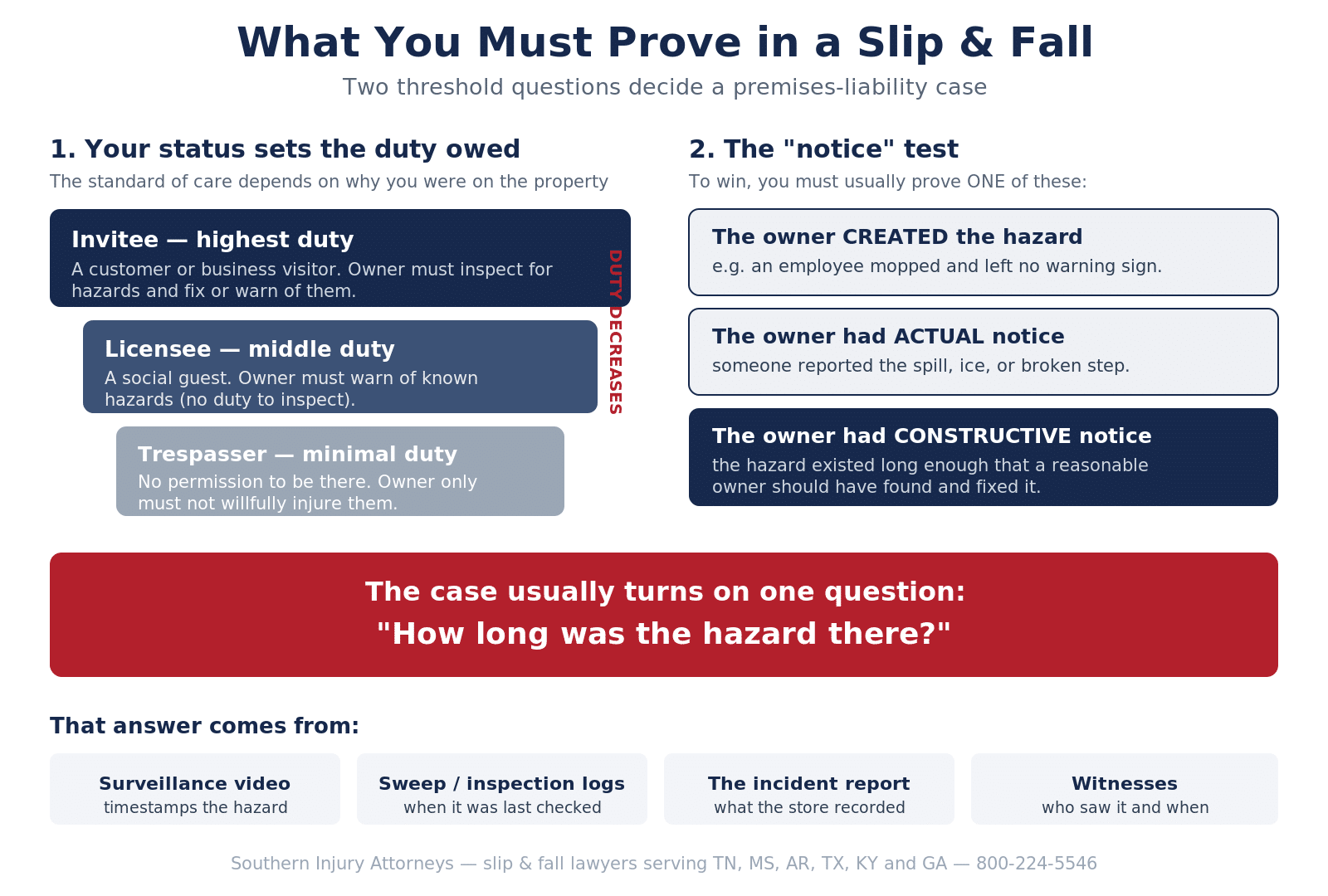
The property owner or occupier is liable when their carelessness creates an unsafe condition that hurts a lawful visitor. Texas law sets the duty owed by your status on the property. As a customer or business visitor (an invitee), you are owed the highest duty: the owner must inspect for dangers and fix or warn of hazards it knew about or should have found. A social guest (licensee) is owed a duty to be warned of known hazards. A trespasser is owed only the duty not to be harmed willfully or through gross negligence.
What Do I Have to Prove? The “Notice” Rule
The heart of a Texas slip and fall case is notice. You must show the owner (1) created the dangerous condition, (2) actually knew about it, or (3) should have known because it existed long enough that a reasonably careful owner would have discovered and removed it. That last point — “how long was the hazard there?” — is why the Texas Supreme Court in Wal-Mart Stores, Inc. v. Reece held that an employee simply being nearby is not enough. Proving the time-on-the-floor often depends on surveillance video and the store’s own inspection (sweep) logs, which is why moving fast matters.
Where Do Slip and Falls Happen in Dallas?
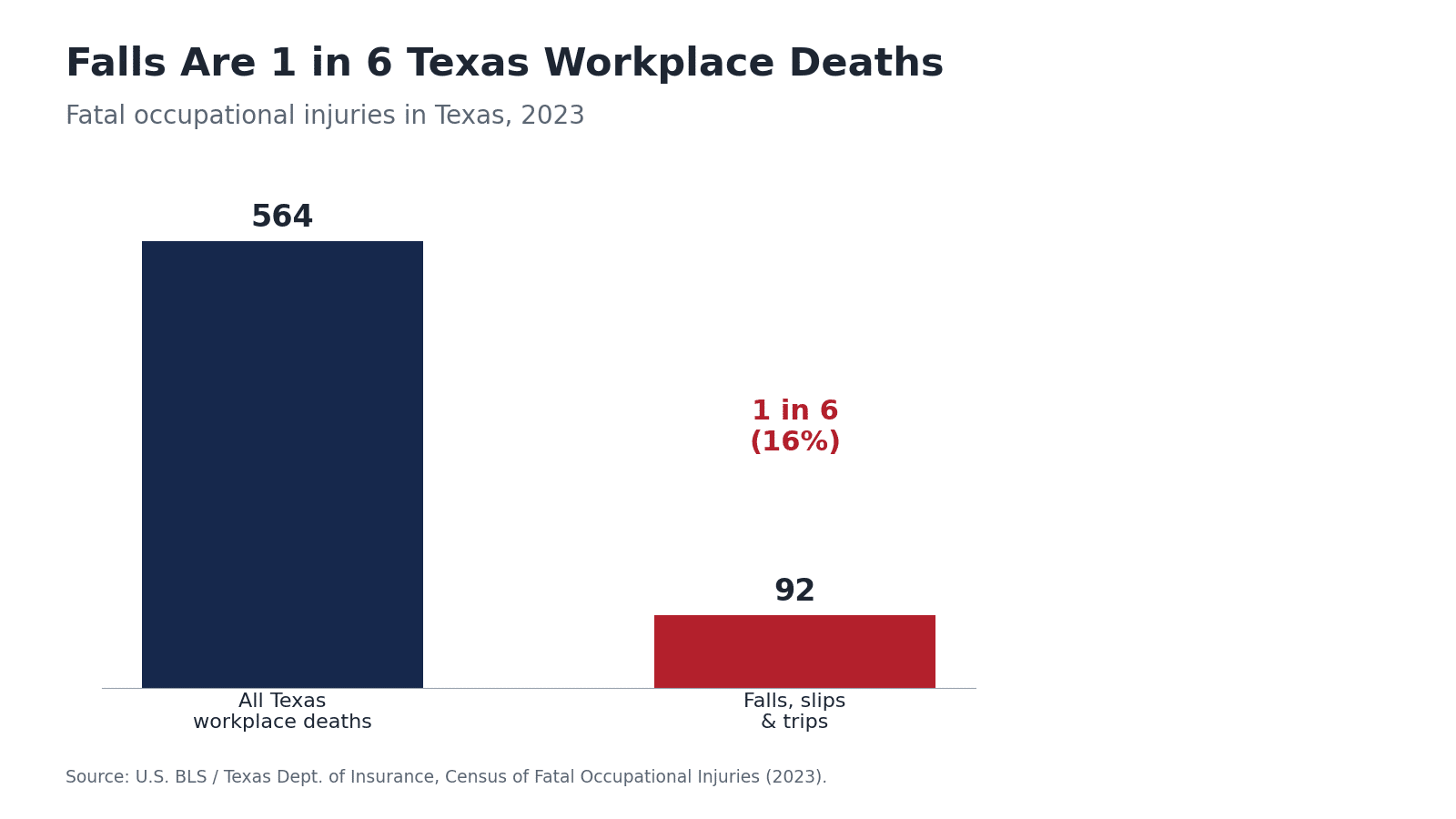
Dangerous conditions turn up anywhere people shop, work, and live across Dallas County. Common Dallas slip-and-fall settings include grocery and big-box stores (spills, freezer leaks, and produce-aisle water), restaurants, apartment complexes and stairwells, hotels, parking lots and garages with potholes or poor lighting, and office and retail entrances during rain. Wherever the fall happened, the questions are the same: what was the hazard, and should the owner have caught it in time?
Why Slip and Fall Evidence Disappears Fast
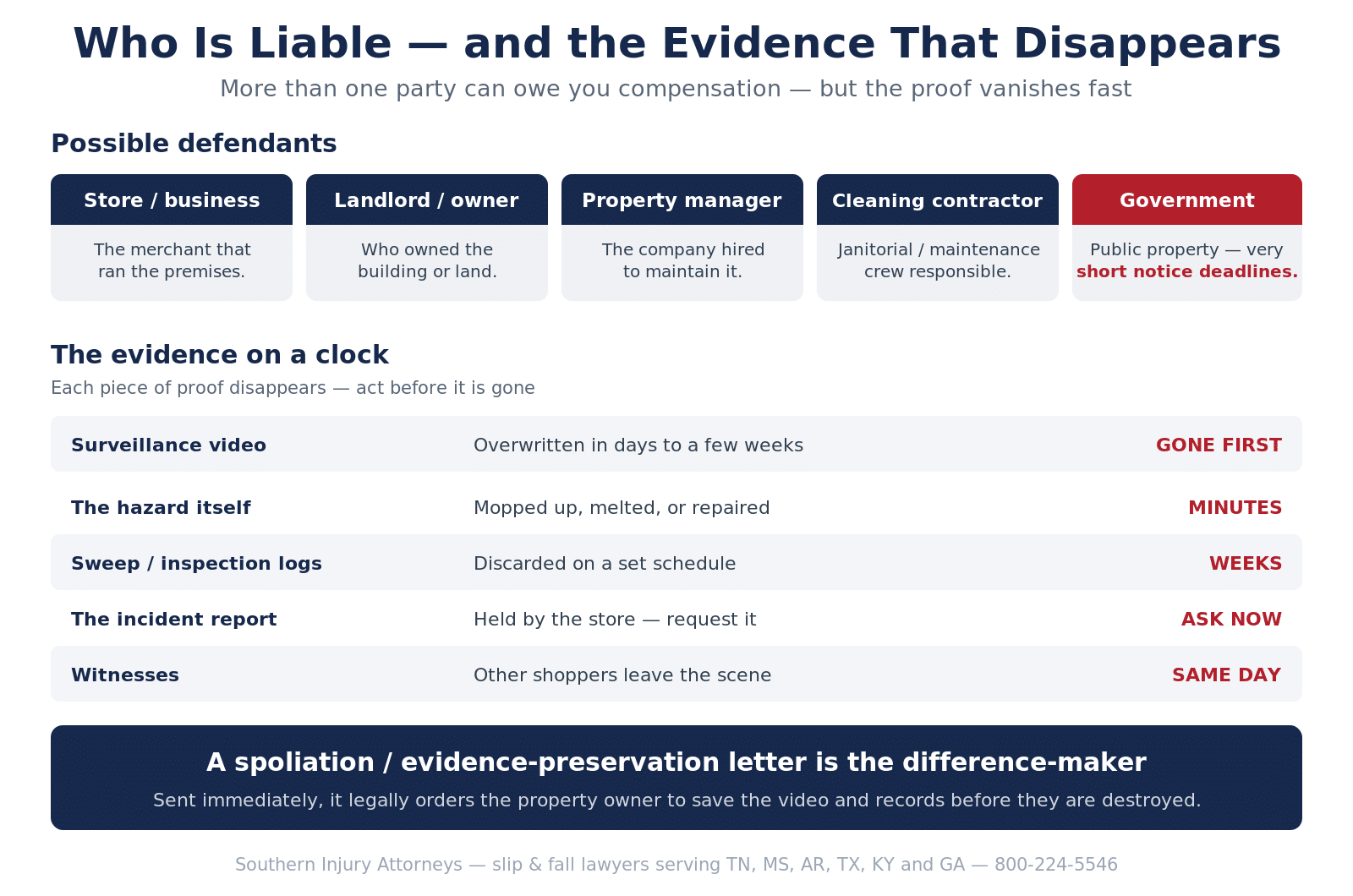
The proof that wins these cases is fragile. Surveillance footage is frequently overwritten within days, spills get mopped, and incident reports get filed away. Under Texas’s spoliation standard from Brookshire Brothers, Ltd. v. Aldridge — itself a slip-and-fall case where a store let its video auto-erase — once a business should reasonably anticipate a claim, it has a duty to preserve evidence. We send a preservation (spoliation) letter immediately to lock down the video, sweep logs, and incident report before they are gone.
The clock starts the moment you fall. The single most important step is preserving the camera footage. Once it is recorded over, it is almost impossible to recover.
What Compensation Can I Recover?
Slip and fall injuries — broken hips and wrists, head injuries, back and spine damage — can be serious and costly. Recoverable damages include:
- Medical expenses — ER care, surgery, imaging, rehabilitation, and future treatment.
- Lost income — wages missed and reduced earning capacity.
- Pain and suffering — physical pain, disfigurement, and loss of enjoyment of life.
- Out-of-pocket costs — assistive devices, transportation, and home help.
- Wrongful death damages — when a fall is fatal, through a Dallas wrongful death claim.
How Long Do I Have to File? (Texas Statute of Limitations)
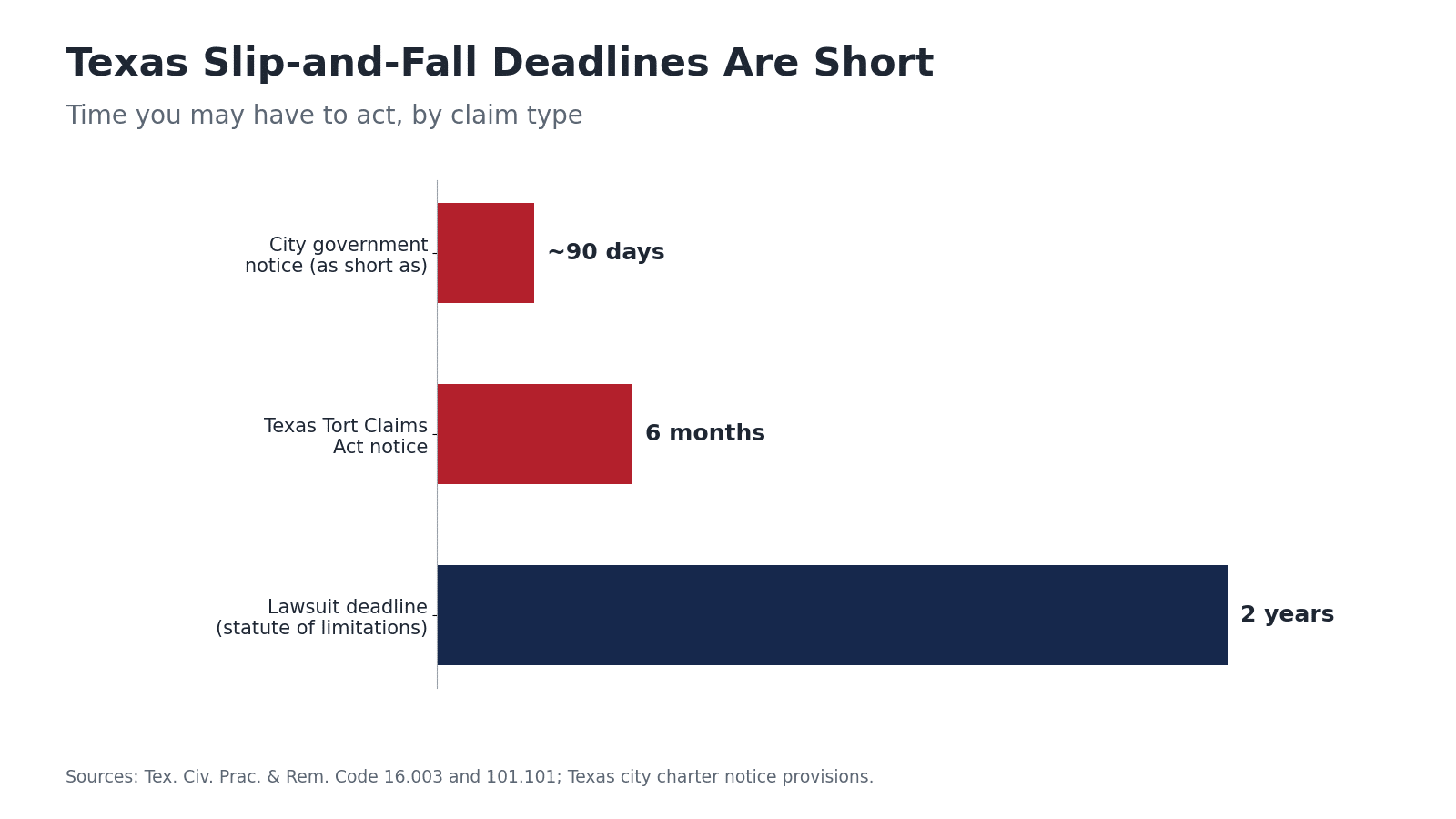
In most Texas slip and fall cases you have two years from the date of the fall to file suit (Tex. Civ. Prac. & Rem. Code § 16.003). But the deadline can be far shorter when a government entity is involved: the Texas Tort Claims Act requires notice within six months, and the City of Dallas’s charter requires written notice in as little as 90 days. Missing the notice deadline can end your claim even if the two years have not run.
What If I Was Partly at Fault?
You can still recover, as long as you were not mostly to blame. Texas uses proportionate responsibility (Tex. Civ. Prac. & Rem. Code § 33.001): you are barred only if you were more than 50% at fault, and otherwise your award is reduced by your percentage. Owners routinely argue the hazard was “open and obvious” or that you were on your phone. We push back with the video and the facts to keep your share of fault from being overstated.
What If I Fell on Government Property?
Claims against a city, county, or state entity follow special rules. The Texas Tort Claims Act governs premises claims against the government, and the deadlines are short — the City of Dallas’s charter notice can be due in about 90 days, well before the two-year filing deadline. Cases against Dallas County or a state agency have their own notice requirements. If your fall happened at a public building, transit stop, or government-owned property, talk to a lawyer right away so the notice is filed correctly and on time. These cases may be heard in the Dallas County district courts or, in some instances, the U.S. District Court for the Northern District of Texas, Dallas Division.
Our Results in Serious Injury Cases
Southern Injury Attorneys has recovered six-figure settlements in serious injury cases, including multiple six-figure results for clients harmed by others’ negligence and a $175,000 recovery in a vehicle-fire case. Every case is different, and these results reflect specific facts and injuries.
Prior results do not guarantee or predict a similar outcome in any future case.
Why Dallas Slip and Fall Victims Choose Southern Injury Attorneys
We move immediately to preserve the video and sweep logs, we know how to prove the notice element that sinks most slip-and-fall claims, and we try cases when insurers refuse to pay fairly. You work directly with attorneys, and you pay nothing unless we win.
Dallas office: 4245 N Central Expressway, Suite 490, Dallas, TX 75205
Phone: 469-253-2533
Serving Dallas County and the greater Dallas–Fort Worth metro area. Our firm is headquartered in Memphis and represents injured clients across Tennessee, Mississippi, Arkansas, Texas, Kentucky, and Georgia.
No fee unless we win. The consultation is free, and we advance the costs of investigating your case.
Southern Injury Attorneys
4245 N Central Expy, Suite 490, Dallas, TX 75205
(469) 253-2533 · Open 24 hours
Get directions · About our Dallas office
What clients say about Southern Injury Attorneys
Real Google reviews from our clients. Individual results vary.
“After other attorneys let us down, Southern Injury won our case and gave us a sense of justice.”
“Attorney Williamson and Ayah walked me through everything. Very pleased with the outcome.”
“They fought hard, got my medical bills covered and money in my pocket. Made a stressful situation less stressful.”
“Jimmy and Andrew were patient with me through my spine and face pain. I recommend them to anyone.”
“Amazing experience. They really care about their clients.”
“Our lawyer was always available and went above and beyond. They made me feel important through the whole process.”
Dallas Slip and Fall FAQs
How long do I have to file a slip and fall claim in Texas?
Generally two years from the date of the fall under Tex. Civ. Prac. & Rem. Code § 16.003. If you fell on government property, you may have to give notice much sooner — as little as 90 days for a City of Dallas claim.
What do I have to prove to win a slip and fall case in Texas?
You must prove the property owner had notice of the hazard — that they created it, actually knew about it, or should have known because it existed long enough to be discovered — and failed to fix it or warn you.
Is the store automatically liable if I fell in it?
No. Texas does not impose strict liability. You must show the owner was negligent and had notice of the dangerous condition. That is why surveillance video and inspection logs are so important.
Can I still recover if I was partly at fault for my fall?
Yes, as long as you were not more than 50% at fault. Under Texas’s proportionate responsibility rule, your recovery is reduced by your percentage of fault, and barred only if you were more than half responsible.
Why is surveillance video so important in a slip and fall case?
Video can show the hazard, how long it was there, and whether the owner should have caught it. Because footage is often erased within days, a preservation letter should go out immediately to keep it from being lost.
What if I slipped and fell on city or government property in Dallas?
Claims against the government follow the Texas Tort Claims Act and short charter deadlines — the City of Dallas’s notice can be due in about 90 days. Contact a lawyer right away so the notice is filed correctly and on time.
What is my Dallas slip and fall case worth?
It depends on the severity of your injuries, your medical bills and lost income, and the impact on your life. Serious falls causing fractures or head injuries carry higher value. We do not settle before your injuries are fully understood.
How much does it cost to hire a Dallas slip and fall lawyer?
Nothing up front. We work on contingency, so you pay no attorney fee unless we recover money for you, and the initial consultation is free.
What are the most common slip and fall injuries?
Common injuries include broken hips and wrists, head injuries and concussions, back and spinal injuries, and shoulder injuries. Older adults are especially at risk for serious harm from a fall.
Injured in a fall in Dallas? Talk with a slip and fall lawyer today. Call 469-253-2533, or reach us through our contact page for a free, no-obligation consultation. You pay no fee unless we win.
Start your free case review
Tell us what happened and we will call you back — usually within minutes during business hours. Free consultation, no fee unless we win.
This page is legal information, not legal advice, and does not create an attorney-client relationship. Outcomes depend on the specific facts of each case. For advice about your situation, speak with a licensed attorney.

