



Losing someone you love to another person’s negligence is a kind of pain no Houston family should have to carry. If that has happened to you, please accept our sincere condolences — and know that you have rights, and time to consider them.
Quick answer: In Texas, a wrongful death claim lets a family seek justice and compensation when a loved one is killed by someone else’s negligence. Only the surviving spouse, children, and parents may file the wrongful death claim (Tex. Civ. Prac. & Rem. Code § 71.004), and the estate may bring a separate survival claim (§ 71.021) for what your loved one suffered before death. You generally have two years from the date of death to file (§ 16.003(b)). Texas does not cap wrongful death damages except in medical-malpractice cases, and exemplary (punitive) damages are available where the death was caused by gross negligence or a willful act. Speaking with a lawyer costs nothing, the conversation is confidential, and you pay no fee unless we recover for you. When you’re ready, call our Houston office at 346-299-8430.
- Texas has the narrowest beneficiary rule of any state we serve: only a surviving spouse, children, and parents can bring the wrongful death claim — siblings and other relatives cannot.
- There are usually two claims: the family’s wrongful death claim and the estate’s survival action, and they recover different losses.
- The deadline is two years from the date of death (§ 16.003(b)) — and it is generally absolute in Texas, with only narrow exceptions.
- Houston is the nation’s energy and petrochemical capital, so fatal refinery, plant, offshore, maritime, and 18-wheeler incidents are a major source of wrongful death cases here.
- Consultations are free and confidential, with no fee unless we recover compensation for your family.
Houston Wrongful Death Claims at a Glance
| Question | Short answer |
|---|---|
| Who can file in Texas? | Only the surviving spouse, children, and parents (§ 71.004); the estate brings the survival claim (§ 71.021). |
| How long do we have? | Two years from the date of death (§ 16.003(b)) — generally absolute, with narrow exceptions. |
| What can a family recover? | Lost support, companionship and society, mental anguish, lost inheritance, funeral and medical costs, and the decedent’s pre-death suffering. |
| Are damages capped? | No — Texas caps wrongful death damages only in medical-malpractice cases. Punitive damages are available for gross negligence. |
| What if our loved one shared fault? | Texas uses a 51% bar (§ 33.001); a family can recover unless the loved one was more than 50% responsible. |
| What does a lawyer cost? | Nothing up front — consultations are free and confidential, and the fee comes only from a recovery. |
Below, we explain — gently and plainly — what a wrongful death claim is under Texas law, who may bring it, what it can recover, the two-year deadline, and the local realities that shape these cases in Houston and Harris County. There is no pressure here. Our goal is simply to help you understand your family’s rights so you can decide what feels right for you.
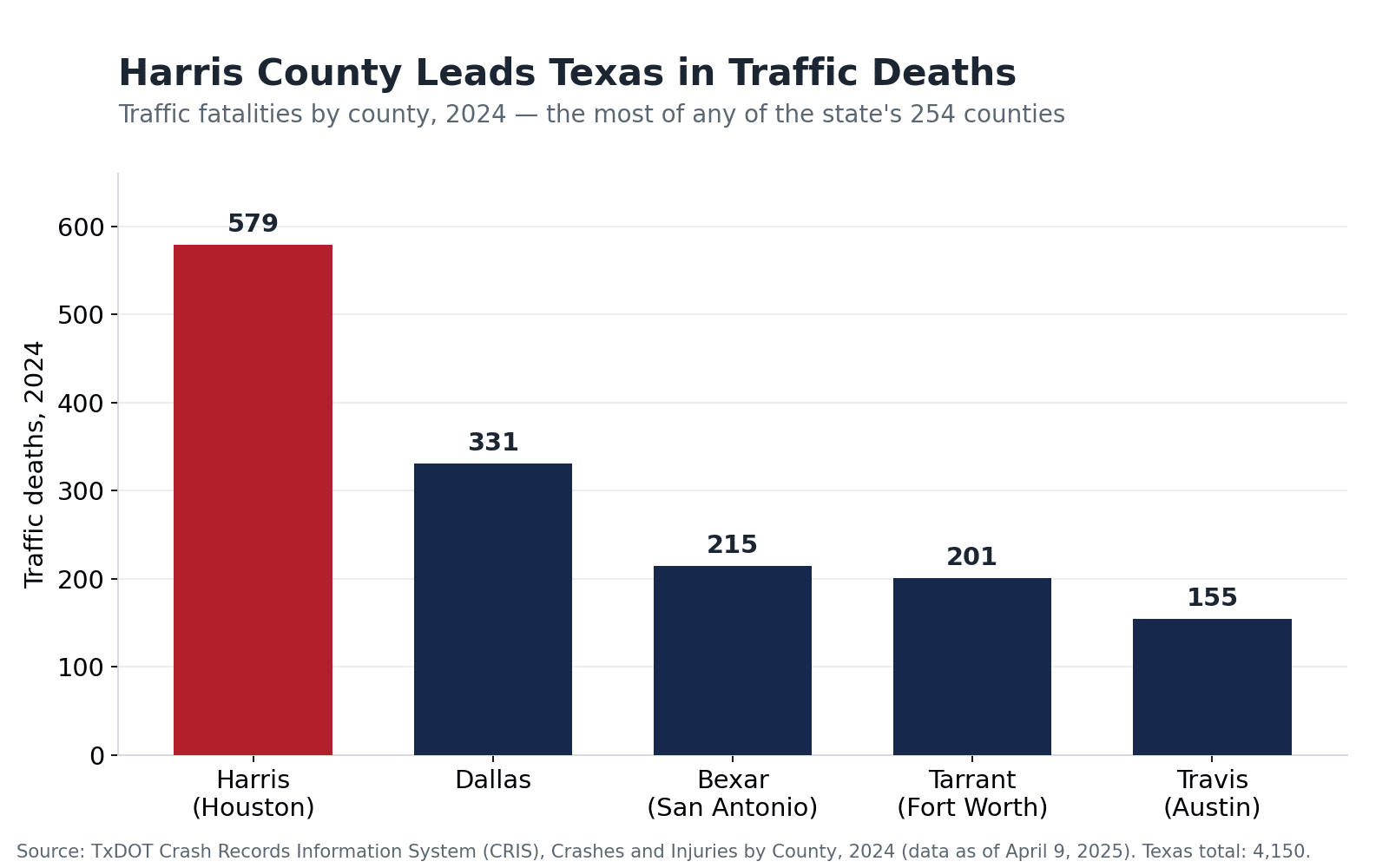
Every one of those numbers was a person, and behind each is a Houston-area family that had to begin again. Fatal accidents here come not only from the ordinary risks of the road but also from the region’s heavy industry — which is why a wrongful death claim can follow almost any kind of negligence, not a single “type” of accident.
What Is a Wrongful Death Claim in Texas?
A Texas wrongful death claim is a legal claim that arises when a person is killed by another’s wrongful act, neglect, carelessness, unskillfulness, or default (Tex. Civ. Prac. & Rem. Code § 71.002). Unlike an injury you recover from, the person who was harmed is no longer here to bring a case — so the law gives that right to their closest family and, through a separate claim, to their estate. The wrongful death statute is found in Chapter 71 of the Texas Civil Practice and Remedies Code, and it sets its own rules about who may sue, what can be recovered, and how long there is to act.
Because the claim is defined by the harm — a death caused by negligence — and not by how the death happened, it can follow a car or truck crash, a refinery or plant explosion, an offshore or maritime incident, a fall on a job site, a defective product, or any other situation where someone failed to use reasonable care. What makes these cases distinct in Texas is not the accident; it is the law that decides who can stand in for the person who died. That is also where Texas families are most often surprised, so it is worth understanding before anything else.
Who Can File a Wrongful Death Lawsuit in Texas?
Texas has the narrowest beneficiary rule of any state we serve. Under § 71.004, the wrongful death claim may be brought only by the surviving spouse, children, and parents of the person who died — individually or together. Siblings, grandparents, and other relatives cannot bring the claim, even if they were close to the person who died. If none of the eligible family members files within three months of the death, the estate’s executor or administrator may file unless the family asks them not to.
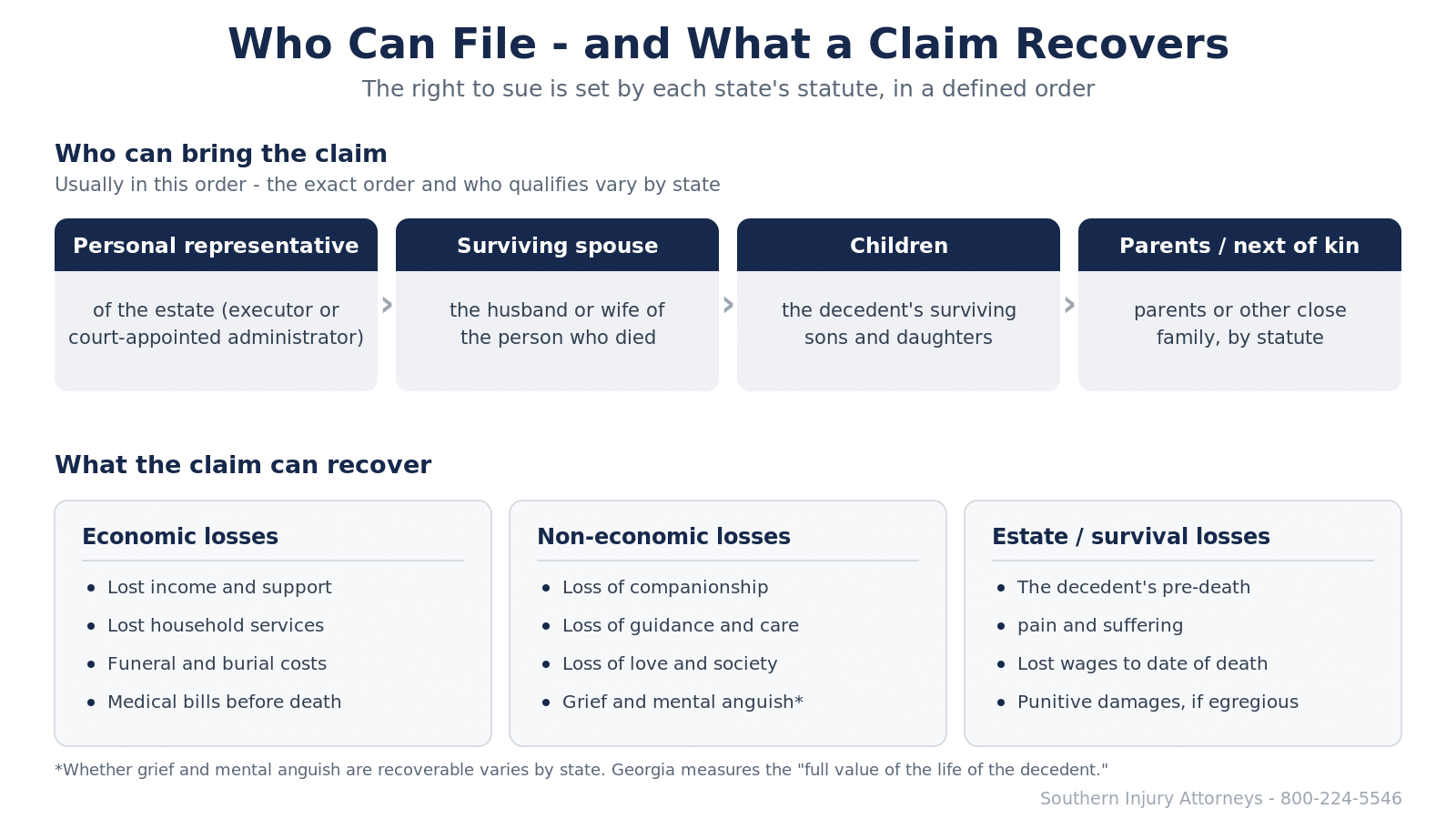
Separately, the estate — through its personal representative, or the heirs if no estate has been opened — may bring a survival action under § 71.021 for the claim the deceased person could have brought had they lived. Families are often surprised to learn that an estate may need to be opened and the right person formally designated before that claim can move forward. Sorting out exactly who in your family is entitled to file is one of the first things a lawyer can do for you — usually at no cost and with no obligation.
What Is the Difference Between a Wrongful Death Claim and a Survival Action?
After a death in Texas, the law recognizes two separate claims, and they compensate two different kinds of loss. The wrongful death claim (§ 71.004) belongs to the spouse, children, and parents and addresses their loss — the support, companionship, and guidance they no longer have. The survival action (§ 71.021) belongs to the estate and addresses what your loved one personally endured between the injury and death. Both can be pursued together.
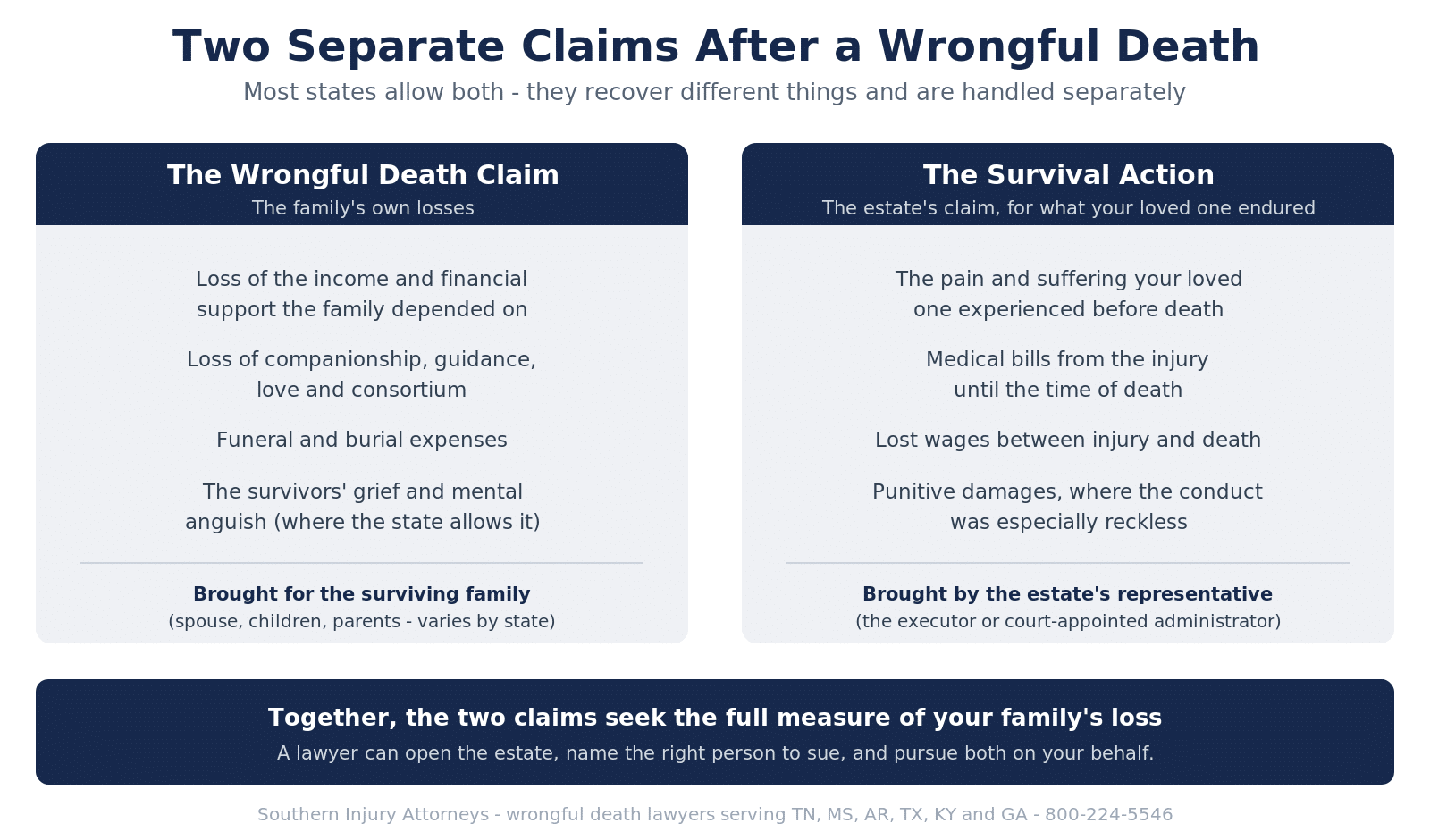
In practical terms, the wrongful death claim seeks the family’s losses: lost financial support and earning capacity, the loss of the person’s companionship, love, comfort, and society, the loss of services and inheritance, and the survivors’ mental anguish. The survival action seeks what the decedent’s own claim would have recovered: the conscious pain and suffering they experienced before death, their medical bills, and their funeral expenses. Pursued together, the two claims seek the full measure of a family’s loss. A lawyer can open the estate, identify the right person to bring each claim, and advance them on your behalf so you don’t have to navigate the paperwork while you grieve.
Common Causes of Wrongful Death in Houston
Because a wrongful death claim follows from negligence rather than a particular kind of accident, it can arise from nearly any fatal incident. In the Houston area, the causes we most often help families with reflect both heavy traffic and the region’s heavy industry:
- Car and auto accidents — Harris County leads the state in traffic deaths; see our Houston car accident lawyers page.
- Truck and 18-wheeler crashes — the Port of Houston and the region’s freight corridors put thousands of heavy trucks on I-10, I-45, I-69, and the Sam Houston and Beltway loops; see our Houston truck accident lawyers.
- Industrial, refinery, and plant explosions — Houston is the energy and petrochemical capital of the United States, and fatal fires, explosions, and toxic releases at refineries and chemical plants are a leading local source of wrongful death claims.
- Offshore and maritime deaths — workers killed on vessels, rigs, and docks along the Gulf may have claims under maritime law; see our maritime injury law for seamen page.
- Construction and job-site accidents — falls, crane and equipment failures, trench collapses, and being struck by objects.
- Medical negligence and dangerous or defective products.
- Unsafe premises — including negligent security and fatal falls.
- Motorcycle and rear-end crashes — see our Houston motorcycle accident lawyers and Houston rear-end accident lawyers.
Texas leads the nation in workplace deaths, and Houston’s energy, construction, and transportation industries account for much of that toll. The two charts below show where those deaths come from.
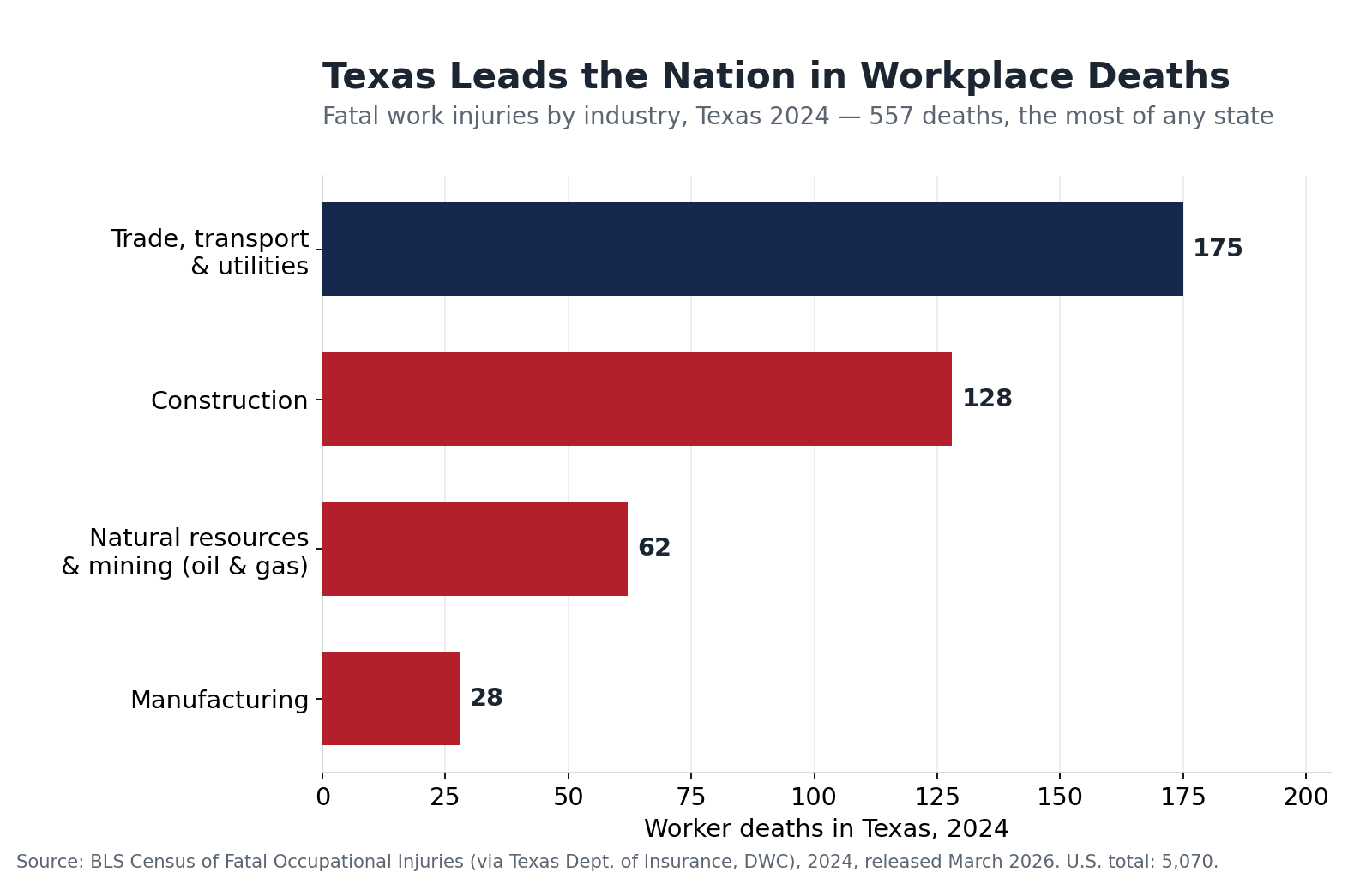
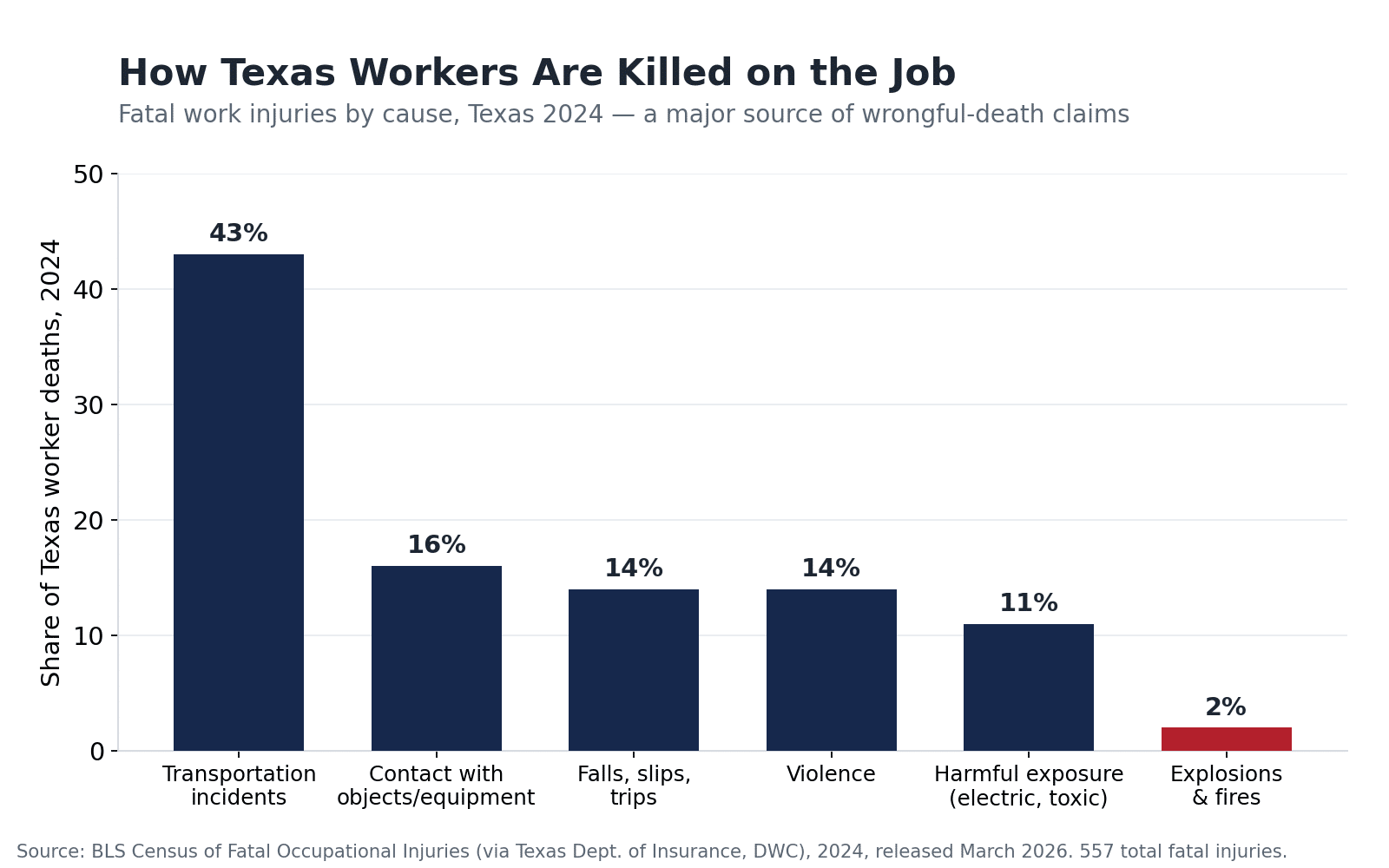
An industrial death often involves more than one responsible party — an employer, a contractor or subcontractor, an equipment manufacturer, or a property owner — and federal OSHA investigation records can be central to proving what went wrong. Identifying every responsible party is one of the most important things a lawyer does in these cases.
What Compensation Can a Houston Family Recover?
A Texas wrongful death case can seek several categories of compensation, falling into three groups:
- The family’s economic losses — the lost financial support and earning capacity the household depended on, the value of services the person provided (childcare, home maintenance, and the like), lost inheritance, and funeral and burial expenses.
- The family’s non-economic losses — the loss of the person’s companionship, love, comfort, society, and guidance, and the survivors’ mental anguish.
- The estate’s survival losses — the conscious pain and suffering the decedent experienced before death, their medical bills, and their funeral expenses.
Importantly, Texas does not cap wrongful death damages — with one exception: medical-malpractice cases, where non-economic damages are limited under § 74.301. Where a death resulted from a willful act or omission or gross negligence, the family may also recover exemplary (punitive) damages under § 71.009 and Chapter 41 of the Civil Practice and Remedies Code, proven by clear and convincing evidence (§ 41.003). The Texas Constitution (art. XVI, § 26) specifically preserves exemplary damages for a death caused by willful act, omission, or gross negligence. These damages are capped in most cases under § 41.008, but they can be a meaningful part of a case where a company’s conduct was egregious. Valuing a life is never truly possible, but the law’s aim is to ease the financial weight a family should never have had to bear — and doing it carefully often takes the help of an economist and other experts.
How Long Do We Have to File? (Texas Statute of Limitations)
In Texas, the deadline to file a wrongful death lawsuit is generally two years from the date of death (Tex. Civ. Prac. & Rem. Code § 16.003(b)). For a wrongful death claim the clock runs from the death itself, which can make it different from an ordinary personal-injury deadline. Texas treats this deadline strictly, and unlike many states it does not generally apply a “discovery rule” to push it back.
There are a few narrow exceptions. The deadline may be paused for a beneficiary who was a minor at the time of death, or where a defendant fraudulently concealed their wrongdoing. And if a government entity may be responsible — a public vehicle, a dangerous road, a public hospital — a much shorter notice deadline applies, sometimes only a matter of months under the Texas Tort Claims Act. Because these rules are technical and easy to miss, it is best to confirm the exact deadline that applies to your family early — there is no cost to ask.
What If Our Loved One Was Partly at Fault?
A Houston family can usually still recover even if their loved one shared some of the blame. Texas uses a modified comparative-fault rule with a 51% bar (Tex. Civ. Prac. & Rem. Code § 33.001): a family can recover as long as the person who died was not more than 50% responsible for what happened, and the recovery is reduced by their share of fault. In other words, recovery is allowed at exactly 50% fault but barred above it. Insurers and defense lawyers often raise fault to lower what they pay, so how a case is investigated and presented can make a real difference — and being blamed is a reason to talk with a lawyer, not a reason to give up.
How Is a Wrongful Death Case Proven, and What Evidence Matters?
Proving a wrongful death case means showing that someone failed to use reasonable care, that the failure caused the death, and the full extent of the family’s loss — and the evidence that does this can disappear quickly. The most important early step is usually preserving evidence: sending preservation (spoliation) letters so a vehicle, a piece of equipment, a black-box or electronic-logging record, or a job-site condition is not repaired, altered, or destroyed before it can be examined.
From there, building the case often involves accident-reconstruction experts, medical and engineering experts, and — for fatal industrial incidents — federal OSHA inspection reports and citations, company safety records, and maintenance logs. For a fatal truck crash, the carrier’s driver-qualification file, hours-of-service logs, and electronic data are key. Establishing the family’s economic loss typically involves an economist who projects the support and earnings the household lost. A lawyer coordinates this work so your family does not have to.
What Is a Houston Wrongful Death Case Worth?
There is no fixed average, and we never pretend a number can measure a life. What the law can do is account for a family’s real, provable losses — both economic (lost income and support, the value of services the person provided, funeral and medical costs) and non-economic (the loss of companionship, society, and guidance, and the survivors’ mental anguish) — together with the estate’s survival damages and any exemplary damages the conduct supports.
Value also depends on how many sources of recovery exist. A fatal accident can involve more than one at-fault party and more than one insurance policy — for example a negligent driver and the company that employed them, a refinery operator and its contractors, or a vehicle or product manufacturer. When the person responsible was uninsured or underinsured, the family’s own uninsured/underinsured motorist coverage may provide another source. Identifying every responsible party and every available policy is often what stands between a quick, low insurance offer and a recovery that truly reflects the loss.
Our Results in Serious Accident Cases
Every family and every case is different, but our results reflect how hard we work for the people we represent:
- Six-figure recovery — Our client was stopped in traffic when an 18-wheeler failed to stop in time and rear-ended them.
- Six-figure settlement — An 18-wheeler pushed our client into a barrier wall, causing her injuries.
- $175,000 settlement — Our client’s Mercedes was rear-ended and caught fire; even with minimal medical treatment, we recovered $175,000.
Prior results do not guarantee a similar outcome. Every case depends on its own facts.
Why Houston Families Choose Southern Injury Attorneys
We are a contingency-fee injury firm with attorneys licensed in Texas and in Tennessee, Mississippi, Arkansas, Kentucky, and Georgia, and we handle wrongful death cases with the care these matters deserve. We can open the estate, identify who is entitled to file, pursue both the wrongful death and survival claims, work with economists, accident reconstructionists, and other experts to value the loss fully, and deal with the insurers and corporate defendants — so your family can focus on each other. We also handle the underlying accidents, including Houston truck accidents, Houston car accidents, and the broad areas covered on our wrongful death lawyer page. Consultations are free and confidential, and there is no fee unless we recover for you.
Our Houston office: 340 N Sam Houston Pkwy E, Suite A1045, Houston, TX 77060 · 346-299-8430. We are part of a firm headquartered in Memphis, with additional offices in Dallas and Atlanta, serving families throughout Texas and the surrounding states. A Texas wrongful death case can usually be handled almost entirely by phone, so distance is never a barrier. When you’re ready, you can also call our firm line at 800-224-5546.
Houston Wrongful Death FAQs
Who can file a wrongful death lawsuit in Texas?
Texas has the narrowest rule of any state we serve. Under Tex. Civ. Prac. & Rem. Code § 71.004, only the surviving spouse, children, and parents of the person who died may bring the wrongful death claim — they can file individually or together. Siblings, grandparents, and other relatives cannot. If none of the eligible family members files within three months of the death, the estate’s executor or administrator may file unless the family asks them not to. The estate also brings a separate survival claim under § 71.021. A lawyer can tell you quickly who in your family is entitled to file.
How long do I have to file a wrongful death claim in Texas?
Generally two years from the date of death (Tex. Civ. Prac. & Rem. Code § 16.003(b)). For a wrongful death claim the clock runs from the death itself, and Texas treats the deadline strictly — it does not generally apply a discovery rule. Narrow exceptions exist for beneficiaries who were minors and for fraudulent concealment, and claims against a government entity carry a much shorter notice deadline, sometimes only months. Because missing the deadline can end a valid claim, it is best to confirm the exact date that applies to your family as early as possible.
What is the difference between a wrongful death claim and a survival action in Texas?
They are two separate claims that recover different things. The wrongful death claim (§ 71.004) belongs to the surviving spouse, children, and parents and compensates the family’s own losses — lost support, companionship and society, mental anguish, lost inheritance, and funeral costs. The survival action (§ 71.021) belongs to the estate and compensates what your loved one personally endured before death, such as their conscious pain and suffering, medical bills, and funeral expenses. Both are usually pursued together so the full measure of the loss is recovered.
Can my family recover punitive damages in a Texas wrongful death case?
Sometimes. Where a death was caused by a willful act or omission or by gross negligence, Texas allows exemplary (punitive) damages — the Texas Constitution (art. XVI, § 26) specifically preserves them for wrongful death, and they must be proven by clear and convincing evidence (§ 41.003). They are most common where a company or driver acted with conscious disregard for the safety of others, such as a grossly negligent trucking company or an employer that ignored known refinery hazards. Exemplary damages are capped in most cases under § 41.008, but they can be a meaningful part of a case where the conduct was egregious.
What is the average wrongful death settlement in Houston?
There is no reliable “average,” because the value of a wrongful death case depends on the specific facts — the family’s lost financial support, the loss of companionship and guidance, the decedent’s pre-death suffering, the strength of the liability evidence, and how many at-fault parties and insurance policies are available. Texas does not cap wrongful death damages outside of medical-malpractice cases, and cases involving gross negligence may add exemplary damages. Anyone who promises a specific figure before reviewing the facts is guessing. A lawyer can give you a realistic assessment after reviewing what happened.
How much does a Houston wrongful death lawyer cost?
Nothing up front. We handle wrongful death cases on a contingency fee, which means our fee comes only from a recovery — if there is no recovery, you owe no attorney’s fee. The initial consultation is always free and completely confidential, so there is no cost or obligation to simply ask questions and understand your family’s options.
Can I file a claim for a worker killed in a refinery or industrial accident in Houston?
Often, yes. Houston is the country’s energy and petrochemical hub, and fatal refinery fires, plant explosions, toxic releases, and construction and offshore incidents are a major source of wrongful death claims here. Even when the death is covered by workers’ compensation, the family may have a separate third-party wrongful death claim against a contractor, an equipment manufacturer, a property owner, or another company whose negligence contributed. Federal OSHA investigation records are often central to proving what went wrong. These cases can involve several defendants and substantial insurance, so it is worth having a lawyer identify every responsible party.
What if more than one family member wants to file?
In Texas the surviving spouse, children, and parents share a single wrongful death claim — they do not each file separate lawsuits. Any one of them may bring the claim for the benefit of all, and family members can join together. If there is disagreement about who should lead or how a recovery should be divided, a court can resolve it, and the survival-action recovery passes through the estate. A lawyer can coordinate the family’s interests so the claim moves forward smoothly and no one is left out.
Will our wrongful death case have to go to court?
Not necessarily. Many wrongful death cases resolve through a settlement once liability is established and the family’s losses are documented, without a trial. Others — especially those against a well-funded company that disputes responsibility — may need to be litigated, and some are tried before a Harris County jury. We prepare every case as if it will go to trial, because that is often what produces the strongest settlement, while sparing the family the burden of a courtroom whenever a fair resolution can be reached.
Talk to a Houston Wrongful Death Lawyer — Free and Confidential
If you have lost someone you love because of another’s negligence, you don’t have to figure any of this out alone. Whenever you feel ready, we’re here for a free, confidential conversation — no pressure, no obligation, and no fee unless we recover for your family. Our attorneys are licensed in Texas and five neighboring states. Call our Houston office at 346-299-8430, our firm line at 800-224-5546, or reach out online when the time is right for you.
This page is general legal information, not legal advice. Every case is different and outcomes are never guaranteed. Contacting us does not create an attorney-client relationship. Prior results do not guarantee a similar outcome.
What Our Clients Say
“My lawyer was always available to answer any questions and went above and beyond to make sure we got what we deserved! Everyone was so nice and made me feel like I was important!”
“Attorney Williamson & Ayah were amazing during my case. I really appreciate them for being so patient with me and with the other party. I TRULY APPRECIATE YOU GUYS!”
“Absolutely the best in the city. Very professional — they helped me with my slip and fall with the apartment complex! Would recommend to anyone with a car accident or slip and fall.”
“I had a time-urgent issue and Jimmy was exceptionally prompt in helping me. He truly listened to my concerns. I did not feel like just another payday for him — and my issue was resolved in my favor! 10/10 recommend!”
“This firm assisted me from start to finish without any hesitation or unnecessary fees. Extremely professional and timely. I am unfamiliar with the laws, but Southern Injury guided me the whole way. Highly recommend!”
“From the start they were honest, responsive, and completely committed to my case. They fought hard and made sure I got the compensation I deserved. If you are looking for a lawyer who truly has your back, this is the one.”
Start your free case review
Tell us what happened and we will call you back — usually within minutes during business hours. Free consultation, no fee unless we win.

