


Quick answer: If you were hit by a vehicle while walking in Houston — or lost a loved one — you generally have two years to file a claim in Texas (Tex. Civ. Prac. & Rem. Code § 16.003). Texas drivers must stop and yield to pedestrians in a crosswalk (Tex. Transp. Code § 552.003), and most pedestrian crashes are caused by a driver who failed to yield, was speeding, or was distracted. Even if you were crossing outside a crosswalk, Texas’s 51% comparative-fault rule (§ 33.001) usually still allows recovery, reduced by your share of fault. A consultation costs nothing, it is confidential, and you pay no fee unless we win. Call our Houston office at 346-299-8430.
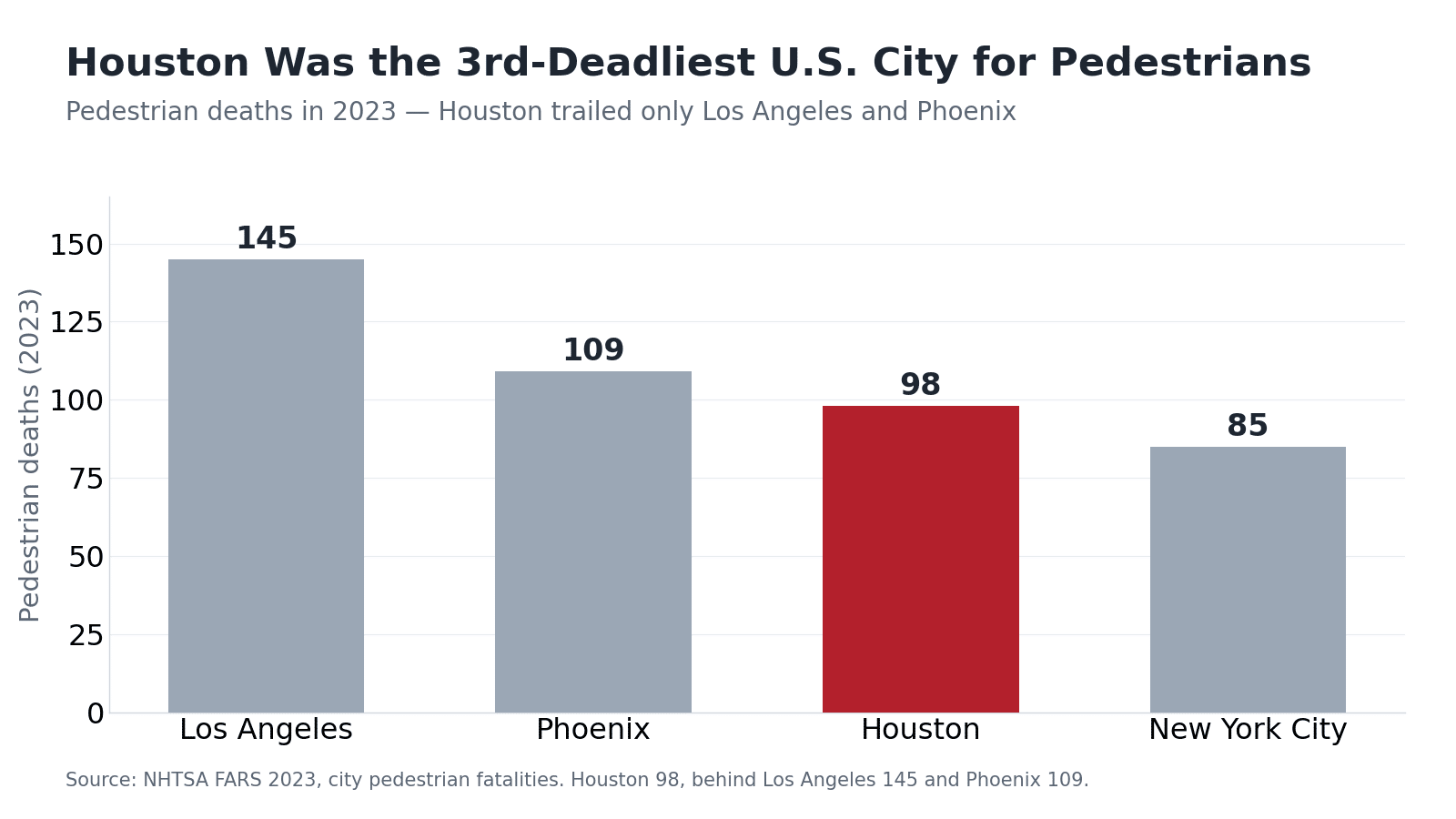
- Houston is one of the deadliest big cities in America for pedestrians — a record 119 pedestrians were killed in 2024, and the city ranked third in the nation in 2023.
- Texas drivers must yield to pedestrians in a crosswalk (Tex. Transp. Code § 552.003); failing to do so is negligence.
- Crossing outside a crosswalk does not bar your claim. Under Texas’s 51% rule (§ 33.001), you can recover unless you were more than 50% at fault.
- You usually have two years to file (§ 16.003) — and far less if a government entity is involved.
- Hit-and-run is common, so your own uninsured-motorist coverage may pay even when the driver is never found.
- Consultations are free and confidential, with no fee unless we recover compensation for you.
Houston Pedestrian Accident Claims at a Glance
| Question | Short answer |
|---|---|
| Who is usually at fault? | Most often the driver — for failing to yield, speeding, distraction, or impairment. |
| Do drivers have to stop for pedestrians? | Yes — drivers must stop and yield to a pedestrian in a crosswalk (Tex. Transp. Code § 552.003). |
| What if I wasn’t in a crosswalk? | You can still recover unless you were more than 50% at fault (§ 33.001); the driver’s fault still counts. |
| How long do I have to file? | Generally two years from the crash (§ 16.003); much less against a government entity. |
| What if the driver fled? | Your uninsured-motorist (UM) coverage may pay, and we work to identify the driver. |
| What does a lawyer cost? | Nothing up front — consultations are free and the fee comes only from a recovery. |
Below, we explain who is usually at fault when a pedestrian is hit in Houston, what Texas’s crosswalk and right-of-way laws mean for your claim, the two-year deadline, what your case may be worth, and the local realities — from wide, high-speed arterials to the I-45 access roads — that make this one of the most dangerous cities in the country to walk.
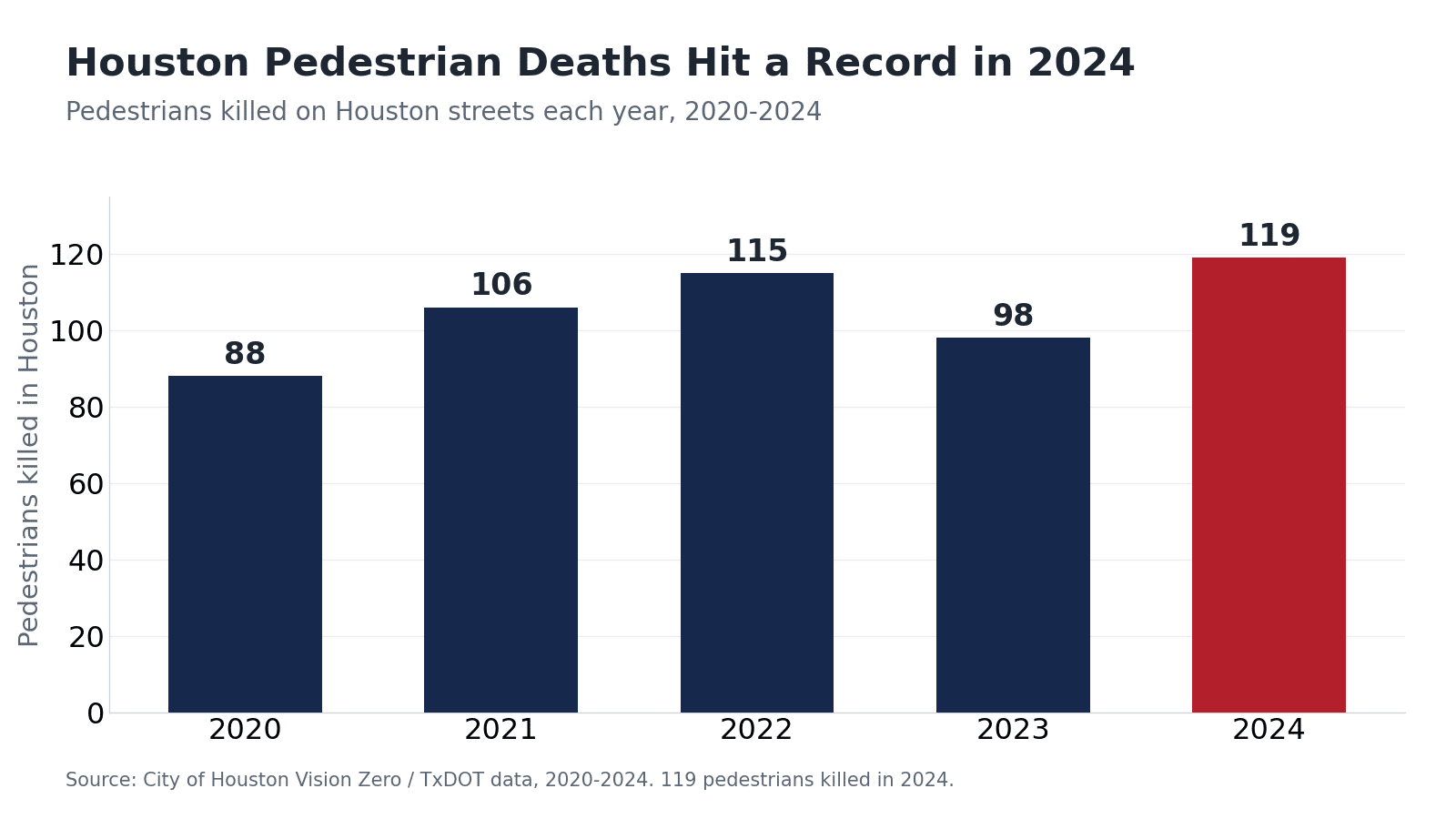
Every one of those numbers was a person. Houston’s wide, fast arterial roads, long distances between crosswalks, and heavy traffic make it one of the most dangerous big cities in America for people on foot — and when a multi-ton vehicle strikes someone walking, the pedestrian almost always suffers the catastrophic injuries.
What Should I Do After a Pedestrian Accident in Houston?
The most important steps after being hit are to protect your health and protect the evidence. If your injuries kept you from doing these things, a lawyer can still reconstruct what happened.
- Get emergency medical care right away. Pedestrian injuries — head trauma, internal injuries, fractures — are often severe and not always obvious at the scene.
- Call 911 and make sure a police report is created, and get the officer’s name and the crash report number.
- Get the driver’s information and insurance, and the names and numbers of any witnesses.
- Photograph the scene — the crosswalk or intersection, signals, the vehicle, skid marks, and your injuries — and note nearby businesses that may have surveillance video.
- Do not admit fault or give a recorded statement to the driver’s insurer before talking to a lawyer.
- Preserve your clothing and belongings exactly as they are.
Who Is at Fault in a Houston Pedestrian Accident?
In most pedestrian crashes, the driver is at fault. Drivers have a duty to keep a proper lookout, obey speed limits, and yield to people on foot — and the most common causes of these crashes are failure to yield, speeding, distracted driving, impaired driving, and failing to look while turning. A driver who says they “never saw” the pedestrian has usually admitted the very failure that caused the crash.
Speed is the single biggest factor in whether a pedestrian lives or dies. The risk of death climbs steeply as a vehicle’s speed rises — which is why crashes on Houston’s higher-speed arterials are so often fatal.
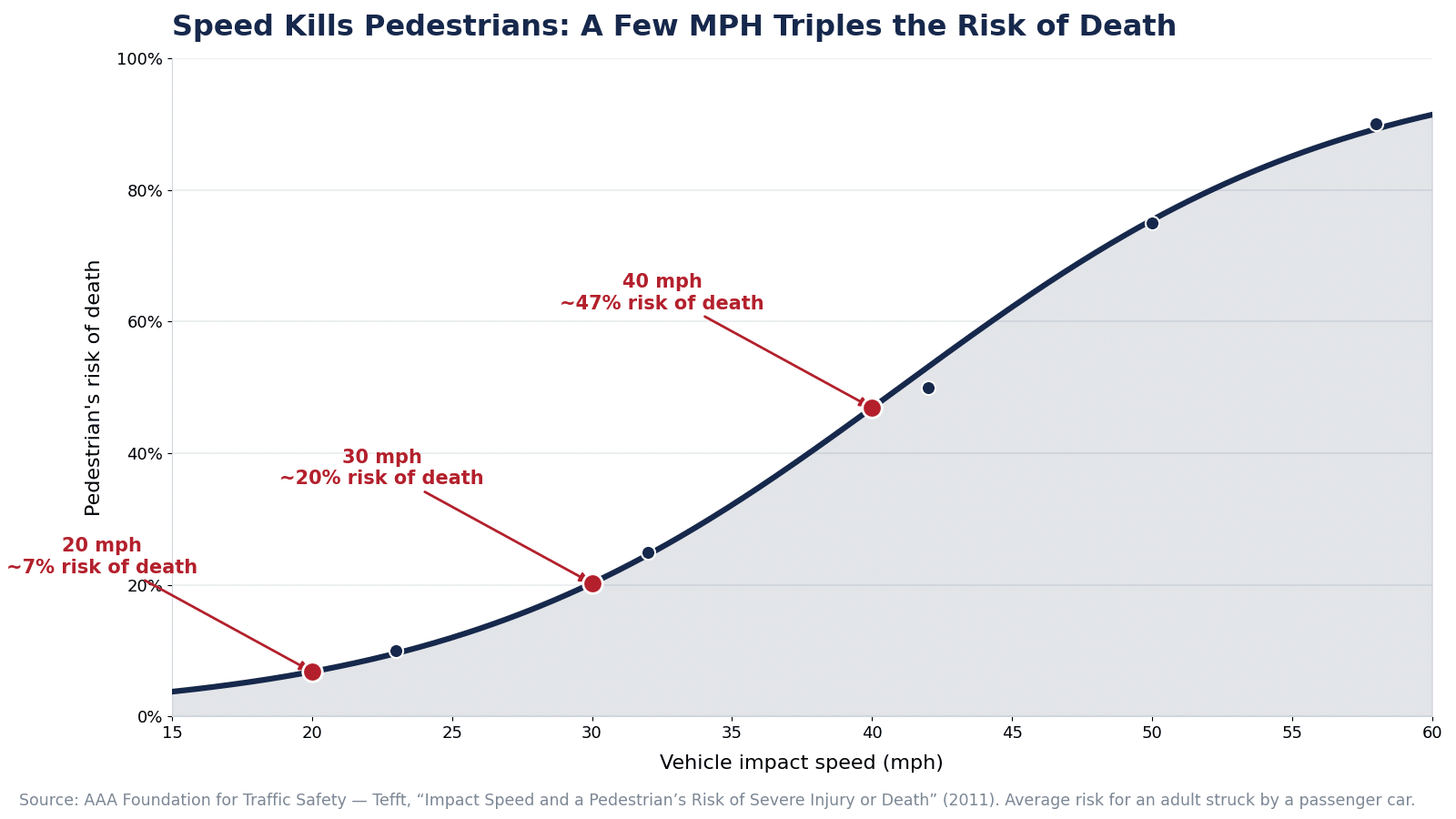
Establishing the driver’s fault — and overcoming the reflex to blame the pedestrian — takes the police report, the signal timing, nearby surveillance or dash-cam video, the vehicle’s damage and event data, and often an accident-reconstruction expert. We build that case so the insurer cannot simply shift blame onto the person who was walking.
Do Drivers Have to Stop for Pedestrians in Texas?
Yes. Under Tex. Transp. Code § 552.003, the driver of a vehicle must stop and yield the right-of-way to a pedestrian crossing in a crosswalk when there is no traffic signal, if the pedestrian is on the driver’s half of the road or close enough to be in danger. A driver also may not pass another vehicle that is stopped at a crosswalk to let someone cross. A crosswalk in Texas includes not just painted crossings but also the unmarked extension of the sidewalk across an intersection. When a driver violates this duty and hits someone, that violation is powerful evidence of negligence.
What If I Was Crossing Outside a Crosswalk?
You may still have a strong claim. Texas law does require a pedestrian crossing outside a crosswalk to yield to vehicles (Tex. Transp. Code § 552.005), and a pedestrian may not suddenly dart off a curb into the path of a car that is too close to stop. But crossing mid-block does not automatically make you responsible — the driver still has a duty to pay attention, drive a safe speed, and avoid hitting people. Under Texas’s comparative-fault rule (§ 33.001), you can recover as long as you were not more than 50% at fault, with your award reduced by your share. Insurers love to label every pedestrian a “jaywalker,” so how fault is investigated and presented often decides the outcome.
Where Do Houston Pedestrian Crashes Happen?
Houston’s danger to pedestrians is concentrated on its wide, high-speed surface arterials — roads like Bissonnet, Westheimer, and the access (feeder) roads along I-45, I-10, and US 59/I-69 — where long blocks, fast traffic, and few safe crossings put people on foot at risk. Notably, many Houston pedestrian deaths happen in daylight on streets posted at 50 mph or less, not on freeways. The city’s pedestrian toll has placed it among the worst in the nation.
Most serious Houston pedestrian cases are filed in the Harris County district courts, or, where there is federal jurisdiction, the U.S. District Court for the Southern District of Texas, Houston Division. Knowing the local courts and how Houston juries view these cases is part of building maximum value.
What Compensation Can a Houston Pedestrian Recover?
A Texas pedestrian injury claim can seek several categories of compensation:
- Medical expenses — emergency care, surgery, hospitalization, rehabilitation, and future treatment. Pedestrian injuries are frequently catastrophic: traumatic brain injury, spinal-cord injury, multiple fractures, and internal injuries.
- Lost income and lost earning capacity — wages missed and the future earnings a permanent injury takes away.
- Pain and suffering, and permanent scarring or disfigurement.
- Property damage and out-of-pocket costs.
- Exemplary (punitive) damages where the driver’s conduct was grossly negligent — for example, a drunk or fleeing driver.
Texas does not cap these damages outside of medical-malpractice cases. If a pedestrian was killed, Texas law allows the family to bring a wrongful death claim — please see our Houston wrongful death lawyers page, and accept our condolences. Value also depends on how much insurance is available, which makes identifying every source of recovery essential.
How Long Do I Have to File? (Texas Statute of Limitations)
In Texas, the deadline to file a pedestrian-injury lawsuit is generally two years from the date of the crash (Tex. Civ. Prac. & Rem. Code § 16.003). A wrongful death claim also runs two years, from the date of death. The deadline can be paused for an injured minor, but it is otherwise strict.
One exception is far shorter. If a government entity may be responsible — a city or METRO bus, a government vehicle, or a dangerous public road or crossing — a notice deadline under the Texas Tort Claims Act applies first, sometimes as little as six months, and the City of Houston requires written notice within 90 days. Because these deadlines are unforgiving, it is best to confirm the exact date that applies to you early — there is no cost to ask.
What If I Was Partly at Fault?
You can usually still recover. Texas uses a modified comparative-fault rule with a 51% bar (Tex. Civ. Prac. & Rem. Code § 33.001): you may recover as long as you were not more than 50% responsible, and your compensation is reduced by your percentage of fault. If your damages are $300,000 and you are found 20% at fault, you recover $240,000; if you are found 51% or more at fault, you recover nothing. Because insurers push to assign pedestrians extra blame, careful investigation and presentation can make a decisive difference.
What If the Driver Fled or Had No Insurance?
Hit-and-run is tragically common in pedestrian crashes — roughly one in four pedestrian deaths nationally involves a driver who flees. If that happened to you, two things matter. First, we work with the police, canvass for surveillance and witness video, and use vehicle debris to help identify the driver. Second, even if the driver is never found or has no insurance, your own uninsured/underinsured motorist (UM/UIM) coverage may pay for your injuries as if the at-fault driver were insured. See our uninsured motorist accident lawyer page. A UM claim is made against your own insurer, which can become an adversary, so it helps to have a lawyer handle it.
Our Results in Serious Accident Cases
Every case is different, but our results reflect how hard we work for the people we represent:
- Six-figure recovery — Our client was stopped in traffic when an 18-wheeler failed to stop in time and rear-ended them.
- Six-figure settlement — An 18-wheeler pushed our client into a barrier wall, causing her injuries.
- $175,000 settlement — Our client’s Mercedes was rear-ended and caught fire; even with minimal medical treatment, we recovered $175,000.
Prior results do not guarantee a similar outcome. Every case depends on its own facts.
Why Houston Pedestrians Choose Southern Injury Attorneys
We are a contingency-fee injury firm with attorneys licensed in Texas and in Tennessee, Mississippi, Arkansas, Kentucky, and Georgia, and we fight to maximize what injured pedestrians and grieving families recover. We investigate the crash, take on the bias against people on foot, identify every at-fault party and insurance policy, work with accident-reconstruction and medical experts, and handle the insurers and defense lawyers — so you can focus on healing. We also handle the related cases in Houston, including Houston car accidents, Houston truck accidents, and Houston motorcycle accidents, plus the broad areas on our pedestrian accident lawyer page. Consultations are free and confidential, and there is no fee unless we recover for you.
Our Houston office: 340 N Sam Houston Pkwy E, Suite A1045, Houston, TX 77060 · 346-299-8430. We are part of a firm headquartered in Memphis, with additional offices in Dallas and Atlanta, serving people throughout Texas and the surrounding states. When you’re ready, you can also call our firm line at 800-224-5546 or reach out online.
Houston Pedestrian Accident FAQs
Who is at fault in most Houston pedestrian accidents?
Most often the driver. Drivers have a duty to keep a proper lookout, obey the speed limit, and yield to pedestrians, and the leading causes of these crashes are failure to yield, speeding, distracted driving, impaired driving, and failing to look while turning. A driver who claims they never saw the pedestrian has usually admitted the failure that caused the crash. Proving fault — and overcoming the reflex to blame the person walking — takes the police report, signal timing, surveillance or dash-cam video, the vehicle’s data, and often an accident-reconstruction expert.
Do drivers have to stop for pedestrians in a crosswalk in Texas?
Yes. Under Texas Transportation Code 552.003, a driver must stop and yield the right-of-way to a pedestrian crossing in a crosswalk when there is no traffic signal, if the pedestrian is on the driver’s half of the road or close enough to be in danger. A driver also may not pass another vehicle that is stopped at a crosswalk to let someone cross. In Texas a crosswalk includes the unmarked extension of the sidewalk across an intersection, not just painted crossings. Violating this duty is strong evidence of negligence.
Can I still recover if I was crossing outside a crosswalk?
Usually, yes. Texas law requires a pedestrian crossing outside a crosswalk to yield to vehicles (Transportation Code 552.005), and you cannot suddenly step off a curb into a car too close to stop. But crossing mid-block does not automatically make you at fault — the driver still must pay attention and drive safely. Under Texas’s comparative-fault rule (33.001), you can recover unless you were more than 50% responsible, with your award reduced by your share of fault. Insurers routinely label pedestrians as jaywalkers, so careful investigation matters.
How long do I have to file a pedestrian accident claim in Texas?
Generally two years from the date of the crash (Tex. Civ. Prac. & Rem. Code 16.003), and a wrongful death claim runs two years from the date of death. The deadline can be paused for an injured minor but is otherwise strict. If a government entity is involved — a city or METRO bus, a government vehicle, or a dangerous public road — a much shorter notice deadline applies first under the Texas Tort Claims Act, sometimes as little as six months, and the City of Houston requires written notice within 90 days. It is best to confirm the exact deadline early.
What if the driver who hit me fled the scene?
Hit-and-run is common in pedestrian crashes — roughly one in four pedestrian deaths nationally involves a driver who flees. We work with police, canvass for surveillance and witness video, and use vehicle debris to help identify the driver. Even if the driver is never found, your own uninsured/underinsured motorist (UM/UIM) coverage may pay for your injuries as if the at-fault driver were insured. A UM claim is made against your own insurer, which can become an adversary, so it helps to have a lawyer handle it.
What is the average pedestrian accident settlement in Houston?
There is no reliable average, because the value depends on the specific facts — the severity and permanence of your injuries, your medical bills and lost income, the strength of the liability evidence, and how much insurance is available. Pedestrian injuries are often catastrophic, which can push damages well past a driver’s policy limits and make uninsured/underinsured coverage important. Anyone who promises a specific figure before reviewing the facts is guessing. A lawyer can give you a realistic assessment after reviewing what happened.
How much does a Houston pedestrian accident lawyer cost?
Nothing up front. We handle pedestrian accident cases on a contingency fee, which means our fee comes only from a recovery — if there is no recovery, you owe no attorney’s fee. The initial consultation is always free and completely confidential, so there is no cost or obligation to ask questions and understand your options.
What if a family member was killed in a Houston pedestrian accident?
Texas law allows the family to bring a wrongful death claim when a pedestrian is killed by another’s negligence. In Texas, only the surviving spouse, children, and parents may bring that claim (Tex. Civ. Prac. & Rem. Code 71.004), and the estate may bring a separate survival claim for what your loved one suffered before death. The deadline is generally two years from the date of death. We handle these cases with the care they deserve; please see our Houston wrongful death page for more detail, and accept our condolences.
Will my Houston pedestrian accident case have to go to court?
Not necessarily. Many pedestrian cases settle once liability is established and your injuries and losses are documented, without a trial. Others — especially those where the insurer disputes fault or undervalues a serious injury — may need to be litigated, and some are tried before a Harris County jury. We prepare every case as if it will go to trial, because that is often what produces the strongest settlement, while sparing you the courtroom whenever a fair resolution can be reached.
Talk to a Houston Pedestrian Accident Lawyer — Free Consultation
If you were hit while walking in Houston, or lost a loved one, you don’t have to face the insurance companies alone. We offer a free, confidential consultation — no pressure, no obligation, and no fee unless we recover for you. Our attorneys are licensed in Texas and five neighboring states. Call our Houston office at 346-299-8430, our firm line at 800-224-5546, or reach out online.
This page is general legal information, not legal advice. Every case is different and outcomes are never guaranteed. Contacting us does not create an attorney-client relationship. Prior results do not guarantee a similar outcome.
What Our Clients Say
“My lawyer was always available to answer any questions and went above and beyond to make sure we got what we deserved! Everyone was so nice and made me feel like I was important!”
“Attorney Williamson & Ayah were amazing during my case. I really appreciate them for being so patient with me and with the other party. I TRULY APPRECIATE YOU GUYS!”
“Absolutely the best in the city. Very professional — they helped me with my slip and fall with the apartment complex! Would recommend to anyone with a car accident or slip and fall.”
“I had a time-urgent issue and Jimmy was exceptionally prompt in helping me. He truly listened to my concerns. I did not feel like just another payday for him — and my issue was resolved in my favor! 10/10 recommend!”
“This firm assisted me from start to finish without any hesitation or unnecessary fees. Extremely professional and timely. I am unfamiliar with the laws, but Southern Injury guided me the whole way. Highly recommend!”
“From the start they were honest, responsive, and completely committed to my case. They fought hard and made sure I got the compensation I deserved. If you are looking for a lawyer who truly has your back, this is the one.”
Start your free case review
Tell us what happened and we will call you back — usually within minutes during business hours. Free consultation, no fee unless we win.

