


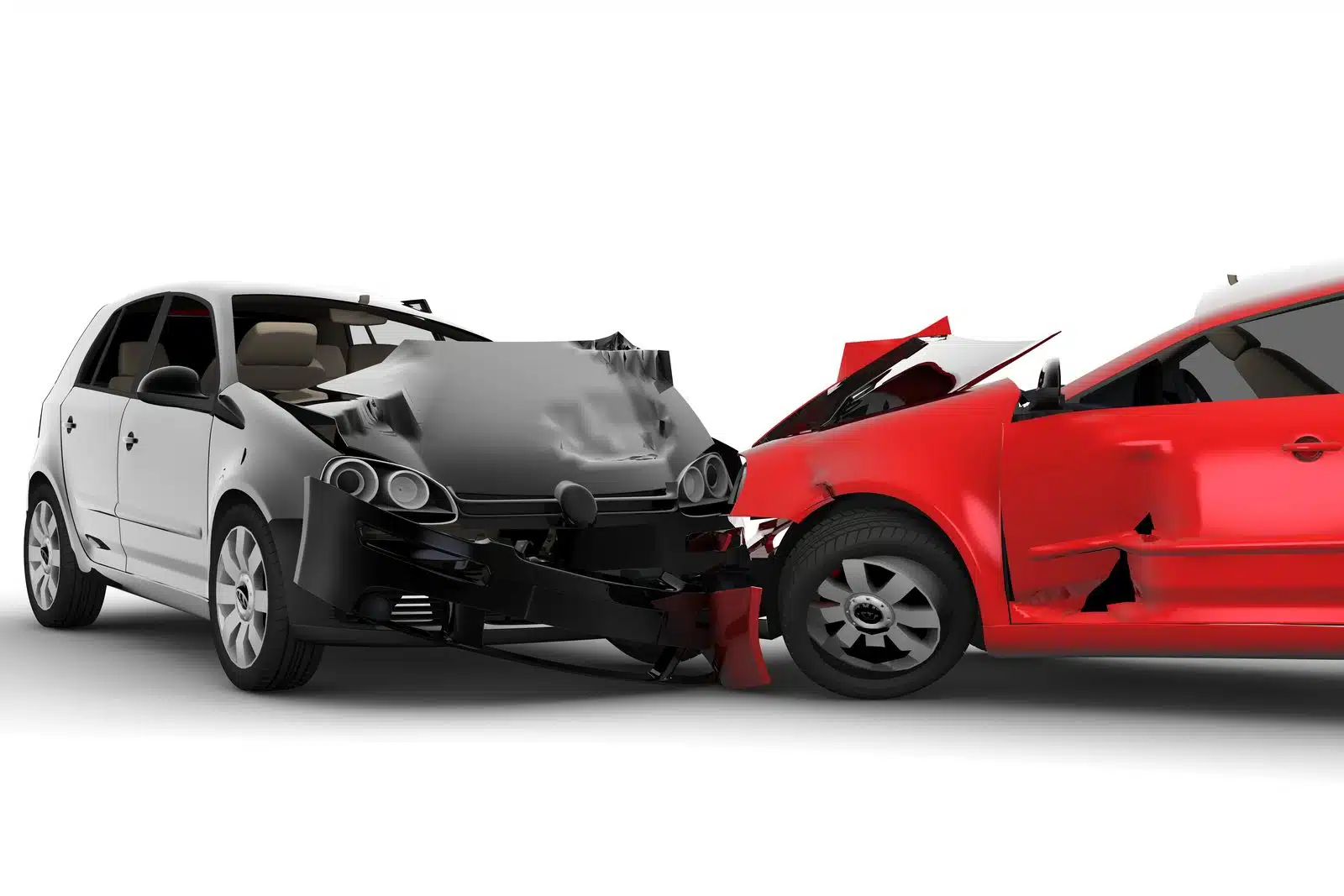
Quick answer: A head-on collision happens when the fronts of two vehicles strike each other — and because the speeds of both cars combine, it is the most violent and deadly type of crash on the road. These cases almost always turn on who crossed the center line, so the driver who caused the wreck (or their insurer) will often dispute fault. We move fast to lock down the evidence — black-box data, skid and gouge marks, dashcam footage, and accident reconstruction — and pursue every source of compensation, including punitive damages when a wrong-way or drunk driver is to blame. Deadlines run from one to three years depending on the state. Call 800-224-5546 for a free consultation — no fee unless you win.
Head-On Collision Claims at a Glance
| Question | Short answer |
|---|---|
| Why are head-on crashes worse than other wrecks? | Both vehicles’ speeds add together, so the force of impact is far higher. |
| What is the most common cause? | A driver crossing the center line — from impairment, fatigue, distraction, or unsafe passing. |
| What if I was partly at fault? | You can usually still recover; most states we serve reduce, not eliminate, your award. |
| Can I get punitive damages? | Often yes — when the at-fault driver was drunk, impaired, or driving the wrong way. |
| How long do I have to file? | 1–3 years depending on the state. Tennessee can be as short as one year. |
| What will a lawyer cost? | Nothing up front — contingency fee, paid only if you recover. |
Why Head-On Collisions Are the Deadliest Crashes on the Road
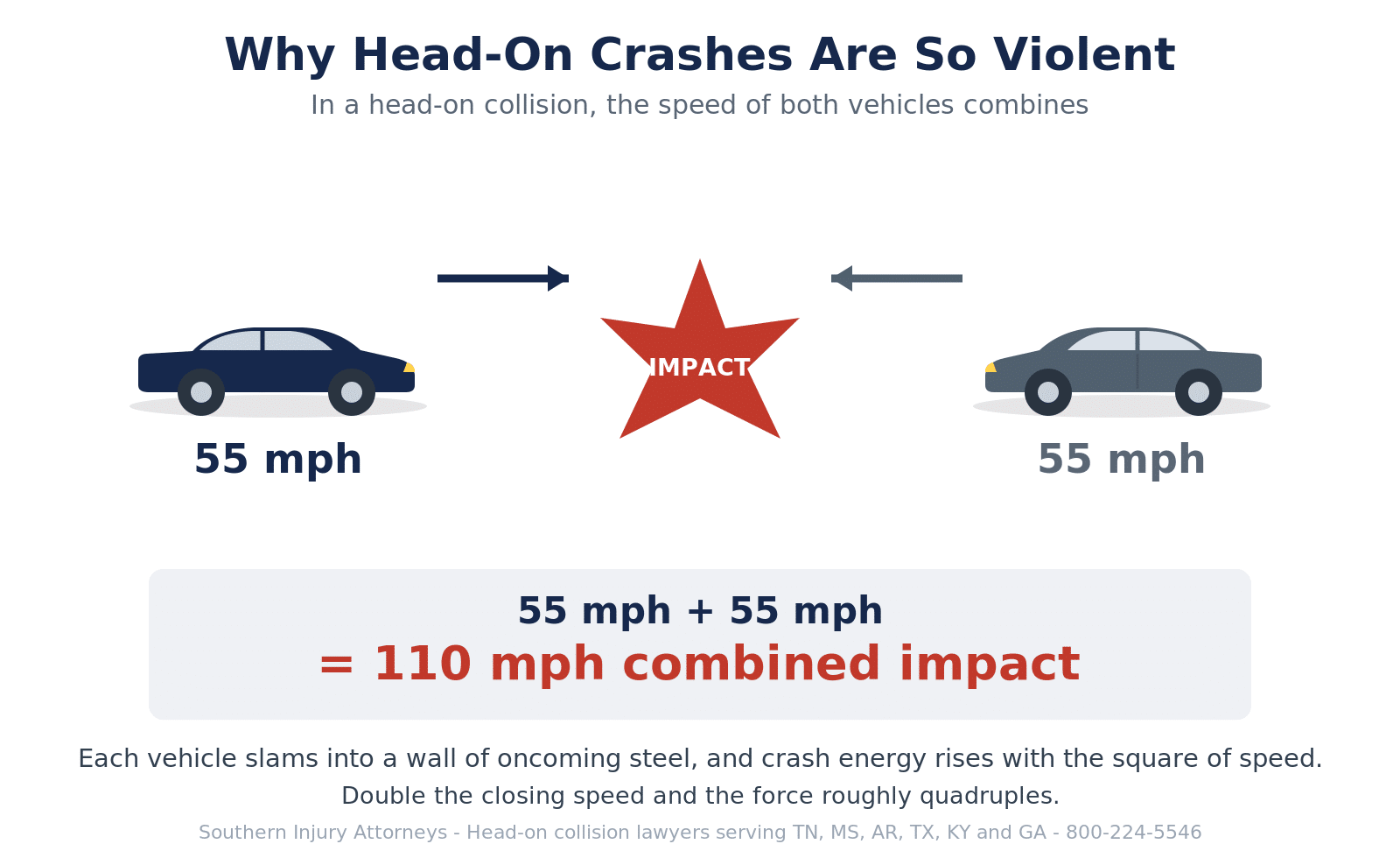
In a rear-end or sideswipe crash, the vehicles are usually moving in the same direction, so the difference in their speeds determines the force of the impact. A head-on collision is different — and far worse. When two vehicles strike front-to-front, their speeds combine. Two cars traveling 55 mph toward each other produce a closing speed of roughly 110 mph, and the energy a crash unleashes rises with the square of that speed. The result is catastrophic: the passenger compartment is crushed, occupants are thrown forward into a decelerating wall of steel, and survivable space disappears in a fraction of a second.
That physics is why frontal impacts dominate the fatality statistics. According to the Insurance Institute for Highway Safety, frontal impacts accounted for 60% of passenger-vehicle occupant deaths in 2023 — the largest share of any impact direction. Head-on crashes also concentrate on rural two-lane highways, where there is no median to separate opposing traffic; rural roads carry roughly 19 percent of the U.S. population but account for about 40 percent of all crash deaths, the majority on roads posted at 55 mph or higher.
Wrong-Way and Head-On Crash Statistics
Sources: AAA Foundation for Traffic Safety (2026), based on NHTSA FARS; IIHS Fatality Facts 2023.
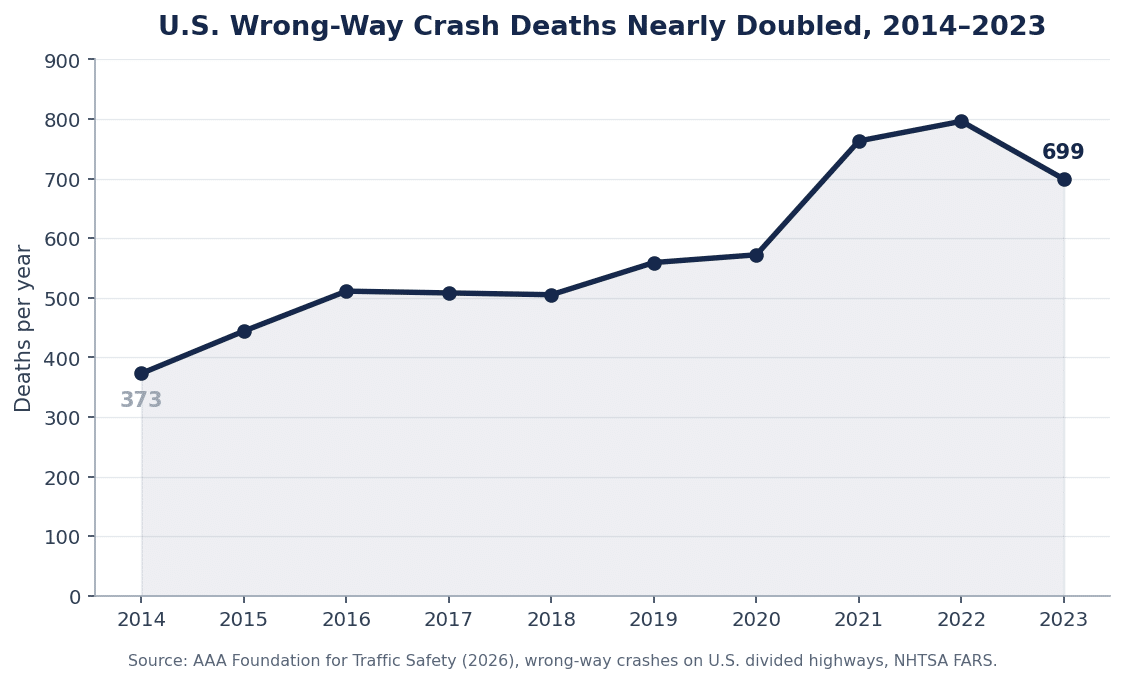
One of the deadliest forms of head-on collision is the wrong-way crash — a driver heading against traffic on a divided highway or an entrance ramp. A 2026 study by the AAA Foundation for Traffic Safety found that 4,164 fatal wrong-way crashes killed 5,730 people on U.S. divided highways between 2014 and 2023, and the annual death toll nearly doubled over that decade, from 373 in 2014 to 699 in 2023. The study’s most striking finding: about 70 percent of wrong-way drivers were alcohol-impaired, and a driver with a BAC above .12 had more than 80 times the odds of being the wrong-way driver. More than 80 percent of these crashes happened in the dark, and drivers age 70 and older were heavily over-represented.
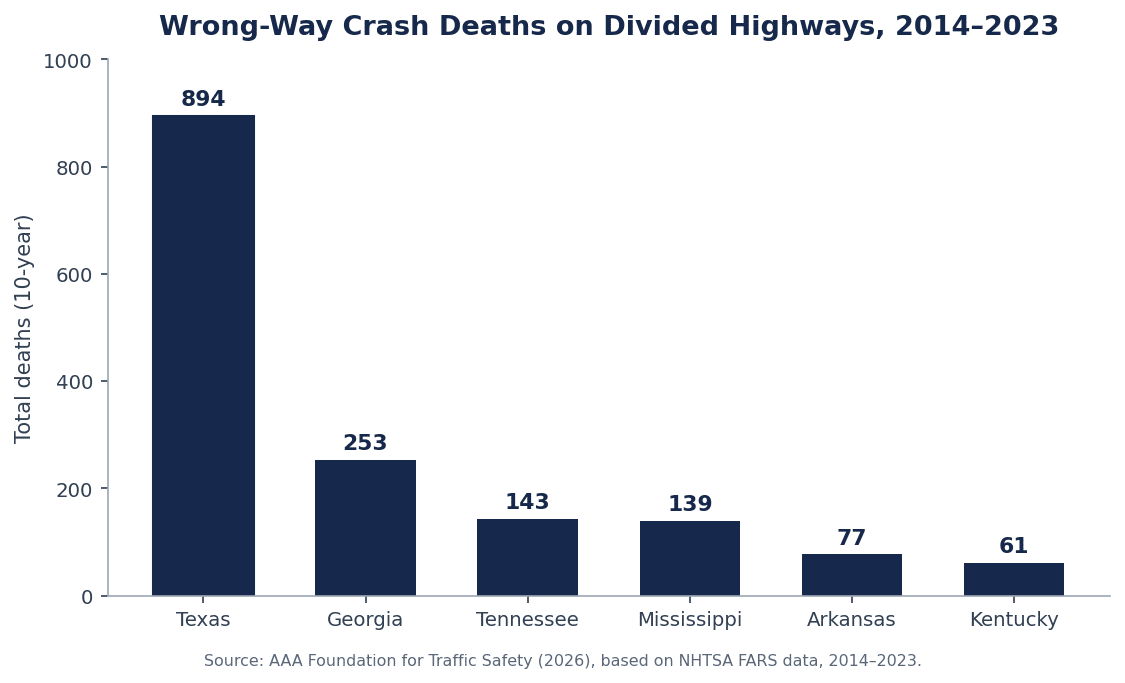
The toll falls heavily on the states we serve. Over the 2014–2023 period, Texas recorded 894 wrong-way crash deaths — more than any other state in the country — followed by Georgia (253), Tennessee (143), Mississippi (139), Arkansas (77), and Kentucky (61).
What Causes Head-On Collisions
Almost every head-on crash starts the same way: a vehicle leaves its proper lane and enters oncoming traffic. The reasons it happens are the heart of the liability case:
- Impaired driving. Alcohol and drugs slow reaction time and destroy lane control — the single biggest factor in wrong-way and center-line crashes. If a drunk driver hit you, see our DUI accident lawyer page; these cases often support punitive damages.
- Wrong-way driving. Entering a highway down an exit ramp or driving against a one-way flow, frequently at night and frequently impaired. If a wrong-way driver hit you, see our wrong-way accident lawyer page.
- Drowsy driving. A fatigued driver who drifts across the center line — common on long rural stretches and among overnight commercial drivers.
- Distraction. Texting, phone use, or looking away long enough for the car to wander into oncoming traffic.
- Unsafe passing. Pulling out to pass on a two-lane road without enough clear distance — a classic rural head-on scenario.
- Speeding and loss of control. Taking a curve too fast, hydroplaning, or overcorrecting across the center line.
Proving Who Crossed the Line
Head-on collision cases almost always come down to a single question: which driver crossed the center line? Because the at-fault driver and their insurer will often dispute that, the case is won or lost on physical evidence — and that evidence disappears fast. The vehicles’ event data recorders (“black boxes”), the skid and gouge marks on the pavement, debris-field patterns, dashcam and traffic-camera footage, and an accident-reconstruction analysis can establish point of impact and lane position with precision.
This is why early action matters so much in head-on cases. Skid marks fade, vehicles get repaired or scrapped (taking their black-box data with them), and surveillance footage is overwritten in days. We send evidence-preservation letters immediately, work to secure the vehicles before they are released, obtain the police crash report and any 911 and dispatch records, and bring in reconstruction and biomechanical experts when fault or injury causation is contested. Building that record early is what defeats a “your client crossed the line” defense.
Shared-Fault Laws in the States We Serve
Because head-on cases so often involve a fault dispute, the state’s comparative negligence rule can decide how much you recover — or whether you recover at all. The rules differ significantly across Tennessee, Mississippi, Arkansas, Texas, Kentucky, and Georgia:
| State | Rule | What it means for you |
|---|---|---|
| Tennessee | Modified — 50% bar (McIntyre v. Balentine, 833 S.W.2d 52 (Tenn. 1992)) | You can recover only if you are less than 50% at fault; your award is reduced by your share. |
| Mississippi | Pure comparative (Miss. Code § 11-7-15) | You can recover even if you are mostly at fault; the award is simply reduced by your percentage. |
| Arkansas | Modified — 50% bar (Ark. Code § 16-64-122) | Barred only if your fault is equal to or greater than the other driver’s; otherwise reduced by your share. |
| Texas | Modified — 51% bar (Tex. Civ. Prac. & Rem. Code § 33.001) | You can recover unless your responsibility is greater than 50%; you may still recover at exactly 50%. |
| Kentucky | Pure comparative (KRS § 411.182) | You can recover even if you are largely at fault; the award is reduced by your percentage. |
| Georgia | Modified — 50% bar (O.C.G.A. § 51-12-33) | You can recover only if you are less than 50% at fault; your award is reduced by your share. |
These rules are applied to the facts of each case. Because insurers use shared-fault arguments to cut payouts, how fault is investigated and presented can change your recovery dramatically.
What Compensation Can You Recover?
A head-on collision claim seeks the full range of damages, documented and aggressively pursued: all medical expenses, past and future, including surgery, rehabilitation, and long-term care; lost wages and lost earning capacity, which can be enormous after a disabling injury; pain, suffering, and emotional distress; property damage; and in fatal crashes, wrongful death damages for the family. When the at-fault driver was drunk, drugged, or driving the wrong way, the law in several of our states allows punitive damages on top of those amounts to punish that reckless conduct — which is why building the impairment evidence early can substantially increase the value of the case. And because head-on crashes are so often caused by impaired or uninsured drivers, we also pursue your own uninsured/underinsured motorist coverage when the at-fault driver can’t cover your losses.
The Catastrophic Injuries Head-On Crashes Cause
The extreme forces in a frontal impact produce some of the most severe injuries we see: traumatic brain injuries from the head striking the interior or from rapid deceleration; spinal cord injuries and paralysis; multiple fractures of the legs, hips, and pelvis as the lower body is driven into the dashboard and footwell; internal organ damage and internal bleeding; chest and rib trauma from the steering wheel, seatbelt, or airbag; and, tragically, fatal injuries. These are life-altering harms with lifetime costs, and valuing them correctly requires medical and economic experts who can project the full cost of future care, lost income, and diminished quality of life — not the lowball figure an insurer offers in the first weeks.
Filing Deadlines by State
Every state sets a strict deadline — the statute of limitations — to file an injury lawsuit. Miss it and your claim is gone, no matter how strong:
| State | Injury filing deadline |
|---|---|
| Tennessee | 1 year (T.C.A. § 28-3-104) |
| Mississippi | 3 years (Miss. Code § 15-1-49) |
| Arkansas | 3 years (Ark. Code § 16-56-105) |
| Texas | 2 years (Tex. Civ. Prac. & Rem. Code § 16.003) |
| Kentucky | 2 years from the crash or last PIP payment (KRS § 304.39-230) |
| Georgia | 2 years (O.C.G.A. § 9-3-33) |
Deadlines can be shorter or longer in specific situations (government defendants, minors, wrongful death). Talk to a lawyer promptly about your exact deadline.
What to Do After a Head-On Collision
- Call 911 and report the crash so officers document the scene and lane positions while the evidence is fresh.
- Get medical care immediately, even if you feel okay — frontal-impact injuries like internal bleeding and brain trauma are often masked by adrenaline.
- Photograph everything — both vehicles, their final resting positions, skid and gouge marks, debris, and the roadway and any signage.
- Get witness names and contacts, especially anyone who saw which car crossed the center line.
- Note conditions — weather, lighting, and whether the other driver appeared impaired or was going the wrong way.
- Request the crash report and, if there was an arrest, the criminal case number.
- Don’t give a recorded statement to the other driver’s insurer until you’ve spoken with a lawyer.
- Call a head-on collision lawyer quickly — black-box data, skid marks, and camera footage disappear fast, and in Tennessee your deadline can be as short as one year.
Our Results in Serious Auto Accident Cases
Every case is different, but our results reflect how hard we fight for crash victims:
- Six-figure recovery — Our client was stopped in traffic when an 18-wheeler failed to stop in time and rear-ended them.
- Six-figure settlement — An 18-wheeler pushed our client into a barrier wall, causing her injuries.
- $175,000 settlement — Our client’s Mercedes was rear-ended and caught fire; even with minimal medical treatment, we recovered $175,000.
Prior results do not guarantee a similar outcome. Every case depends on its own facts.
Why Choose Southern Injury Attorneys
We are a contingency-fee injury firm built for serious car accident and head-on collision cases, with attorneys licensed in Tennessee, Mississippi, Arkansas, Texas, Kentucky, and Georgia. Head-on cases are won on evidence and physics, so we move fast to preserve black-box data, skid and gouge marks, and camera footage, retain accident-reconstruction and medical experts, and build every case for trial — which is what produces fair settlements. You pay nothing unless we win. If your crash happened in Memphis, see our dedicated Memphis head-on collision attorneys page.
Headquarters: 5050 Poplar Ave, Ste 920, Memphis, TN 38157, with offices in Dallas, Houston, and Atlanta. Consultations are free and handled by phone anywhere we practice: 800-224-5546.
Head-On Collision FAQs
Why are head-on collisions so much more dangerous than other crashes?
Because the speeds of both vehicles combine. Two cars closing at 55 mph each create a roughly 110-mph impact, and crash energy rises with the square of speed. The passenger compartment takes the full force at once, which is why frontal impacts cause the largest share of passenger-vehicle occupant deaths.
How do you prove the other driver crossed the center line?
With physical evidence: event-data-recorder (“black box”) downloads, skid and gouge marks, the debris field, vehicle damage patterns, dashcam and traffic-camera footage, and accident reconstruction. We preserve that evidence quickly because it degrades or disappears within days.
What if the other driver says I crossed the line?
Fault disputes are common in head-on cases, which is exactly why reconstruction evidence matters. Point-of-impact analysis, gouge marks, and black-box speed and braking data can objectively show which vehicle left its lane, regardless of what the other driver claims.
Can I still recover if I was partly at fault?
Usually yes. Mississippi and Kentucky use pure comparative negligence, so you can recover even if you were mostly at fault, with the award reduced by your share. Tennessee, Arkansas, Texas, and Georgia allow recovery as long as your fault stays below the state’s bar (50% in most, with Texas barring recovery only above 50%).
Can I get punitive damages after a head-on crash?
Often, when the at-fault driver was drunk, drug-impaired, or driving the wrong way. That kind of conscious, reckless conduct is what punitive damages exist to punish. Georgia removes its punitive cap entirely for intoxicated drivers, and Tennessee’s cap does not apply when the defendant was impaired.
What is the average settlement for a head-on collision?
There is no fixed average. Value depends on injury severity, future medical and care costs, lost earning capacity, available insurance, and whether punitive damages apply. Head-on crashes tend to cause catastrophic injuries, so the stakes — and the potential value — are usually high.
What if the wrong-way or drunk driver had no insurance?
You can still recover. We pursue your own uninsured/underinsured motorist coverage, which exists for exactly this situation, plus any other liable parties such as an employer, vehicle owner, or a bar that over-served an impaired driver.
How long do I have to file a head-on collision lawsuit?
It depends on the state: one year in Tennessee, two years in Texas, Kentucky, and Georgia, and three years in Mississippi and Arkansas. Some situations shorten the deadline, so talk to a lawyer promptly so nothing lapses.
The insurance company already offered me money. Should I take it?
Not before a lawyer values your case. Early offers in head-on cases rarely account for future surgeries, long-term care, lost earning capacity, or the punitive value when impairment is involved. Once you accept, you usually cannot reopen the claim.
What does a head-on collision lawyer cost?
Nothing up front. We work on contingency — our fee comes out of the recovery, and you owe nothing unless we win. Consultations are free.
Talk to a Head-On Collision Lawyer — Free
A head-on crash you didn’t cause can change your life in an instant. Getting full compensation shouldn’t be a fight you take on alone. Get a free, no-obligation consultation with attorneys licensed in Tennessee, Mississippi, Arkansas, Texas, Kentucky, and Georgia. Call 800-224-5546 — no fee unless you win. You can also contact us online.
This page is general legal information, not legal advice. Every case is different and outcomes are never guaranteed. Contacting us does not create an attorney-client relationship.

