



Quick answer: A wrong-way crash is rare but among the deadliest crashes on the road — it is almost always caused by an impaired driver going the wrong way at night, and it usually ends in a high-speed head-on collision. Because so many of these crashes trace to drunk driving and to bad road design, you can often pursue more than one defendant: the impaired driver, frequently the bar or restaurant that over-served them (a dram-shop claim), and sometimes the government or contractor responsible for a confusing ramp, missing “WRONG WAY” signs, poor lighting, or a missing wrong-way detection system. Punitive damages may apply to the drunk driver, and because the wrong-way driver often dies in the crash, your own uninsured/underinsured motorist coverage matters too. Evidence and deadlines run fast — a claim against a road authority carries a much shorter notice deadline than the normal filing deadline. Call 800-224-5546 for a free consultation — no fee unless you win.
- Rare but catastrophic. Wrong-way crashes are a small fraction of crashes but among the deadliest — typically high-speed, head-on, and frequently fatal.
- Usually an impaired driver at night. Nearly 7 in 10 wrong-way drivers are over the legal alcohol limit, and about 81% of these crashes happen in the dark.
- The road authority can share the blame. Confusing ramps, missing or low signs, poor lighting, or a missing wrong-way detection system can create a government road-design claim.
- A dram-shop claim may apply. The bar or restaurant that over-served the wrong-way driver can be liable alongside the driver.
- The wrong-way driver often dies — so the other defendants and your own UM/UIM coverage can be what makes you whole.
Wrong-Way Crash Claims at a Glance
| Question | Short answer |
|---|---|
| How dangerous are wrong-way crashes? | Among the deadliest — rare, but typically high-speed head-on collisions that are frequently fatal. |
| What usually causes them? | An impaired driver going the wrong way at night — nearly 70% of wrong-way drivers are legally drunk. |
| Who can be liable? | The impaired driver, often the bar that over-served them, and sometimes the road authority for bad ramp design or missing signs. |
| Can I get punitive damages? | Often yes, because the driver was drunk — though the rules and caps vary by state. |
| What if the wrong-way driver died? | You pursue their estate/insurer and the other defendants, and your own UM/UIM coverage becomes important. |
| How long do I have to file? | 1–3 years depending on the state — but a road-authority claim has a much shorter notice deadline. Act now. |
Wrong-Way Crash Statistics
Source: AAA Foundation for Traffic Safety, Fatal Wrong-Way Crashes on Divided Highways 2014–2023 (March 2026), based on NHTSA FARS data.
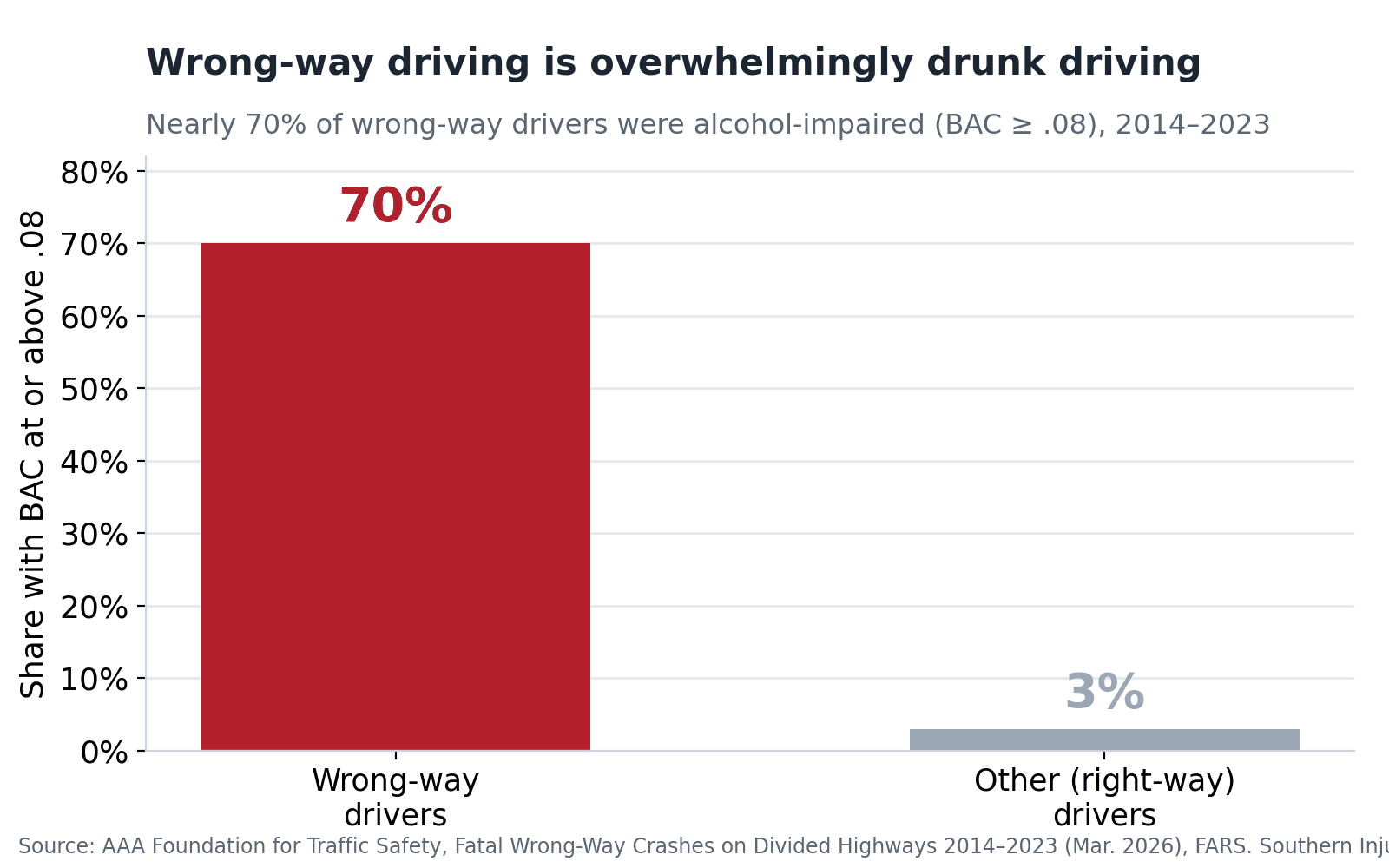
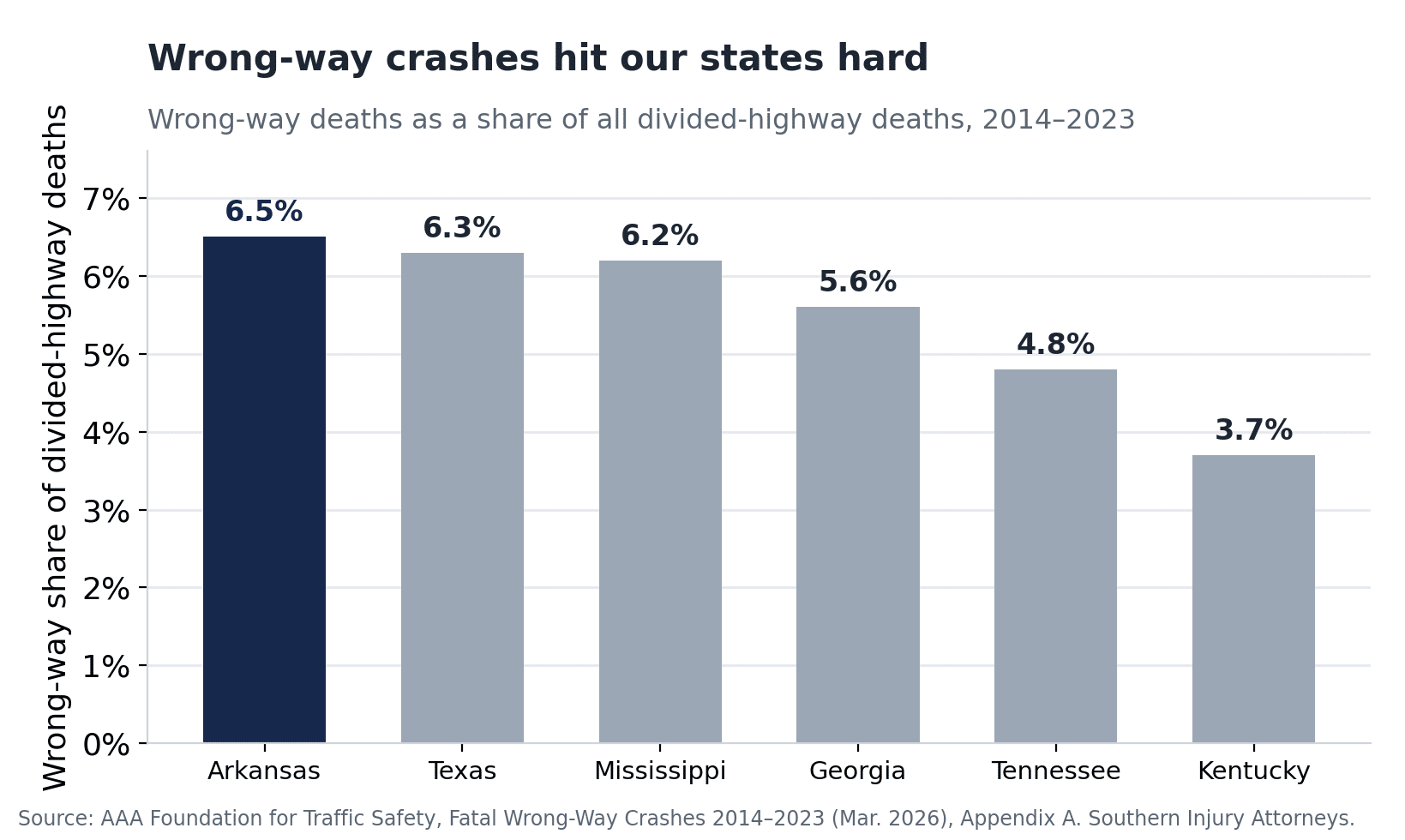
Wrong-way crashes are the rare crash that is defined less by how the vehicles met than by who was behind the wheel. From 2014 to 2023 there were 4,164 fatal wrong-way crashes on U.S. divided highways, killing 5,730 people. They remain a small share of all crashes — but they are growing fast, and they kill far out of proportion to how often they happen. What sets them apart is a single, stubborn fact: the driver going the wrong way is almost always impaired.
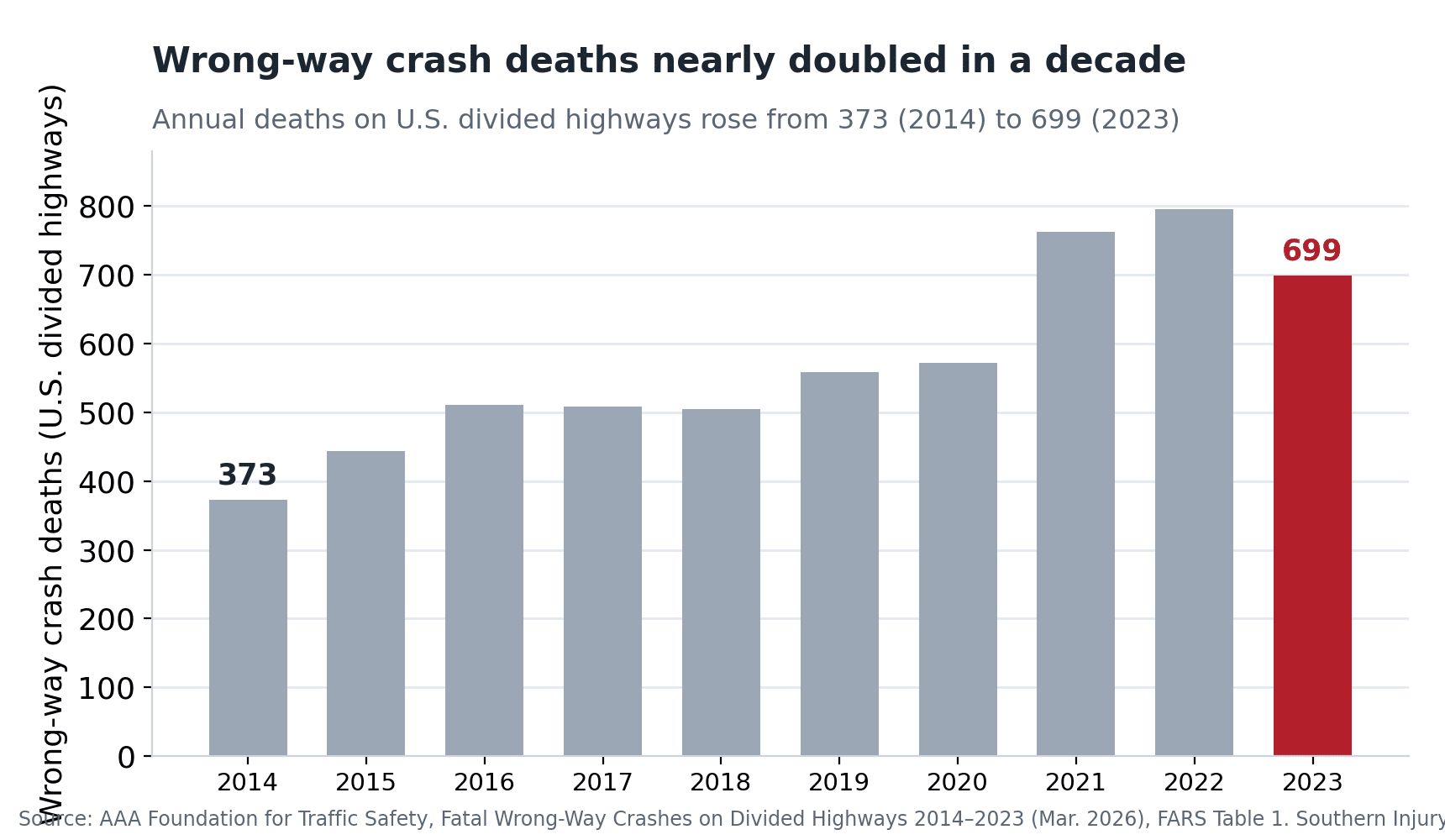
The trend is the other half of the story. Annual wrong-way deaths on divided highways nearly doubled in a decade — from 373 in 2014 to 699 in 2023, peaking at 796 in 2022. Total traffic deaths rose over the same period, but wrong-way deaths rose faster, climbing as a share of all highway fatalities. These are not freak accidents; they are a recognized and worsening safety failure.
Why Are Wrong-Way Crashes So Deadly?
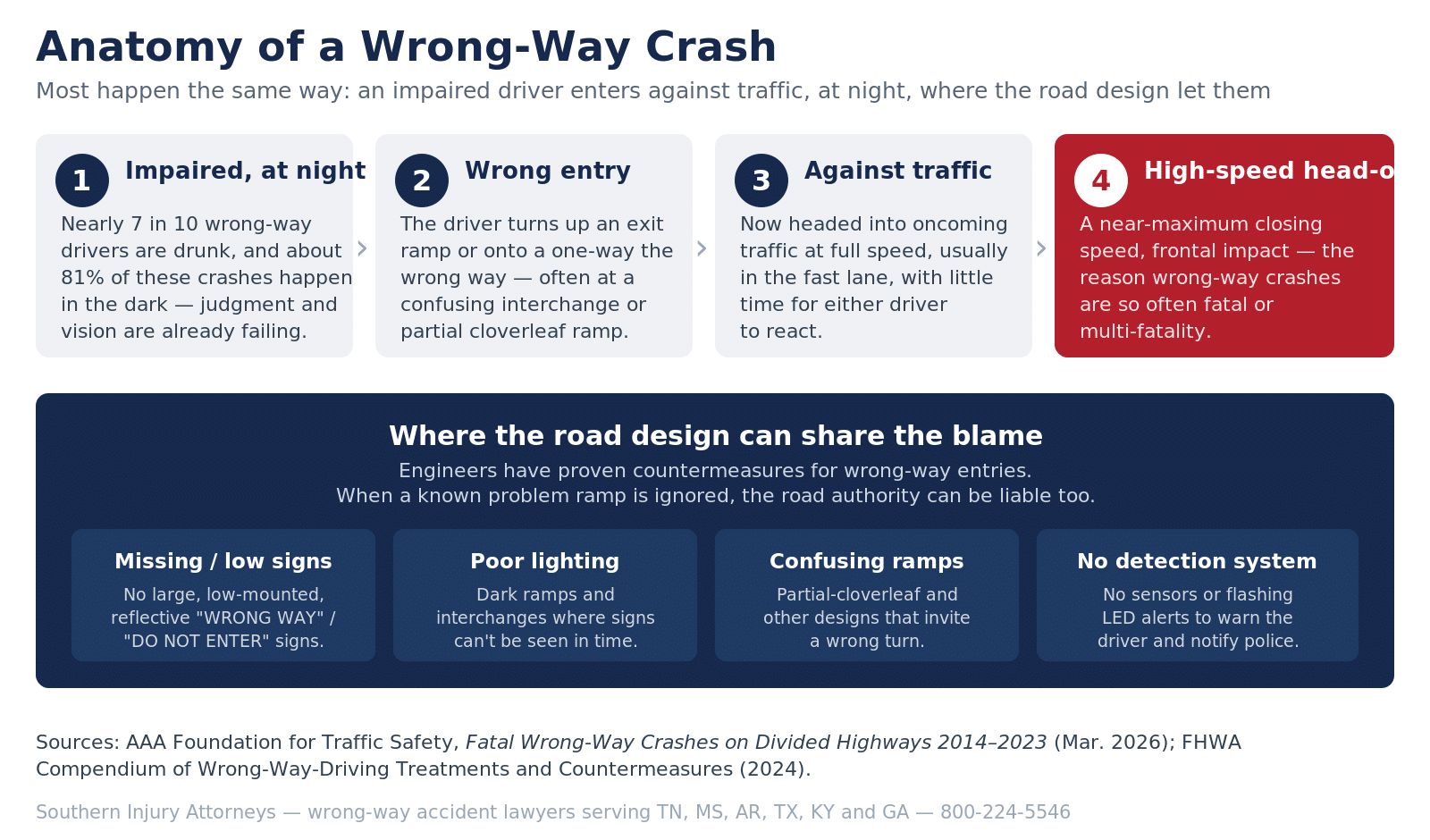
Wrong-way crashes are so deadly because they are almost always high-speed, head-on collisions — two vehicles meeting front-to-front, often in the fast lane, with little time for either driver to react. That combination produces a near-maximum impact, which is why a crash type that is statistically rare is so frequently fatal or multi-fatality.
The physics of the frontal impact — the closing speed of two vehicles, the forces on the people inside — is the same engine that drives any head-on collision case, and we cover that mechanism in detail on our head-on collision page. What makes a wrong-way crash its own kind of case is not the geometry of the impact but the scenario that created it: an impaired driver, in the dark, entering a highway against traffic where the road may have done too little to stop them. That scenario is what opens up the unusual set of defendants below.
Why Do Wrong-Way Crashes Happen?
Wrong-way crashes are remarkably consistent in how they unfold, and the research points to a handful of causes that appear again and again:
- Alcohol impairment — the leading cause by far. Nearly 70% of wrong-way drivers are legally drunk, and a driver with a BAC above .12 has more than 80 times the odds of being the wrong-way driver. An impaired driver misreads the ramp, the signs, and the direction of traffic.
- Darkness and low visibility. About 81% of wrong-way crashes happen in the dark, when “WRONG WAY” and “DO NOT ENTER” signs are hardest to see and easiest to drive past.
- Confusing ramps and interchanges. Wrong-way entries cluster at poorly designed exit ramps and certain interchange layouts — partial cloverleafs in particular — where it is easy to turn up an off-ramp.
- Older and medically impaired drivers. Drivers over 70 are sharply over-represented among wrong-way drivers, often because of confusion or diminished night vision.
- Unfamiliar drivers and fatigue. Drivers far from home, tired, or new to an area are more likely to enter in the wrong direction.
Who Is Liable for a Wrong-Way Crash?
Here is what surprises most wrong-way crash victims: this is usually not a case against a single negligent driver. Because a wrong-way crash so often combines drunk driving with a road that failed to stop it, you can frequently pursue several defendants — the impaired driver, the business that over-served them, and the government or contractor responsible for the road. Identifying every one of them is what turns a limited claim into a full recovery.
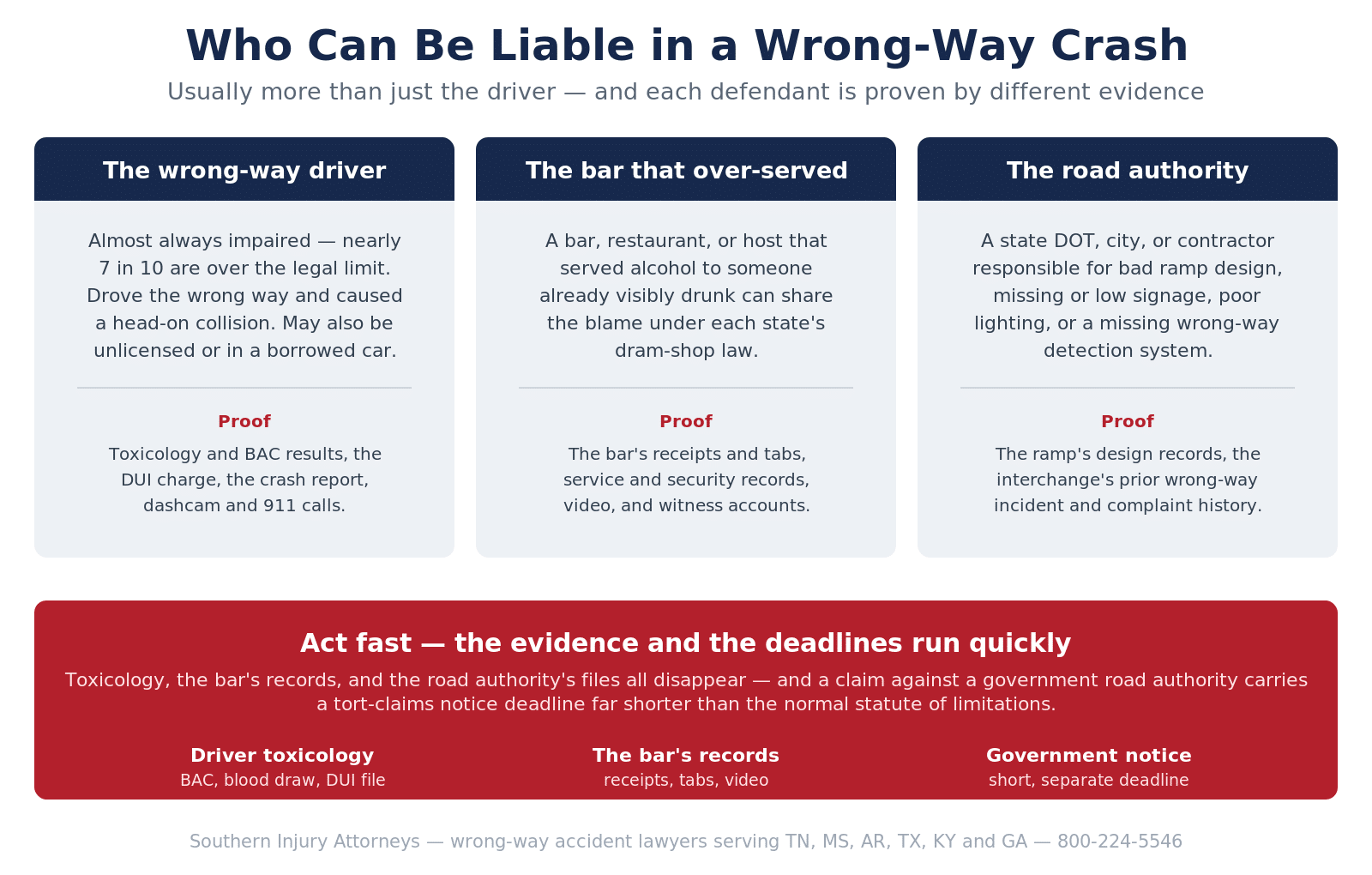
There are three main possibilities, and a strong case often involves more than one:
- The wrong-way driver — almost always impaired, and sometimes also unlicensed or driving a borrowed or stolen vehicle. This is proven with the driver’s toxicology and BAC results, the DUI charge, the crash report, dashcam, and 911 calls.
- The bar, restaurant, or host that over-served them — under each state’s dram-shop law, a business that serves alcohol to someone already visibly intoxicated can share responsibility for the harm that driver later causes. This is proven with the establishment’s receipts, tabs, service and security records, and video.
- The government entity or road contractor — when a confusing ramp, missing or poorly placed signs, inadequate lighting, or the failure to install an available wrong-way detection system contributed to the entry. This is proven with the ramp’s design records and the interchange’s prior wrong-way incident and complaint history.
What ties these together is evidence that disappears quickly — toxicology samples, a bar’s nightly records, and a road authority’s files are all time-sensitive, and a claim against a government road authority carries its own short deadline. That is why preserving the proof and identifying every defendant has to start immediately.
Wrong-Way Crashes and Drunk Driving
It is impossible to talk about wrong-way crashes without talking about alcohol. Because nearly 70% of wrong-way drivers are over the legal limit, a wrong-way case is, in practice, almost always a drunk-driving case — which changes both who you pursue and what you can recover. You pursue the impaired driver directly, and you frequently pursue the bar or restaurant that over-served them under the state’s dram-shop law. Every state we serve recognizes some form of dram-shop liability — Tennessee (§57-10-102), Mississippi (§67-3-73), Arkansas (§16-126-104), Texas (Alcoholic Beverage Code §2.02), Kentucky (§413.241), and Georgia (§51-1-40) — though the standards and deadlines differ, and Kentucky’s dram-shop claim in particular carries a tight one-year limit.
Drunk driving also opens the door to punitive damages — money meant to punish especially reckless conduct, on top of compensation for your injuries. The rules vary: Georgia does not cap punitive damages in DUI cases, Tennessee applies a statutory cap framework, and Texas caps these damages and does not treat intoxication offenses as the kind of felony that removes the cap. Because the overlap with DUI law is so central to these cases, see our dedicated DUI accident lawyer page for how we pursue the drunk driver and the bar behind them.
Can the Government Be Liable for Bad Ramp Design or Missing Signs?
Sometimes, yes — and this is the part of a wrong-way case most people never consider. When a road authority knew about a wrong-way problem at a ramp or interchange and failed to fix it, it can be a defendant alongside the drunk driver. Wrong-way driving is one of the most heavily studied roadway-safety problems in the country, and proven countermeasures exist — so a failure to use them can be negligence.
Federal and state engineers have developed a well-documented toolkit for preventing wrong-way entries. The Federal Highway Administration’s Compendium of Wrong-Way-Driving Treatments and Countermeasures and the National Academies’ Wrong-Way Driving Solutions Handbook describe measures such as larger, lowered, and more reflective “WRONG WAY” and “DO NOT ENTER” signs, better lighting, pavement arrows and directional rumble strips, and — most powerfully — active wrong-way detection systems: sensors paired with flashing LED or blank-out signs that alert the wrong-way driver, warn oncoming drivers, and notify a traffic-management center or police in real time. Many state transportation departments, including Texas, have piloted these systems and reported drivers self-correcting before a crash.
When a state DOT, city, or road contractor ignored a known wrong-way problem at a particular ramp — one with a documented history of wrong-way entries or complaints — that failure can support a road-design or road-defect claim. These claims are technical: they require the ramp’s design records, the interchange’s prior-incident history, and a roadway-engineering expert. They also carry a critical catch — a claim against a government entity triggers a tort-claims notice deadline that is far shorter than the normal statute of limitations, sometimes only a matter of months, and it varies by entity. Missing it can end the road-design claim before the case even begins, which is why a wrong-way crash needs a lawyer’s attention immediately.
Common Wrong-Way Crash Injuries
Because wrong-way crashes are high-speed frontal impacts, the injuries are among the most severe in all of auto-accident law: traumatic brain injuries, spinal cord injuries and paralysis, multiple broken bones, internal organ damage, severe chest and crush injuries from the steering column and dashboard, and, far too often, fatal injuries and wrongful death. These are catastrophic, life-changing injuries that frequently require surgery, long-term rehabilitation, and lifetime care. Valuing them correctly means accounting for the full future cost of medical care and lost earning capacity — which takes medical and economic experts, not the first number an insurer offers.
What If I Was Partly at Fault?
In most wrong-way crashes the victim bears little or no fault — you were driving correctly when a car came at you the wrong way — but insurers still try to assign you a share of the blame to cut what they pay. Every state we serve uses some form of comparative negligence, so even if some fault is argued, it usually reduces your recovery rather than eliminating it.
| State | Rule | What it means for you |
|---|---|---|
| Tennessee | Modified — 50% bar (McIntyre v. Balentine, 833 S.W.2d 52 (Tenn. 1992)) | You can recover only if you are less than 50% at fault; your award is reduced by your share. |
| Mississippi | Pure comparative (Miss. Code § 11-7-15) | You can recover even if you are mostly at fault; the award is reduced by your percentage. |
| Arkansas | Modified — 50% bar (Ark. Code § 16-64-122) | Barred only if your fault is equal to or greater than the other party’s; otherwise reduced by your share. |
| Texas | Modified — 51% bar (Tex. Civ. Prac. & Rem. Code § 33.001) | You can recover unless your responsibility is greater than 50%; you may still recover at exactly 50%. |
| Kentucky | Pure comparative (KRS § 411.182) | You can recover even if you are largely at fault; the award is reduced by your percentage. |
| Georgia | Modified — 50% bar (O.C.G.A. § 51-12-33) | You can recover only if you are less than 50% at fault; your award is reduced by your share. |
Because wrong-way victims are usually blameless, these arguments are mostly an insurer tactic — but how the case is investigated and presented still affects your recovery.
How Much Is a Wrong-Way Crash Case Worth?
There is no fixed average — wrong-way cases tend to run higher than ordinary crashes because the injuries are so often catastrophic, and because there is frequently more than one defendant and more than one insurance policy. The impaired driver, the bar that over-served them, and a government road authority can each contribute, which can multiply the available compensation. Punitive damages against the drunk driver can add to the recovery where state law allows. And because the wrong-way driver so often dies in the crash — or turns out to be uninsured or underinsured — your own uninsured/underinsured motorist coverage is frequently a key source of recovery, and in a fatal crash the family can pursue wrongful-death damages. Getting the value right means identifying every defendant and proving the full lifetime cost of the injuries.
What to Do After a Wrong-Way Crash
- Call 911 and get the crash report so officers document the scene, the vehicles’ positions, and what happened while it is fresh.
- Tell the police you believe the other driver was impaired or going the wrong way, so it is written into the report and the officer pursues testing.
- Get medical care immediately, even if you feel okay — brain and internal injuries from a high-speed frontal impact are often masked by adrenaline.
- Photograph everything — the vehicles and their final positions, the scene, and the ramp, signs, and lighting where the wrong-way driver entered.
- Identify witnesses and get their names and numbers, including anyone who saw the car traveling the wrong way.
- Note the exact interchange or ramp location — it may support a road-design claim against the road authority.
- Don’t give a recorded statement to any insurer until you have spoken with a lawyer.
- Call a wrong-way accident lawyer fast — toxicology results, the bar’s records, and the road authority’s notice deadline all run quickly.
Our Results in Serious Auto Accident Cases
Every case is different, but our results reflect how hard we fight for crash victims:
- Six-figure recovery — Our client was stopped in traffic when an 18-wheeler failed to stop in time and rear-ended them.
- Six-figure settlement — An 18-wheeler pushed our client into a barrier wall, causing her injuries.
- $175,000 settlement — Our client’s Mercedes was rear-ended and caught fire; even with minimal medical treatment, we recovered $175,000.
Prior results do not guarantee a similar outcome. Every case depends on its own facts.
Why Choose Southern Injury Attorneys
We are a contingency-fee injury firm built for serious car accident and wrong-way crash cases, with attorneys licensed in Tennessee, Mississippi, Arkansas, Texas, Kentucky, and Georgia. A wrong-way crash is rarely a simple insurance claim — it is usually a drunk-driving case with a possible road-design claim attached — so we move fast to secure the driver’s toxicology, the bar’s service records, and the road authority’s files before they disappear, and we identify every defendant who shares the blame. We also handle the related crashes these collisions involve, including head-on collisions and drunk-driving crashes. You pay nothing unless we win. If your crash happened in Memphis, see our dedicated Memphis wrong-way crash attorneys page.
Headquarters: 5050 Poplar Ave, Ste 920, Memphis, TN 38157, with offices in Dallas, Houston, and Atlanta. Consultations are free and handled by phone anywhere we practice: 800-224-5546.
Deadlines to File a Wrong-Way Crash Claim
The deadline to sue — the statute of limitations — depends on the state. But a wrong-way case can involve separate, much shorter deadlines for a government road-design claim and for a dram-shop claim, so it is critical to talk to a lawyer early.
| State | Injury filing deadline | Statute |
|---|---|---|
| Tennessee | 1 year | Tenn. Code § 28-3-104 |
| Mississippi | 3 years | Miss. Code § 15-1-49 |
| Arkansas | 3 years | Ark. Code § 16-56-105 |
| Texas | 2 years | Tex. Civ. Prac. & Rem. Code § 16.003 |
| Kentucky | 2 years | KRS § 304.39-230 |
| Georgia | 2 years | O.C.G.A. § 9-3-33 |
Two wrinkles make wrong-way deadlines especially dangerous. First, a claim against a government entity for a road-design defect triggers a tort-claims notice deadline that is far shorter than the statute of limitations — often just months, and it varies by the entity involved. Second, a dram-shop claim against the bar can carry its own shorter limit (Kentucky’s, for example, is one year). Miss any of these and that piece of the case is gone, so the safest move is to have a lawyer confirm every deadline that applies right away.
We serve crash victims throughout Tennessee, Mississippi, Arkansas, Texas, Kentucky, and Georgia.
Wrong-Way Crash FAQs
Why are wrong-way crashes so deadly?
Because they are almost always high-speed, head-on collisions. Two vehicles meet front-to-front, usually in the fast lane and often at night, leaving little time to react. That produces a near-maximum impact, which is why wrong-way crashes — though rare — are so frequently fatal or kill more than one person. The frontal-impact mechanics are the same as any head-on collision, but the wrong-way scenario makes them especially severe.
Are most wrong-way drivers drunk?
Yes. Nearly 70% of wrong-way drivers have a blood alcohol concentration at or above the legal limit of .08, and a driver with a BAC above .12 has more than 80 times the odds of being the wrong-way driver. About 81% of wrong-way crashes also happen in the dark. That is why a wrong-way case is, in practice, almost always a drunk-driving case — and often a dram-shop case against the bar that over-served the driver.
Can I sue the government for bad ramp design or missing signs?
Sometimes, yes. When a road authority knew about a wrong-way problem at a ramp or interchange and failed to use proven countermeasures — larger or lower “WRONG WAY” signs, better lighting, or an active wrong-way detection system — that failure can support a road-design claim against the state DOT, city, or contractor. These claims require the ramp’s design records and prior-incident history, and they carry a very short government notice deadline, so they must be investigated immediately.
Can I sue the bar that over-served the wrong-way driver?
Often yes. Every state we serve recognizes some form of dram-shop liability, which can hold a bar, restaurant, or host responsible for serving alcohol to someone already visibly intoxicated who then causes a crash. Proving it takes the establishment’s receipts, tabs, service records, and video, gathered quickly before they are gone. Dram-shop deadlines can be shorter than the normal filing deadline — Kentucky’s is one year.
What if the wrong-way driver died in the crash?
You can still recover. More than half of the people killed in wrong-way crashes are the wrong-way drivers themselves, so the claim often shifts to the driver’s estate and their insurance policy. Just as important, the other defendants — a bar that over-served them or a road authority — may still be liable, and your own uninsured/underinsured motorist coverage can pay when the driver’s policy is too small or nonexistent.
Can I get punitive damages?
Often, because the driver was drunk. Punitive damages punish especially reckless conduct, and impaired wrong-way driving frequently qualifies. The rules vary: Georgia does not cap punitive damages in DUI cases, Tennessee applies a statutory cap framework, and Texas caps these damages and does not treat intoxication offenses as exempt from the cap. A lawyer can tell you whether punitive damages are realistic in your state and on your facts.
What if the wrong-way driver was uninsured or had little insurance?
This is common, because wrong-way drivers are often impaired, unlicensed, or driving someone else’s car — and many die in the crash. Your own uninsured/underinsured motorist (UM/UIM) coverage is built for exactly this situation and can pay your damages when the at-fault driver cannot. Because a wrong-way crash often also involves a bar or a road authority, there may be additional defendants to pursue as well.
What if I was partly at fault?
Most wrong-way victims bear little or no fault — you were driving correctly when another car came at you the wrong way. Even if an insurer argues you share some blame, every state we serve uses comparative negligence, so it generally reduces your recovery rather than eliminating it. Don’t accept an insurer’s fault argument at face value.
How long do I have to file a wrong-way crash claim?
The injury deadline depends on the state: one year in Tennessee, two years in Texas, Kentucky, and Georgia, and three years in Mississippi and Arkansas. But a claim against a government road authority carries a much shorter notice deadline — sometimes only months — and a dram-shop claim can have its own shorter limit. Because several clocks may be running at once, talk to a lawyer right away.
How much is a wrong-way crash case worth?
There is no fixed average, but these cases often carry higher value because the injuries are severe and there are frequently multiple defendants and policies — the impaired driver, the bar that over-served them, a road authority, and your own underinsured-motorist coverage. Punitive damages against the drunk driver can add to it. Value turns on injury severity, the full cost of future care and lost earnings, and how many sources of recovery your lawyer can identify.
Should I talk to the insurance company?
Not before talking to a lawyer. Insurers use recorded statements to get you to guess about speed, position, or fault, then use your words to reduce or deny the claim. In a wrong-way case with several possible defendants, an early statement can do real damage. You are generally not required to give the other side’s insurer a recorded statement — let your lawyer handle communications.
How much does a wrong-way accident lawyer cost?
Nothing up front. We work on contingency — our fee comes out of the recovery, and you owe nothing unless we win. That matters in wrong-way cases, where securing toxicology, a bar’s records, and a road authority’s files quickly takes resources most people don’t have. Consultations are always free.
Talk to a Wrong-Way Accident Lawyer — Free
If you or someone you love was hurt by a wrong-way driver, the most important steps — securing the toxicology, the bar’s records, and the road authority’s files, and meeting the short government deadline — have to happen now. Get a free, no-obligation consultation with attorneys licensed in Tennessee, Mississippi, Arkansas, Texas, Kentucky, and Georgia. Call 800-224-5546 — no fee unless you win. You can also contact us online.
This page is general legal information, not legal advice. Every case is different and outcomes are never guaranteed. Contacting us does not create an attorney-client relationship.

