


Losing someone you love to another person’s carelessness is a kind of pain no family should have to carry. If that has happened to you, please accept our sincere condolences — and know that you have rights, and time to consider them.
Quick answer: A wrongful death claim lets a family seek justice and compensation when someone is killed by another’s negligence, in any kind of accident. Who can file is set by each state’s law — often the estate’s personal representative and close family such as a spouse, children, or parents. A wrongful death case can include both the family’s own losses and the estate’s survival claim for what your loved one endured before death. Deadlines can run from the date of death, and they vary by state. Speaking with a lawyer costs nothing, the conversation is confidential, and you pay no fee unless we recover for you. When you’re ready, call 800-224-5546.
- A wrongful death claim is a statutory right belonging to close family members and the deceased person’s estate — created by each state’s law.
- There are often two separate claims: the family’s wrongful death claim and the estate’s survival action, and they recover different things.
- Recoverable losses can include financial support, companionship and guidance, funeral and burial costs, and the pain and suffering your loved one experienced before death.
- Who can sue and how long you have vary by state, and the deadline can run from the date of death — sometimes as little as one year.
- Consultations are free and confidential, with no fee unless we recover compensation for your family.
Wrongful Death Claims at a Glance
| Question | Short answer |
|---|---|
| What is a wrongful death claim? | A statutory claim that lets a family seek compensation when negligence causes a death — in any kind of accident. |
| Who can file it? | Set by each state’s law — usually the estate’s personal representative and/or close family (spouse, children, parents). |
| Is there more than one claim? | Often two: the family’s wrongful death claim and the estate’s survival action, which recover different things. |
| What can a family recover? | Lost support, companionship and guidance, funeral and medical costs, and the decedent’s pre-death suffering. |
| How long do we have? | 1 to 3 years depending on the state; the clock often starts on the date of death. Confirm yours early. |
| What does a lawyer cost? | Nothing up front — consultations are free and confidential, and the fee comes only from a recovery. |
Below, we explain — gently and plainly — what a wrongful death claim is, who can bring it, what it can recover, and the deadlines in each state we serve. There is no pressure here. Our goal is simply to help you understand your family’s rights so you can decide what feels right for you.
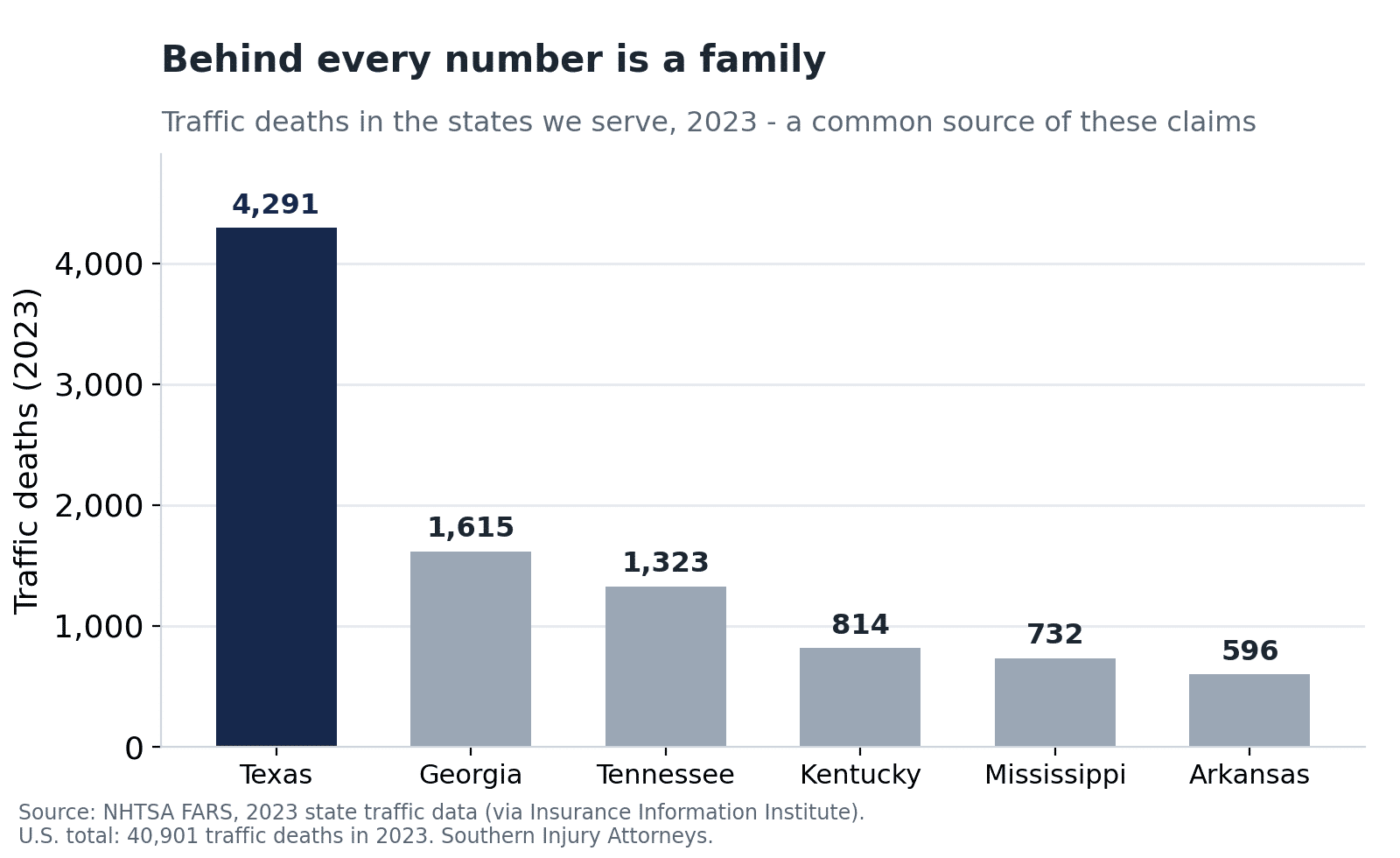
Every one of those numbers was a person, and behind each is a family that had to begin again. Fatal accidents most often come from the ordinary risks of the road and of daily life, which is why a wrongful death claim can follow almost any kind of negligence — not a single “type” of crash.
What Is a Wrongful Death Claim?
A wrongful death claim is a legal claim that arises when a person is killed by someone else’s negligence or wrongful act. Unlike an injury you recover from, the person who was harmed is no longer here to bring a case — so the law gives that right to their family and their estate instead. It is created entirely by statute, which means each state writes its own rules about who may sue, what can be recovered, and how long there is to act.
Because it is defined by the harm — a death caused by negligence — and not by how the death happened, a wrongful death claim can follow a car or truck crash, a fall, a defective product, an act of violence, or any other situation where someone failed to use reasonable care. What makes these cases distinct is not the accident; it is the law that governs who can stand in for the person who died. That is also where grieving families are most often tripped up, so it is worth understanding before anything else.
What Is the Difference Between a Wrongful Death Claim and a Survival Action?
After a death, the law usually recognizes two separate claims, and they compensate two different kinds of loss. The wrongful death claim belongs to the family and addresses their loss — the support, companionship, and guidance they no longer have. The survival action belongs to the estate and addresses what your loved one personally endured between the injury and death. Most states allow both, and they are handled differently.
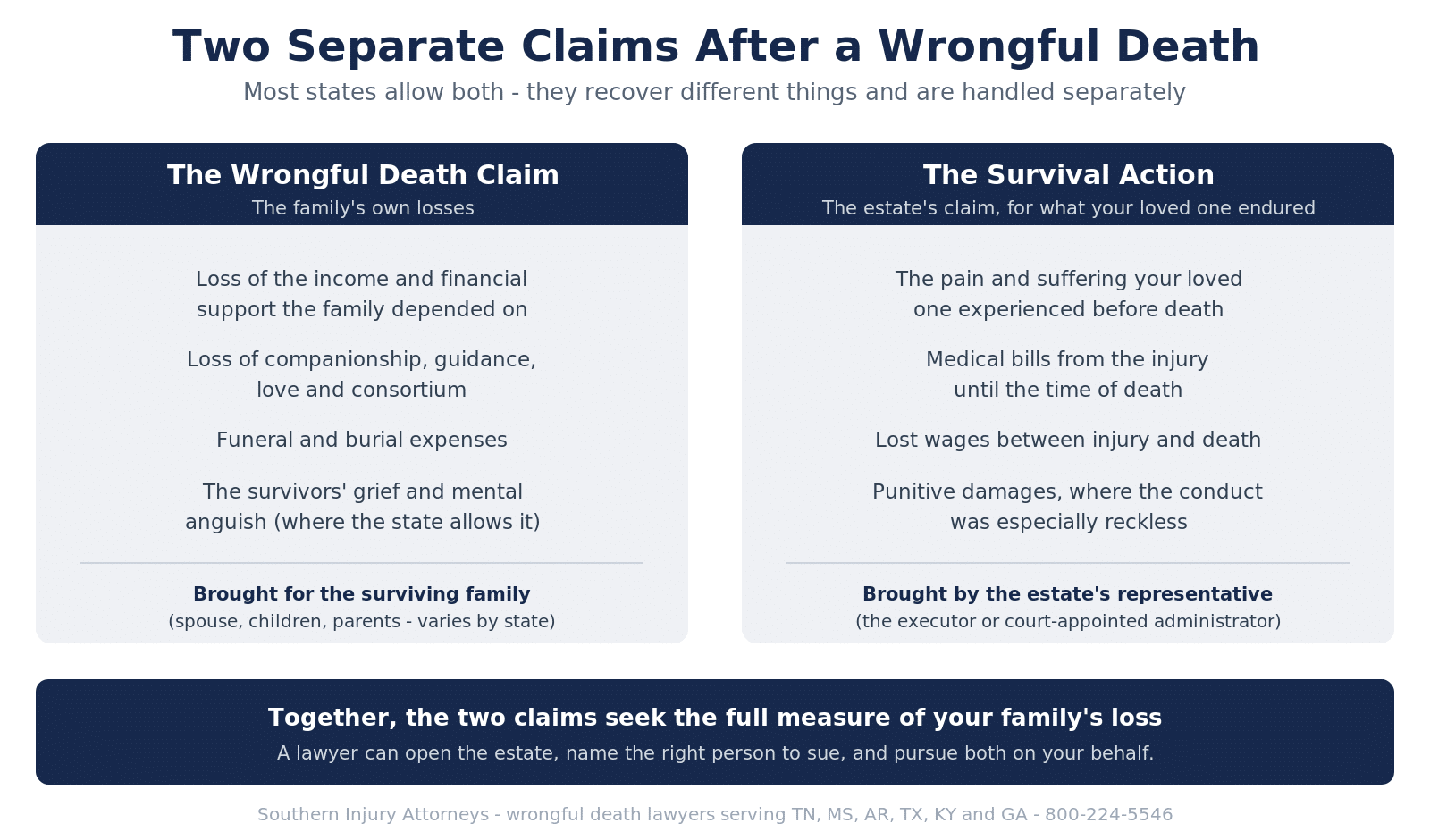
In practical terms, the wrongful death claim seeks the family’s losses: the income and financial support the household depended on, the loss of the person’s companionship, love, and guidance, funeral and burial expenses, and — in states that allow it — the survivors’ grief and mental anguish. The survival action seeks what the decedent’s own legal claim would have recovered had they lived: the pain and suffering they experienced before death, their medical bills, and their lost wages from the injury until death. Pursued together, the two claims seek the full measure of a family’s loss. A lawyer can open the estate, identify the right person to bring each claim, and advance them on your behalf so you don’t have to navigate the paperwork while you grieve.
Who Can File a Wrongful Death Lawsuit?
Who is allowed to bring a wrongful death claim is decided by statute, and it varies from state to state. In most states the claim is brought by the personal representative of the estate (an executor named in a will, or an administrator the court appoints) and/or by specific surviving family members — typically in a defined order that begins with a spouse, then children, then parents or other close kin. Families are often surprised to learn that an estate may need to be opened and the right person formally designated before a lawsuit can be filed.
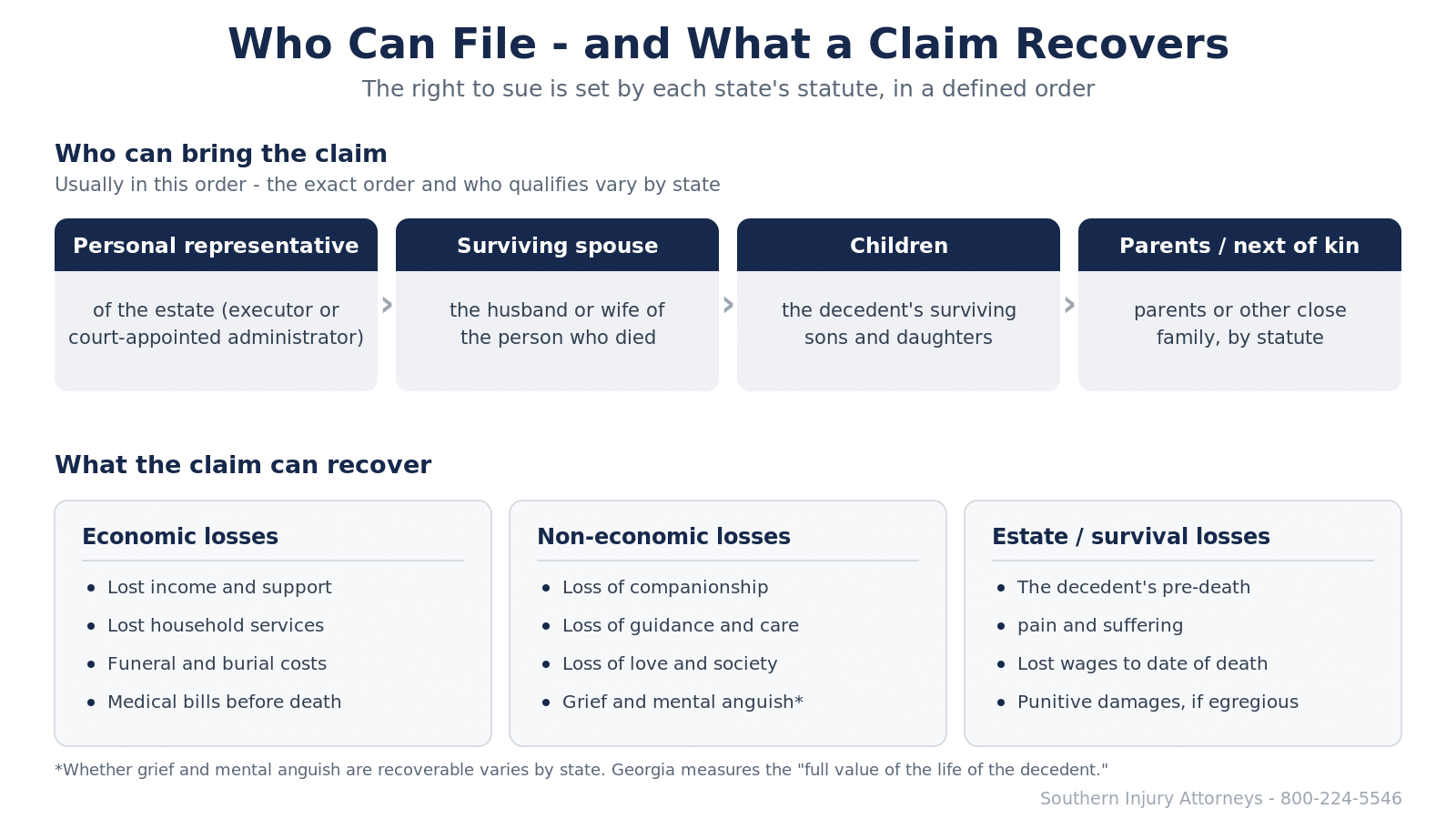
The differences are real. Texas, for example, limits the wrongful death claim to a surviving spouse, children, and parents only. Kentucky requires the claim to be brought by the estate’s personal representative, with the recovery distributed to family by statute. Mississippi allows a single combined action by a broad group of “interested parties.” If you are not sure who in your family is entitled to file, that is one of the first things a lawyer can sort out for you — usually at no cost and with no obligation.
What Compensation Can a Family Recover?
A wrongful death case can seek several categories of compensation, falling into three groups:
- Economic losses — the financial support and income the family has lost, the value of services the person provided (childcare, home maintenance, and the like), and funeral, burial, and medical expenses.
- Non-economic losses — the loss of the person’s companionship, love, society, care, and guidance, and, where the state allows it, the survivors’ grief and mental anguish.
- The estate’s survival losses — the pain and suffering the decedent experienced before death, their medical bills, and their lost wages from injury to death.
Some states measure these losses in their own way. Georgia is notable: it lets the family recover the “full value of the life of the decedent” — measured from the perspective of the person who died, with no deduction for what their own living expenses would have been — alongside a separate estate claim for funeral, medical, and pre-death pain and suffering. Where a death resulted from especially reckless or egregious conduct, punitive damages may also be available, though the rules differ by state (in Georgia, for instance, punitive damages are pursued through the estate’s claim rather than the wrongful death claim). Valuing a life is never truly possible, but the law’s aim is to ease the financial weight a family should never have had to bear — and doing it carefully often takes the help of an economist and other experts.
Wrongful Death Laws in the States We Serve
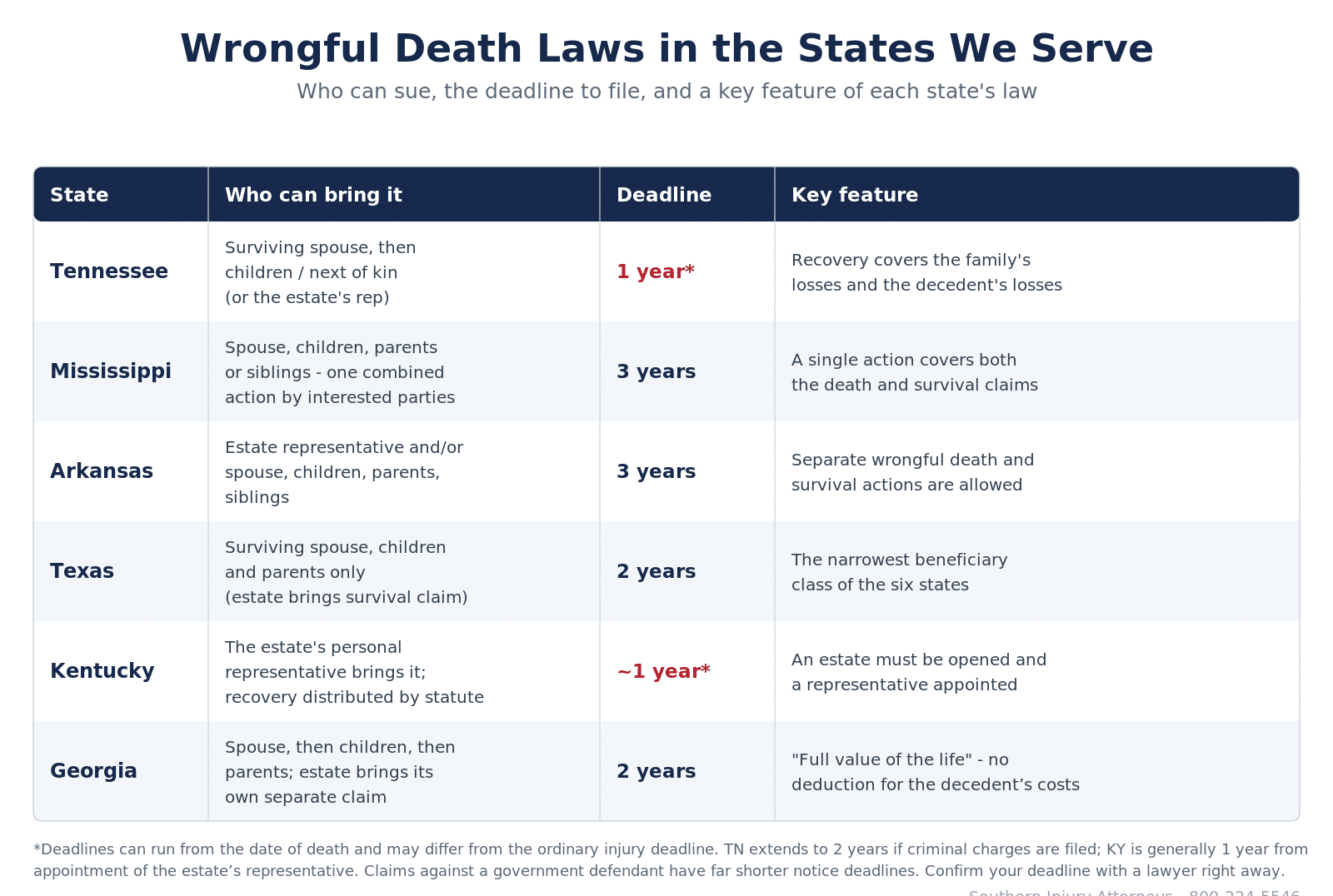
The heart of a wrongful death case is the statute that governs it. Below is a plain-language comparison of who may bring the claim, the deadline to file, and a key feature of each state’s law across Tennessee, Mississippi, Arkansas, Texas, Kentucky, and Georgia. These rules are technical and change with the facts, so please treat this as a starting point and confirm the details with a lawyer.
| State | Who may bring the claim | Deadline to file | Key feature |
|---|---|---|---|
| Tennessee | Surviving spouse, then children / next of kin, or the estate’s representative (Tenn. Code § 20-5-106) | 1 year* | Recovery covers the family’s losses and the decedent’s own losses (§ 20-5-113) |
| Mississippi | Spouse, children, parents, or siblings — one combined action by interested parties (Miss. Code § 11-7-13) | 3 years | A single action covers both the death and survival claims |
| Arkansas | The estate’s representative and/or spouse, children, parents, siblings (Ark. Code § 16-62-102) | 3 years | Separate wrongful death and survival (§ 16-62-101) claims |
| Texas | Surviving spouse, children, and parents only; the estate brings the survival claim (Tex. CPRC §§ 71.004, 71.021) | 2 years | The narrowest beneficiary class of the six states |
| Kentucky | The estate’s personal representative; recovery distributed to family by statute (KRS § 411.130) | ~1 year* | An estate must be opened and a representative appointed |
| Georgia | Surviving spouse, then children, then parents; the estate brings its own claim (O.C.G.A. §§ 51-4-1, 51-4-2) | 2 years | “Full value of the life” — no deduction for the decedent’s own expenses |
*Deadlines can run from the date of death and may differ from the ordinary injury deadline. Tennessee’s one-year limit can extend to two years if criminal charges are filed; Kentucky’s is generally one year from appointment of the estate’s representative (and the representative must be appointed within one year of death). Claims against a government defendant carry far shorter notice deadlines. A lawyer should confirm the exact deadlines that apply to your family.
What Kinds of Accidents Lead to Wrongful Death Claims?
Because a wrongful death claim follows from negligence rather than a particular kind of accident, it can arise from nearly any fatal incident. The most common we help families with include:
- Car and auto accidents — see our car accident lawyer page.
- Truck and 18-wheeler crashes — our truck accident lawyer team handles these federally regulated cases.
- Rollover crashes, which are often defect or crashworthiness cases.
- Head-on collisions — see head-on collision lawyer.
- Rear-end collisions — see rear-end collision lawyer.
- Intersection and T-bone crashes — see intersection accident lawyer.
- Pedestrians struck by vehicles — see pedestrian accident lawyer.
- Drunk and impaired driving crashes — see DUI accident lawyer.
- Distracted and texting-while-driving crashes — see texting and driving accident lawyer.
- Rideshare (Uber and Lyft) crashes — see Uber and Lyft accident lawyer.
- Van and passenger-van crashes — see van accident lawyer.
When the person responsible had little or no insurance, a family’s recovery may also come from the victim’s own uninsured and underinsured motorist coverage. Whatever the cause, the path forward is the same: understand who may file, identify every source of compensation, and act within the deadline.
How Long Do We Have to File a Wrongful Death Claim?
The deadline — the statute of limitations — depends on the state, and for a wrongful death claim it often runs from the date of death rather than the date of the original injury. That can make it different from an ordinary personal-injury deadline, which is one reason it is easy to miss. Most families have time, but it is worth confirming early so the deadline is never a worry.
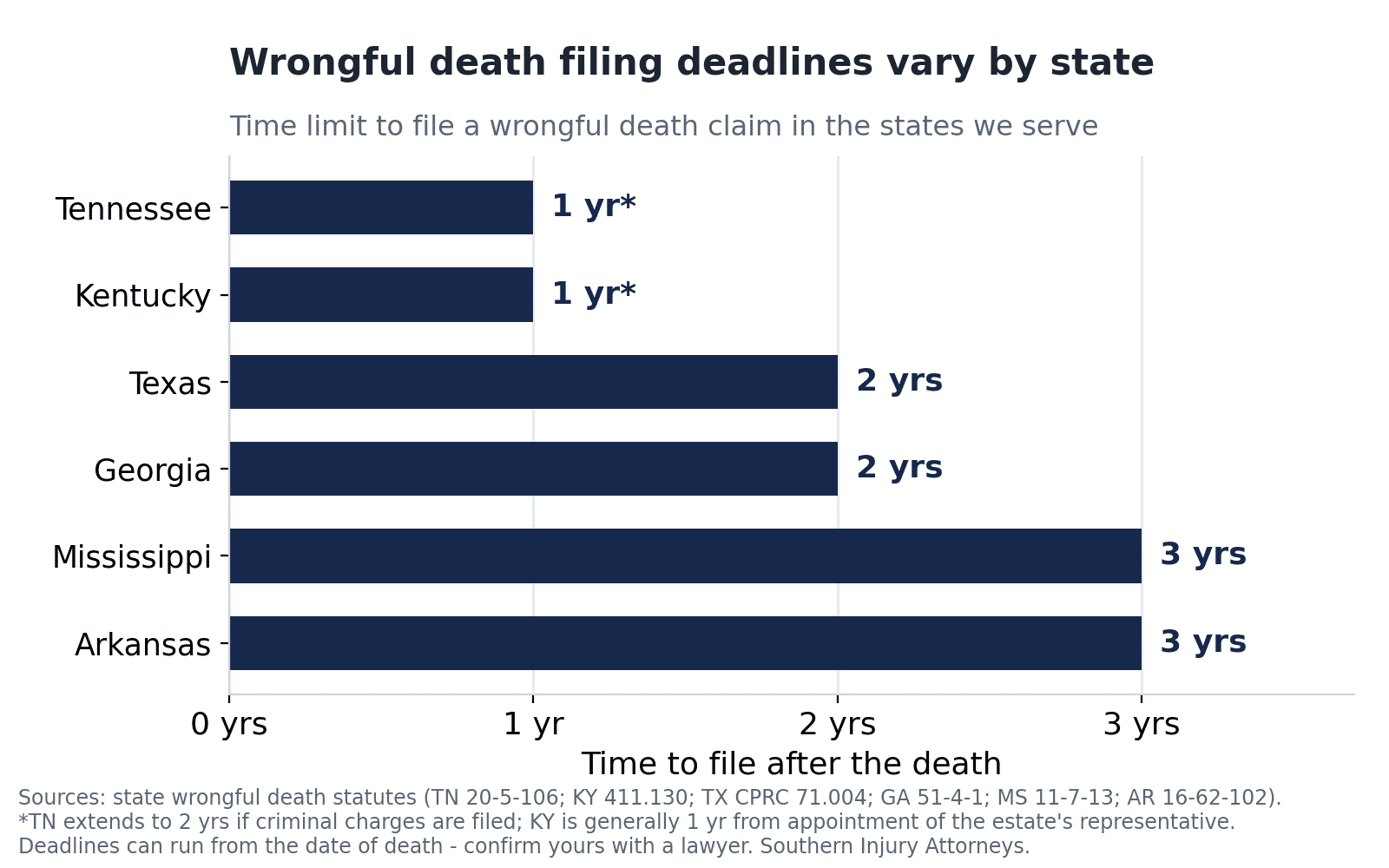
| State | Wrongful death filing deadline | Statute |
|---|---|---|
| Tennessee | 1 year (up to 2 if criminal charges are filed) | Tenn. Code §§ 20-5-106, 28-3-104 |
| Mississippi | 3 years | Miss. Code §§ 11-7-13, 15-1-49 |
| Arkansas | 3 years | Ark. Code § 16-62-102 |
| Texas | 2 years (from the date of death) | Tex. Civ. Prac. & Rem. Code §§ 71.004, 16.003 |
| Kentucky | ~1 year from appointment of the estate’s representative | KRS §§ 411.130, 413.180 |
| Georgia | 2 years | O.C.G.A. §§ 51-4-1, 9-3-33 |
A few deadlines deserve special care. Tennessee’s can be as short as one year. Kentucky’s is tied to when the estate’s personal representative is appointed, so opening the estate promptly matters. And if a government entity may be responsible — a public vehicle, a dangerous road, a public hospital — the notice deadline is usually much shorter, sometimes only a matter of months. These are technical rules, and a brief conversation with a lawyer can confirm exactly how they apply to your family.
How Is a Wrongful Death Case Valued?
No amount can measure the value of a life, and we never pretend otherwise. What the law can do is account for a family’s real, provable losses — both economic (the lost income and support, the value of the services the person provided, funeral and medical costs) and non-economic (the loss of companionship, guidance, and care). Establishing the economic side often involves an economist, who projects the support and earnings the family lost over the years to come.
Value also depends on how many sources of recovery exist. A fatal accident can involve more than one at-fault party and more than one insurance policy — for example a negligent driver and the company that employed them, or a vehicle or product manufacturer. When the person responsible was uninsured or underinsured, the family’s own uninsured/underinsured motorist coverage may provide another source. Identifying every responsible party and every available policy is one of the most important things a lawyer does — and it is often what stands between a quick, low insurance offer and a recovery that truly reflects the loss.
What to Do After a Fatal Accident
In the days after a loss, almost nothing about a legal claim needs to happen immediately. The steps below are offered gently, for whenever you feel ready — and a lawyer can take most of them off your plate entirely.
- Take care of yourself and your family first. Lean on the people around you and give yourself room to grieve — everything here can wait until you are ready.
- Obtain the death certificate and any autopsy or police report. These records document what happened and are often needed before a claim can move forward.
- Preserve evidence where you can — the vehicle, the scene, and anything else connected to what happened — so it is still available if it is needed later.
- Keep records of medical and funeral expenses. Save bills, receipts, and statements in one place; these are recoverable costs.
- Speak with a lawyer about opening the estate and naming the personal representative, since in many states this must happen before a claim can be filed.
- Avoid signing anything or accepting an insurer’s early offer before getting advice. Early offers are often far below what a claim is worth, and signing can give up rights.
What If Our Loved One Was Partly at Fault?
A family can usually still recover even if their loved one shared some of the blame. Every state we serve uses some form of comparative negligence, which generally reduces a recovery in proportion to the person’s share of fault rather than barring it outright. Insurers sometimes raise fault to lower what they pay, so how a case is investigated and presented can make a real difference.
| State | Rule | What it means for your family |
|---|---|---|
| Tennessee | Modified — 50% bar (McIntyre v. Balentine, 833 S.W.2d 52 (Tenn. 1992)) | Recovery is possible if your loved one was less than 50% at fault; the award is reduced by their share. |
| Mississippi | Pure comparative (Miss. Code § 11-7-15) | Recovery is possible even with a large share of fault; the award is reduced by that percentage. |
| Arkansas | Modified — 50% bar (Ark. Code § 16-64-122) | Barred only if their fault was equal to or greater than the other party’s; otherwise reduced by their share. |
| Texas | Modified — 51% bar (Tex. Civ. Prac. & Rem. Code § 33.001) | Recovery is possible unless their responsibility was greater than 50%; recovery is allowed at exactly 50%. |
| Kentucky | Pure comparative (KRS § 411.182) | Recovery is possible even with a large share of fault; the award is reduced by that percentage. |
| Georgia | Modified — 50% bar (O.C.G.A. § 51-12-33) | Recovery is possible if your loved one was less than 50% at fault; the award is reduced by their share. |
How shared fault affects a wrongful death recovery depends on the state and the facts. If an insurer is blaming your loved one, that is a reason to talk with a lawyer — not a reason to give up.
Our Results in Serious Accident Cases
Every family and every case is different, but our results reflect how hard we work for the people we represent:
- Six-figure recovery — Our client was stopped in traffic when an 18-wheeler failed to stop in time and rear-ended them.
- Six-figure settlement — An 18-wheeler pushed our client into a barrier wall, causing her injuries.
- $175,000 settlement — Our client’s Mercedes was rear-ended and caught fire; even with minimal medical treatment, we recovered $175,000.
Prior results do not guarantee a similar outcome. Every case depends on its own facts.
Why Families Choose Southern Injury Attorneys
We are a contingency-fee injury firm with attorneys licensed in Tennessee, Mississippi, Arkansas, Texas, Kentucky, and Georgia, and we handle wrongful death cases with the care these matters deserve. We can open the estate, identify who is entitled to file, pursue both the wrongful death and survival claims, work with economists and other experts to value the loss fully, and deal with the insurers — so your family can focus on each other. We also handle the underlying accidents, including car accidents, truck accidents, and drunk-driving crashes. Consultations are free and confidential, and there is no fee unless we recover for you. If your loss happened in Memphis, you can also visit our dedicated Memphis wrongful death attorneys page.
Headquarters: 5865 Ridgeway Center Pkwy, Suite 390, Memphis, TN 38120, with offices in Dallas, Houston, and Atlanta. Consultations are free and can be handled entirely by phone anywhere we practice: 800-224-5546. We serve families throughout Tennessee, Mississippi, Arkansas, Texas, Kentucky, and Georgia.
Wrongful Death FAQs
Who can file a wrongful death claim?
It depends on the state, because the right is created by statute. In most states the claim is brought by the personal representative of the estate (an executor or court-appointed administrator) and/or by close family members in a defined order — typically a surviving spouse first, then children, then parents or other next of kin. Texas limits it to a spouse, children, and parents; Kentucky requires the estate’s personal representative to bring it. A lawyer can tell you quickly who in your family is entitled to file.
What is the difference between a wrongful death claim and a survival action?
They are two separate claims that recover different things. The wrongful death claim belongs to the family and compensates their losses — lost support, companionship, guidance, and funeral expenses. The survival action belongs to the estate and compensates what your loved one personally endured before death, such as their pre-death pain and suffering, medical bills, and lost wages. Most states allow both, and they are pursued together.
What compensation can a family recover in a wrongful death case?
A family can seek economic losses (lost income and support, the value of services the person provided, and funeral and medical costs), non-economic losses (loss of companionship, guidance, love, and society, and mental anguish where allowed), and the estate’s survival damages (the decedent’s pre-death pain and suffering and lost wages). Georgia uniquely allows recovery of the “full value of the life of the decedent.” Punitive damages may be available where the conduct was especially egregious.
How long do we have to file a wrongful death claim?
The deadline depends on the state and often runs from the date of death: one year in Tennessee (up to two if criminal charges are filed), about one year from appointment of the estate’s representative in Kentucky, two years in Texas and Georgia, and three years in Mississippi and Arkansas. Claims involving a government entity carry much shorter notice deadlines. Because these rules are easy to miss, it is best to confirm your deadline with a lawyer early.
Do we need to open an estate or be named personal representative?
Often, yes. Many states require an estate to be opened and a personal representative (an executor or court-appointed administrator) to be designated before a wrongful death or survival claim can be filed — Kentucky requires it, and the survival claim is generally brought by the estate in every state. A lawyer can handle opening the estate and getting the right person appointed, so this does not have to fall on you during a difficult time.
Who receives the money from a wrongful death settlement?
The recovery is distributed to the surviving family members the statute identifies, usually in a defined order and proportion. In Georgia, for example, a surviving spouse shares with the children but can never receive less than one-third. Survival-action damages, by contrast, belong to the estate and pass according to the will or the state’s intestacy law. The exact distribution depends on the state and the family, and a court often approves it.
Can we recover punitive damages in a wrongful death case?
Sometimes. Punitive damages are meant to punish especially reckless or intentional conduct — for example a drunk driver — and whether they are available, and how they are capped, varies by state. In Georgia, punitive damages are pursued through the estate’s survival claim rather than the wrongful death claim. They are never automatic, but where the conduct was egregious they can be an important part of the case. A lawyer can tell you whether your circumstances may support them.
What if our loved one was partly at fault?
Your family can usually still recover. Every state we serve uses comparative negligence, which generally reduces a recovery by the person’s share of fault rather than eliminating it. Mississippi and Kentucky follow a “pure” rule; Tennessee, Arkansas, and Georgia bar recovery only if the person was 50% or more at fault; Texas bars it only above 50%. If an insurer is blaming your loved one, that is a reason to speak with a lawyer rather than to give up.
What if the at-fault driver had no insurance?
Your family may still have a source of recovery. The victim’s own uninsured/underinsured motorist coverage is designed for exactly this situation, including hit-and-run crashes, and it can apply even though the at-fault driver cannot pay. There may also be additional responsible parties — an employer, a vehicle or product maker, or a property owner. Identifying every available policy is one of the first things a lawyer will do.
How much is a wrongful death case worth?
There is no fixed average, because value depends on the family’s provable losses — the lost financial support and services, funeral and medical costs, and the loss of companionship and guidance — as well as the decedent’s pre-death suffering and how many sources of recovery exist. Establishing the economic losses often involves an economist. The honest answer is that value is determined case by case, and a lawyer can give you a realistic assessment after reviewing the facts.
How long does a wrongful death case take?
It varies. Some cases resolve through a settlement in a matter of months once the estate is opened and the losses are documented; others, especially those that must be litigated against a well-funded defendant, can take a year or more. Opening the estate, gathering records, and valuing the loss carefully all take time. A lawyer can give you a clearer timeline once they understand the circumstances of your case.
How much does a wrongful death lawyer cost?
Nothing up front. We handle wrongful death cases on a contingency fee, which means our fee comes only from a recovery — if there is no recovery, you owe no attorney’s fee. The initial consultation is always free and completely confidential, so there is no cost or obligation to simply ask questions and understand your family’s options.
Talk to a Wrongful Death Lawyer — Free and Confidential
If you have lost someone you love because of another’s negligence, you don’t have to figure any of this out alone. Whenever you feel ready, we’re here for a free, confidential conversation — no pressure, no obligation, and no fee unless we recover for your family. Our attorneys are licensed in Tennessee, Mississippi, Arkansas, Texas, Kentucky, and Georgia. Call 800-224-5546 or reach out online when the time is right for you.
This page is general legal information, not legal advice. Every case is different and outcomes are never guaranteed. Contacting us does not create an attorney-client relationship.

