


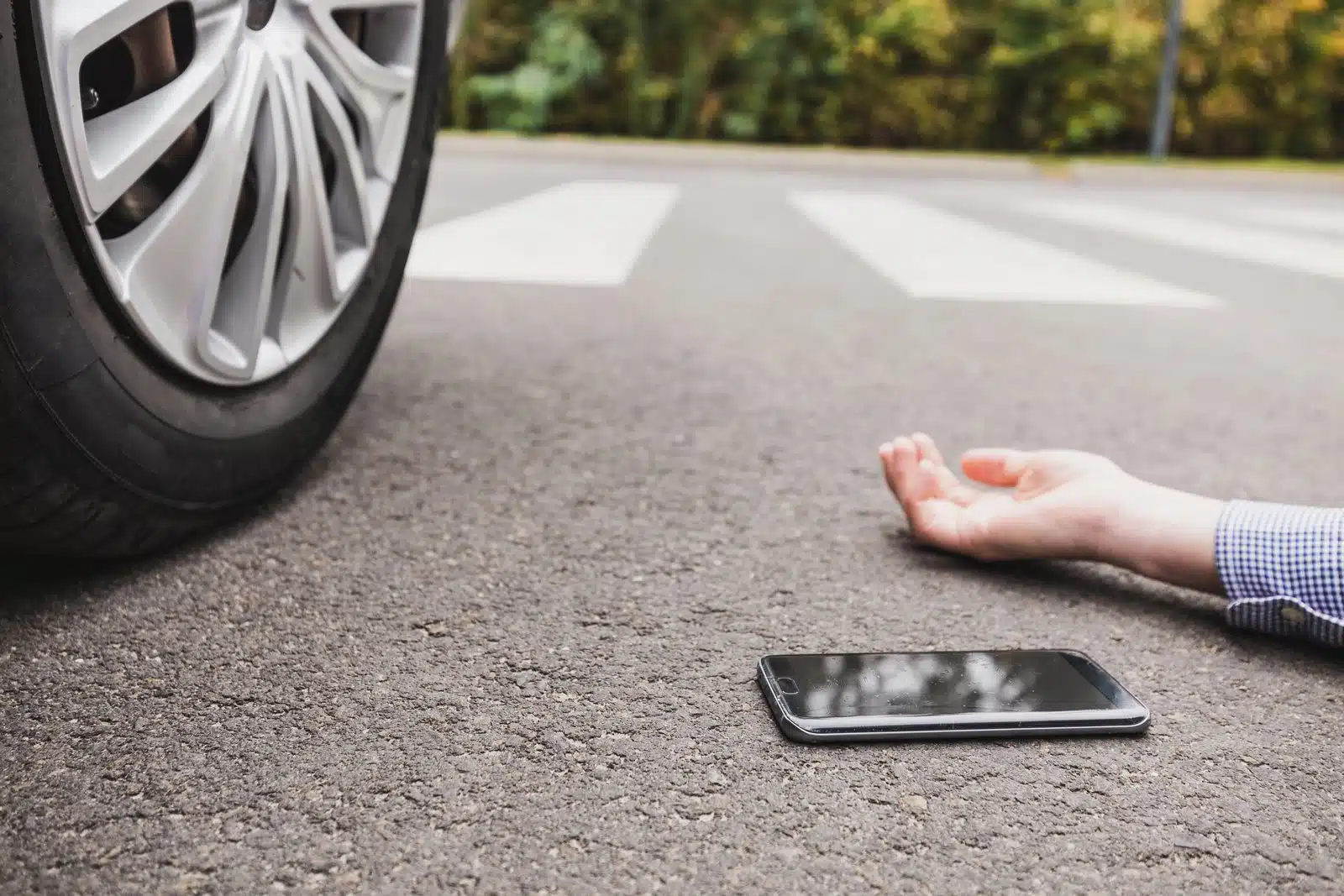
Quick answer: If you were hit by a car while walking, you can almost always pursue compensation from the driver who struck you — and in most of the states we serve, you can still recover even if you were partly at fault, such as crossing outside a crosswalk. Pedestrian cases turn on fast-disappearing evidence, so get medical care immediately and let a lawyer lock down the signal timing, surveillance and dashcam footage, vehicle “black-box” data, and witness accounts before they’re gone. If the driver fled or was uninsured, your own auto policy’s uninsured-motorist coverage can still pay. Deadlines run from one to three years depending on the state. Call 800-224-5546 for a free consultation — no fee unless you win.
Pedestrian Accidents at a Glance
| Question | Short answer |
|---|---|
| Can I sue if I was hit while walking? | Yes — the driver who struck you is usually liable for your medical bills, lost income, and pain. |
| What if I was crossing outside a crosswalk? | You can usually still recover; most states we serve reduce, not eliminate, your award. |
| What if the driver fled the scene? | Your own uninsured-motorist coverage can pay even in a hit-and-run. |
| How dangerous is being hit? | At just 40 mph a struck pedestrian has roughly a 1-in-2 chance of dying. |
| How long do I have to file? | 1–3 years depending on the state. Tennessee can be as short as one year. |
| What will a lawyer cost? | Nothing up front — contingency fee, paid only if you recover. |
Why Pedestrian Accidents Are So Deadly
A pedestrian accident lawyer sees the same brutal physics in case after case: a person on foot has no crumple zone, no airbag, and no seatbelt — nothing but their body absorbs the impact of a vehicle that can weigh two tons or more. That is why being hit by a car while walking is so much more likely to be fatal than a collision between two vehicles, and why pedestrians make up a share of traffic deaths far larger than their share of the road.
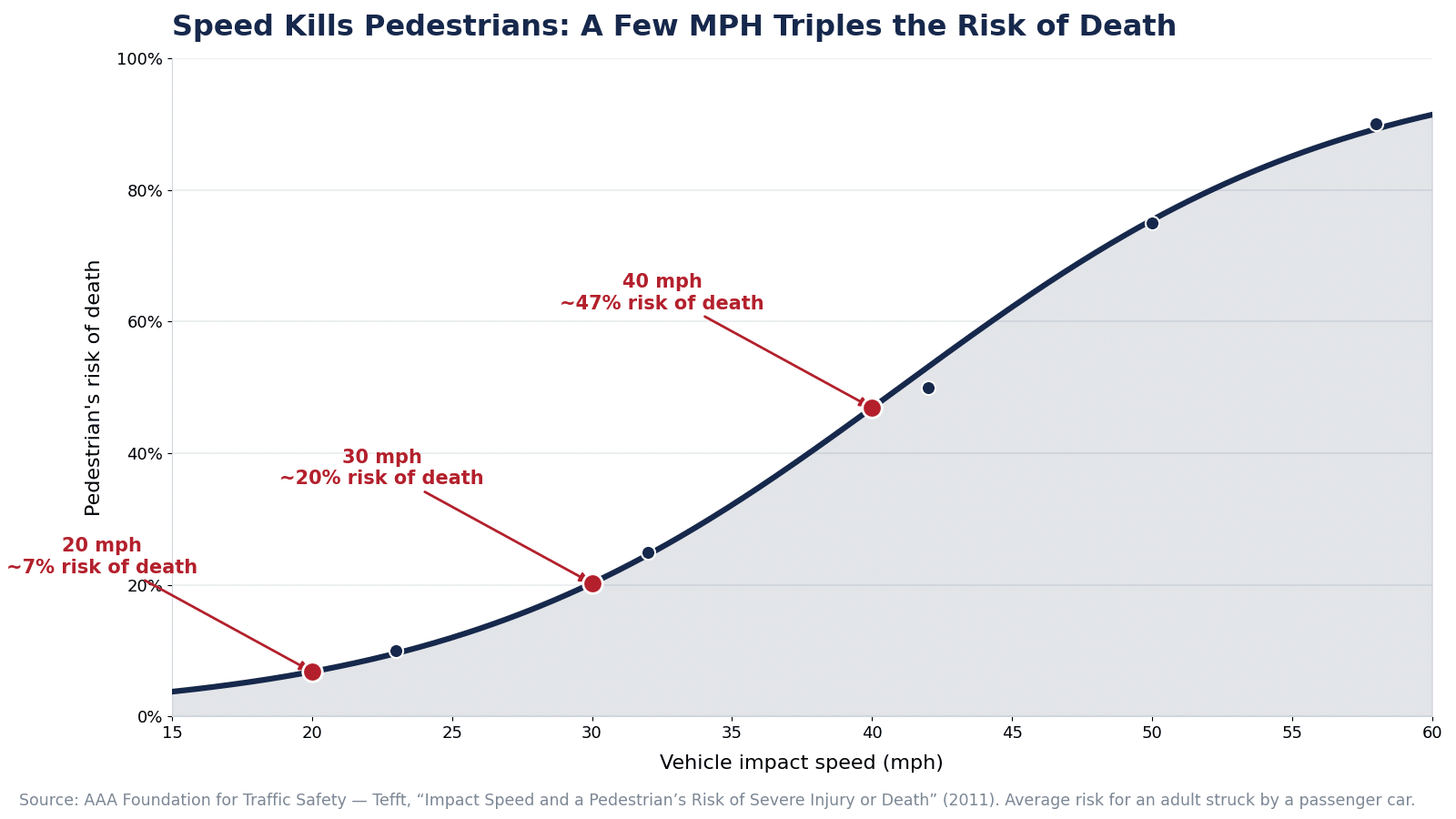
The single biggest factor is speed. The faster the vehicle, the more energy it dumps into the human body — and the relationship is not gradual, it is explosive. Research by the AAA Foundation for Traffic Safety found that a pedestrian struck at 20 mph has roughly a 7% chance of dying, but at 30 mph that risk climbs to about 20%, and at 40 mph it reaches nearly 50%. A few miles per hour is the difference between a survivable injury and a funeral.
The second factor is the vehicles themselves. America’s fleet has grown taller and heavier — over the past 30 years the average vehicle gained about 8 inches in height and 1,000 pounds. That matters enormously for pedestrians. An Insurance Institute for Highway Safety study of nearly 18,000 crashes found that pickups, SUVs, and vans with a hood height above 40 inches are about 45% more likely to kill a pedestrian than cars with a low, sloped front end, because a tall, blunt grille strikes the torso and head rather than sweeping the legs. Light trucks now account for the majority of pedestrian fatalities where the vehicle type is known.
Pedestrian Accident Statistics
Source: NHTSA, “Pedestrians: 2023 Data,” DOT HS 813 727 (June 2025), based on the Fatality Analysis Reporting System (FARS).
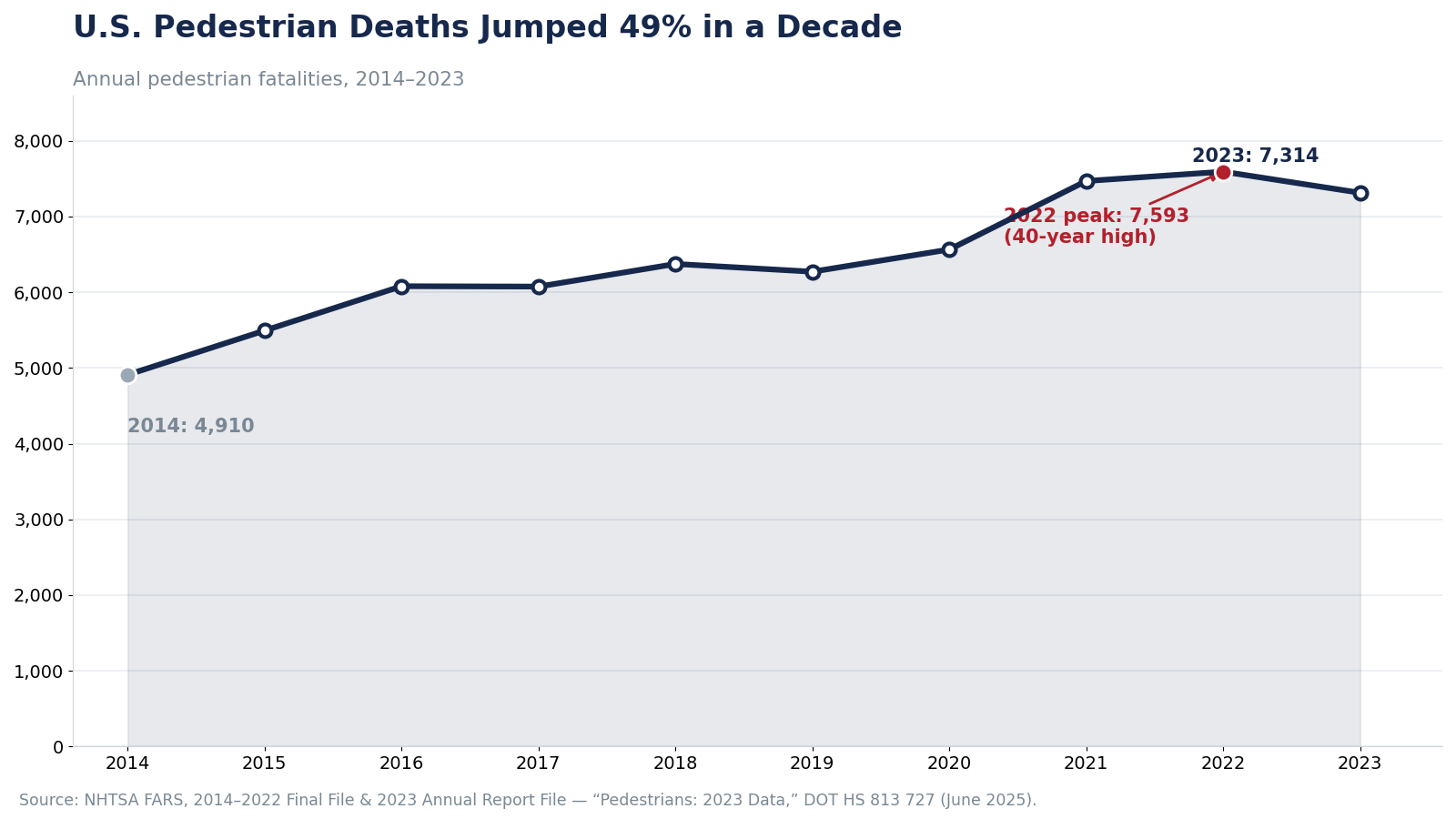
Pedestrian deaths are not a fading problem — they have surged. In 2023, 7,314 pedestrians were killed in U.S. traffic crashes and another 68,244 were injured, meaning a pedestrian was struck and killed roughly every 72 minutes. Pedestrians made up 18% of all traffic fatalities, far out of proportion to the small share of travel done on foot. And the trend is alarming: annual pedestrian deaths jumped 49% over the decade, from 4,910 in 2014 to a 40-year high of 7,593 in 2022 before easing slightly in 2023.
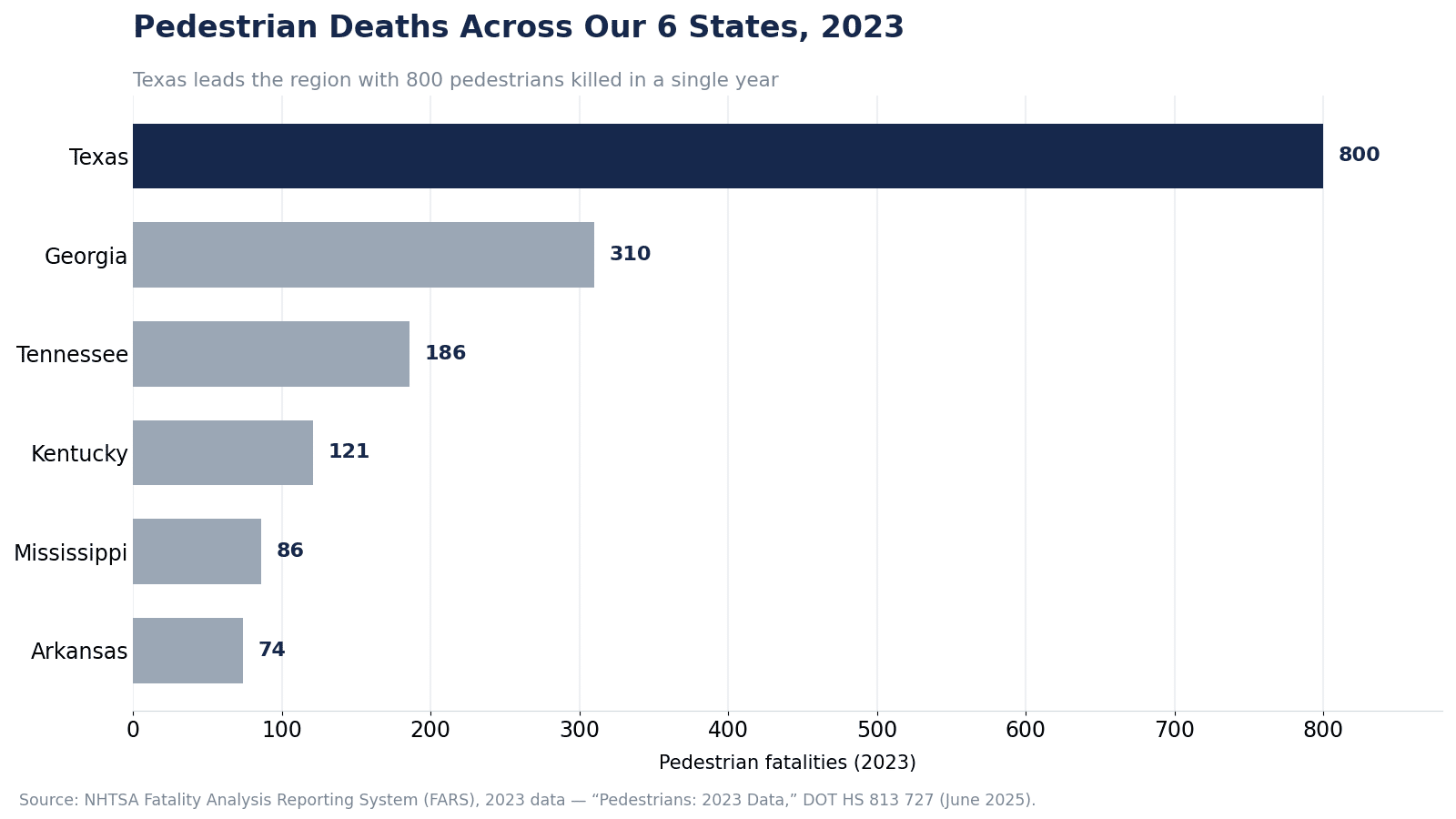
The toll is heavy in the states we serve. In 2023, Texas recorded 800 pedestrian deaths — among the highest in the nation — followed by Georgia (310), Tennessee (186), Kentucky (121), Mississippi (86), and Arkansas (74).
Where and When Do Pedestrian Crashes Happen?
Most fatal pedestrian crashes share a profile: after dark, away from intersections, on busy roads. According to NHTSA’s 2023 data, 77% of pedestrian fatalities occurred in the dark — and fatal nighttime pedestrian crashes have risen 84% since 2010 — while only 19% happened in daylight. Drivers simply don’t see pedestrians at night until it is too late, especially against the glare of headlights and signs.
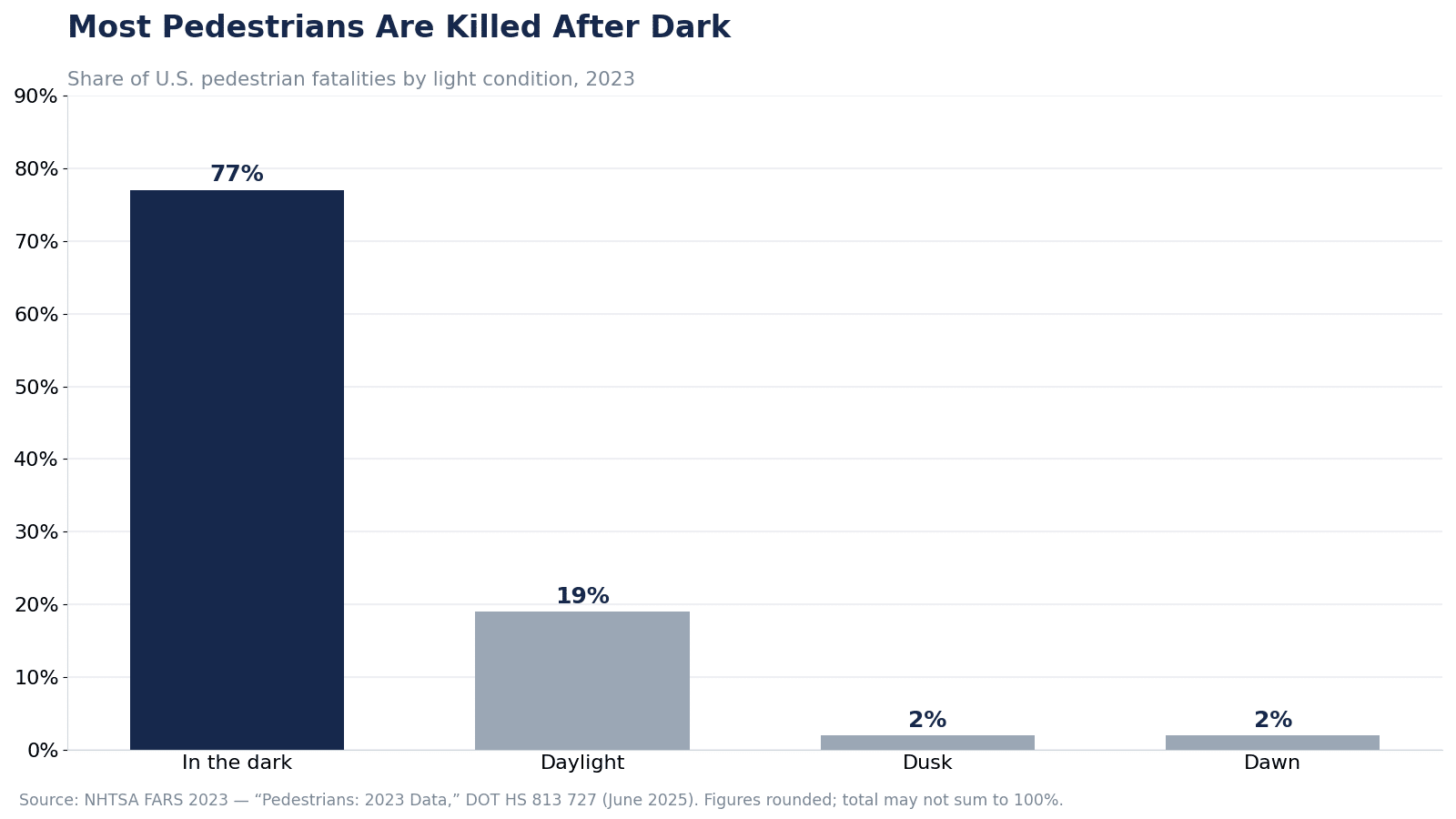
Location matters just as much. Fully 74% of pedestrian deaths happened away from intersections — typically mid-block crossings on wide, high-speed arterial roads built to move cars quickly, with crosswalks spaced far apart. Only 17% occurred at intersections. The crashes also cluster in urban areas (84%) and overwhelmingly involve a single vehicle (89%) striking one person. Understanding exactly where and when you were hit — the lighting, the roadway design, the presence or absence of a marked crossing — is often central to proving the driver, and sometimes a government road authority, failed to keep you safe.
Common Causes of Pedestrian Accidents
Most pedestrian crashes come down to a driver who wasn’t paying attention or wasn’t following the rules that exist to protect people on foot. The most common causes we see include:
- Distracted driving. Texting, phone use, or infotainment screens that pull a driver’s eyes off the road long enough to miss a person in or near the crosswalk.
- Failure to yield right-of-way. Drivers who don’t stop for pedestrians in a crosswalk, or who roll through a crossing while looking only for other cars.
- Speeding. Higher speeds give drivers less time to stop and make every impact far deadlier, as the speed-survivability data above shows.
- Impaired driving. Alcohol or drugs slow reaction time and impair judgment; if a drunk driver hit you, our DUI accident lawyer page explains how those cases can support punitive damages.
- Turning drivers. Left- and right-turning vehicles striking pedestrians who have the walk signal — a very common intersection scenario.
- Backing up. Drivers reversing in parking lots and driveways who fail to check for people behind the vehicle.
- Poor visibility and dark conditions. Unlit arterials, missing crosswalks, and worn signal timing that leaves pedestrians exposed.
Who Is Liable — and What If I Was Partly at Fault?
In most pedestrian crashes the driver is liable for failing to yield, speeding, driving distracted, or otherwise breaching the duty to watch for people on foot. But insurers love the “the pedestrian jaywalked” defense — arguing you crossed outside a crosswalk or stepped out suddenly, so the crash was your own fault. Here is the key point: in the states we serve, being partly at fault usually reduces your compensation rather than eliminating it. Your state’s comparative negligence rule decides how much:
| State | Rule | What it means for you |
|---|---|---|
| Tennessee | Modified — 50% bar (McIntyre v. Balentine, 833 S.W.2d 52 (Tenn. 1992)) | You can recover only if you are less than 50% at fault; your award is reduced by your share. |
| Mississippi | Pure comparative (Miss. Code § 11-7-15) | You can recover even if you are mostly at fault; the award is simply reduced by your percentage. |
| Arkansas | Modified — 50% bar (Ark. Code § 16-64-122) | Barred only if your fault is equal to or greater than the driver’s; otherwise reduced by your share. |
| Texas | Modified — 51% bar (Tex. Civ. Prac. & Rem. Code § 33.001) | You can recover unless your responsibility is greater than 50%; you may still recover at exactly 50%. |
| Kentucky | Pure comparative (KRS § 411.182) | You can recover even if you are largely at fault; the award is reduced by your percentage. |
| Georgia | Modified — 50% bar (O.C.G.A. § 51-12-33) | You can recover only if you are less than 50% at fault; your award is reduced by your share. |
These rules are applied to the facts of each case. Because insurers use the jaywalking argument to slash payouts, how fault is investigated and presented can change your recovery dramatically.
The defense’s blame-the-pedestrian story collapses when the evidence is preserved. Traffic-signal and walk-signal timing data, intersection and business surveillance footage, dashcam video, the vehicle’s event data recorder (“black box”) showing speed and braking, and independent witnesses can establish that you had the right-of-way and the driver did not. That evidence vanishes fast — footage is overwritten within days and vehicles get repaired — so we send preservation letters and secure it immediately.
Liability isn’t always limited to the driver, either. A government road authority may share fault for a dangerous crossing, missing signals, or inadequate lighting; an employer may be liable if the driver was working; and a bar or vehicle owner may be on the hook in impaired-driving cases. Identifying every responsible party — and every applicable insurance policy — is central to maximizing what you recover.
Pedestrian Accident Injuries
With nothing between the body and the vehicle, pedestrian crashes produce some of the most catastrophic injuries we handle: traumatic brain injuries from the head striking the hood, windshield, or pavement; spinal cord injuries and paralysis; pelvic and leg fractures as the bumper and hood strike the lower body; internal organ damage and bleeding; broken ribs and chest trauma; and, far too often, fatal injuries giving rise to a wrongful-death claim. These are lifelong harms with lifelong costs. Valuing them correctly means projecting the full future cost of care — surgeries, rehabilitation, assistive equipment, lost earning capacity, and diminished quality of life — with medical and economic experts, not accepting the lowball number an insurer floats in the first weeks while you’re still in the hospital.
How Much Is a Pedestrian Accident Case Worth?
There is no fixed average — value depends on the severity of your injuries, your past and future medical costs, lost income and earning capacity, the pain and disruption you’ve endured, and how much insurance is available. The recovery typically comes from the at-fault driver’s liability insurance, but a serious pedestrian injury can easily exceed those limits. That is why we also pursue your own uninsured/underinsured motorist (UM/UIM) coverage — which applies when the driver fled, had no insurance, or carried too little. UM/UIM coverage on your auto policy follows you, not just your car, so it can pay even though you were on foot. Our uninsured motorist page explains how this works, and we identify every policy that could contribute before any settlement is finalized.
What to Do After Being Hit by a Car
- Get medical care immediately, even if you think you’re okay — internal injuries and brain trauma are often masked by adrenaline, and a gap in treatment is the first thing insurers attack.
- Call 911 so officers respond and document the scene, the vehicle, and the driver while everything is fresh.
- Get the driver’s information — name, license, insurance, and license plate; if they flee, write down or photograph anything you can about the vehicle.
- Photograph everything — the vehicle, the roadway, the crosswalk or lack of one, traffic signals, your injuries, and the lighting conditions.
- Get witness names and contacts. Bystanders who saw you in the crosswalk or saw the driver run the light are powerful evidence.
- Don’t admit fault or say “I didn’t see the car” — let the investigation establish what happened.
- Request the crash report and note any citation issued to the driver.
- Don’t give a recorded statement to the driver’s insurer, and call a pedestrian accident lawyer quickly — surveillance footage and signal data disappear within days, and in Tennessee your deadline can be as short as one year.
Filing Deadlines by State
Every state sets a strict statute of limitations to file an injury lawsuit. Miss it and your claim is gone, no matter how strong:
| State | Injury filing deadline |
|---|---|
| Tennessee | 1 year (T.C.A. § 28-3-104) |
| Mississippi | 3 years (Miss. Code § 15-1-49) |
| Arkansas | 3 years (Ark. Code § 16-56-105) |
| Texas | 2 years (Tex. Civ. Prac. & Rem. Code § 16.003) |
| Kentucky | 2 years from the crash or last PIP payment (KRS § 304.39-230) |
| Georgia | 2 years (O.C.G.A. § 9-3-33) |
Deadlines can be shorter or longer in specific situations (government defendants, minors, wrongful death). Talk to a lawyer promptly about your exact deadline.
Our Results in Serious Auto Accident Cases
Every case is different, but our results reflect how hard we fight for crash victims:
- Six-figure recovery — Our client was stopped in traffic when an 18-wheeler failed to stop in time and rear-ended them.
- Six-figure settlement — An 18-wheeler pushed our client into a barrier wall, causing her injuries.
- $175,000 settlement — Our client’s Mercedes was rear-ended and caught fire; even with minimal medical treatment, we recovered $175,000.
Prior results do not guarantee a similar outcome. Every case depends on its own facts.
Why Choose Southern Injury Attorneys
We are a contingency-fee injury firm that handles serious car accident and pedestrian-knockdown cases, with attorneys licensed in Tennessee, Mississippi, Arkansas, Texas, Kentucky, and Georgia. Pedestrian cases are won on evidence that disappears quickly, so we move fast to preserve signal-timing records, surveillance and dashcam footage, and black-box data, retain medical and reconstruction experts, and build every case for trial — which is what produces fair settlements. You pay nothing unless we win. If your crash happened in Memphis, see our dedicated Memphis pedestrian accident attorneys page.
Headquarters: 5865 Ridgeway Center Pkwy, Suite 390, Memphis, TN 38120, with offices in Dallas, Houston, and Atlanta. Consultations are free and handled by phone anywhere we practice: 800-224-5546.
Pedestrian Accident FAQs
Can I sue if I was jaywalking when I was hit?
Usually yes. Crossing outside a crosswalk doesn’t automatically bar your claim — it just becomes part of the comparative-negligence analysis. In Mississippi and Kentucky you can recover even if you were mostly at fault; in Tennessee, Arkansas, Texas, and Georgia you can recover as long as your share of fault stays below the state’s bar. And drivers still have a duty to watch for and avoid pedestrians, even ones outside a crosswalk.
What if the driver who hit me fled the scene?
You may still recover. In a hit-and-run, your own uninsured-motorist (UM) coverage is designed to pay your medical bills and other damages as if it were the fleeing driver’s insurance. We also work to identify the driver through surveillance footage, witnesses, and police investigation. UM coverage on your auto policy protects you even when you’re on foot.
Are pedestrians always given the right of way?
No — that’s a common myth. Pedestrians generally have the right-of-way in marked and unmarked crosswalks at intersections, and drivers must yield to them. But pedestrians crossing mid-block or against a signal may have to yield to traffic. Even then, a driver who could have avoided the crash by paying attention can still be liable, so right-of-way is rarely the end of the story.
How long do I have to file a pedestrian accident lawsuit?
It depends on the state: one year in Tennessee, two years in Texas, Kentucky, and Georgia, and three years in Mississippi and Arkansas. Some situations shorten the deadline, so talk to a lawyer promptly so nothing lapses.
What is the average settlement for a pedestrian accident?
There is no fixed average. Value depends on injury severity, future medical and care costs, lost earning capacity, available insurance, and how clearly fault rests with the driver. Because pedestrian crashes so often cause catastrophic injuries, the stakes — and the potential value — are usually high.
The driver who hit me had no insurance or very little. Can I still recover?
Yes. We pursue your own uninsured/underinsured motorist coverage, which exists for exactly this situation, plus any other liable parties — an employer if the driver was working, a vehicle owner, or a bar that over-served an impaired driver.
The driver’s insurance company wants a recorded statement. Should I give one?
Not before talking to a lawyer. Adjusters use recorded statements to get you to guess, minimize your injuries, or accept blame (“I didn’t see the car coming”). You are not required to give the other driver’s insurer a recorded statement, and what you say can be used to cut your payout.
The insurer already offered me money. Should I take it?
Not before a lawyer values your case. Early offers rarely account for future surgeries, long-term care, or lost earning capacity, and pedestrian injuries often worsen or reveal themselves over time. Once you accept and sign a release, you usually cannot reopen the claim.
What does a pedestrian accident lawyer cost?
Nothing up front. We work on contingency — our fee comes out of the recovery, and you owe nothing unless we win. Consultations are free.
Talk to a Pedestrian Accident Lawyer — Free
Being hit by a car while walking can change your life in an instant — and the driver’s insurer is already working to pay you as little as possible. You don’t have to face that alone. Get a free, no-obligation consultation with attorneys licensed in Tennessee, Mississippi, Arkansas, Texas, Kentucky, and Georgia. Call 800-224-5546 — no fee unless you win. You can also contact us online.
This page is general legal information, not legal advice. Every case is different and outcomes are never guaranteed. Contacting us does not create an attorney-client relationship.

