


Quick answer: A slip and fall is a premises-liability claim, and it works differently from a car wreck. To win, you usually have to prove the property owner created the hazard, knew about it, or should have known because it was there long enough that a reasonable owner would have found and fixed it (called “notice”). Liability can fall on the store, the landlord, a property manager, or a cleaning contractor — and sometimes more than one. The catch is that the critical evidence — the surveillance video, the incident report, and the hazard itself — disappears within days, so it has to be preserved immediately. Deadlines to sue run from one to three years, and falls on government property carry separate, much shorter notice deadlines. Call 800-224-5546 for a free consultation — no fee unless you win.
- Falls are common and seriously underestimated — the #1 cause of injury ER visits, the leading cause of traumatic brain injury, and the top cause of injury death for older adults.
- It’s a “notice” case. The whole question is usually whether the owner created the hazard, knew about it, or should have known — i.e., how long was it there?
- Your status on the property sets the duty owed — a customer (invitee) is owed the highest duty: to inspect for and fix or warn of hazards.
- There can be several defendants — the store, the landlord, the property manager, a janitorial contractor, or a government entity.
- Preserve the video and evidence fast. Surveillance footage is overwritten in days to weeks, and deadlines are strict — especially on public property.
Slip and Fall Claims at a Glance
| Question | Short answer |
|---|---|
| What kind of claim is it? | Premises liability — the property owner’s duty to keep the property reasonably safe. |
| What do I have to prove? | That the owner created the hazard, knew about it, or should have known (notice) — and didn’t fix or warn. |
| Who can be liable? | The store/business, landlord, property manager, cleaning contractor, or a government entity. |
| What’s the most important evidence? | Surveillance video, sweep/inspection logs, and the incident report — they disappear fast. |
| How long do I have to file? | 1–3 years depending on the state (one year in Tennessee and Kentucky); government claims are much shorter. |
| What will a lawyer cost? | Nothing up front — contingency fee, paid only if you recover. |
Slip and Fall Accident Statistics
Sources: National Safety Council, Injury Facts 2023; CDC/NCHS Data Brief 532, June 2025; U.S. BLS, Census of Fatal Occupational Injuries 2023.
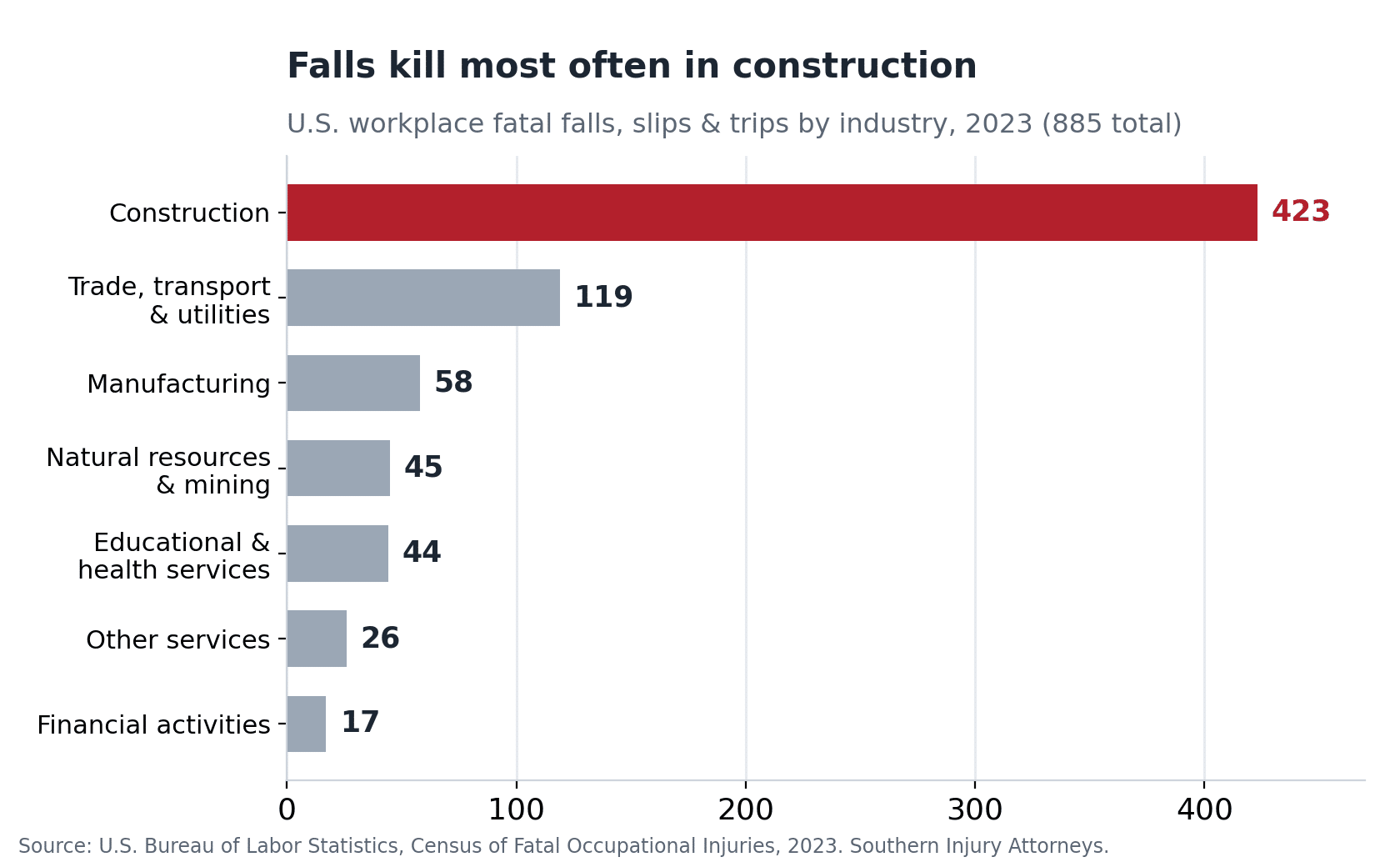
Falls are easy to underestimate — until one happens to you or someone you love. They are not the rare, dramatic event; they are the single most common serious injury in the country. In 2023, more than 8.8 million people were treated in emergency rooms for fall-related injuries, about 35 percent of all preventable nonfatal injuries treated in U.S. ERs — far more than any other cause. Falls are also the leading cause of traumatic brain injury, a top cause of workplace death, and the number-one cause of injury death for adults 65 and older.
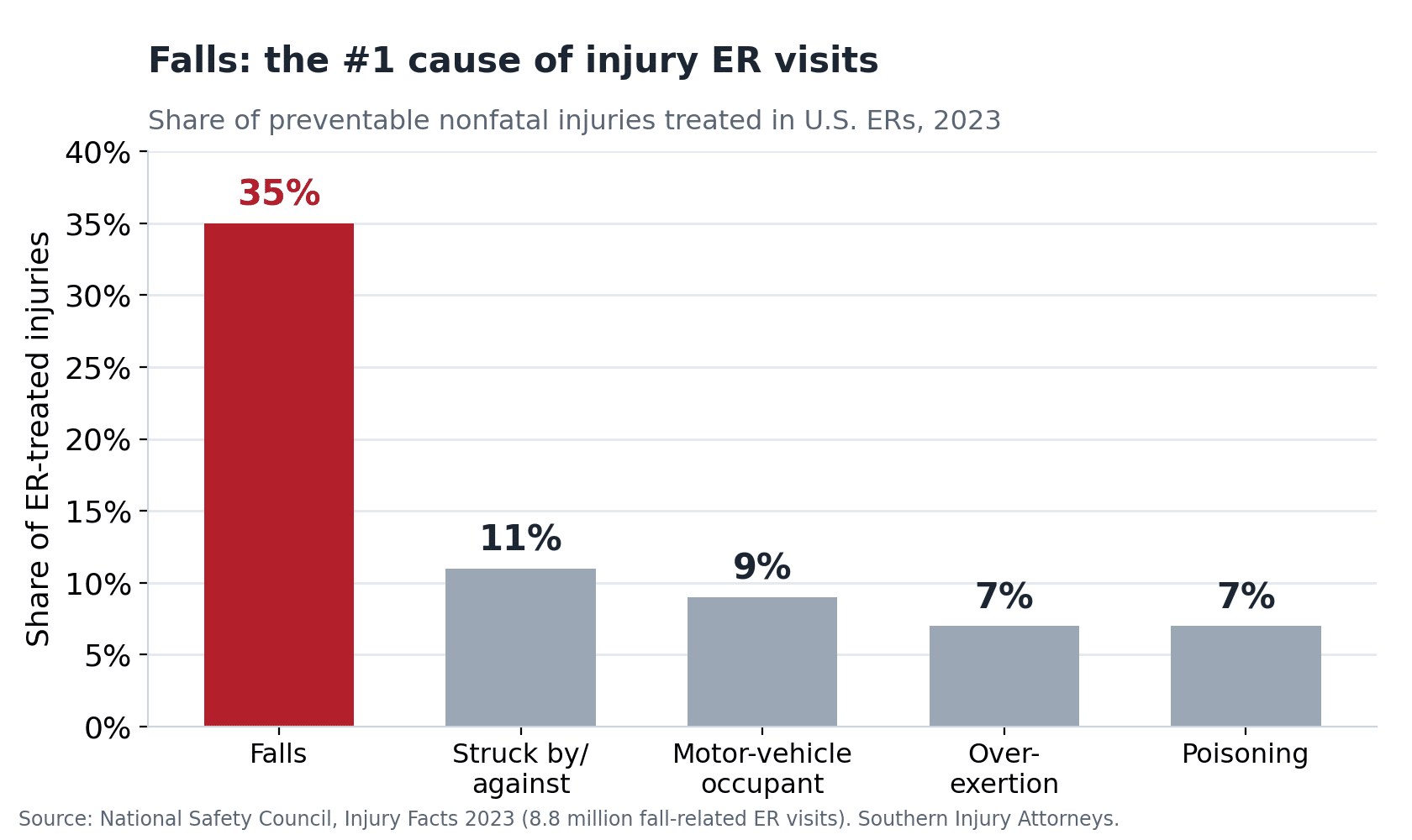
What makes falls a legal matter — and not just bad luck — is that so many of them happen on someone else’s property because that property was not kept reasonably safe. A wet floor with no warning sign, an icy walkway no one salted, a broken stair, poor lighting on a stairwell: these are premises-liability failures. When a property owner’s carelessness causes a fall, the owner can be held responsible for the injuries.
Who Is Liable for a Slip and Fall Accident?
A slip and fall is governed by premises liability — the legal duty of whoever controls a property to keep it reasonably safe for the people allowed on it. Depending on who controlled the area where you fell, the responsible party can be the store or business, the landlord or property owner, a property-management company, a janitorial or maintenance contractor, or a government entity. More than one can be liable, and each may have its own insurance — which is one reason identifying every defendant matters so much.
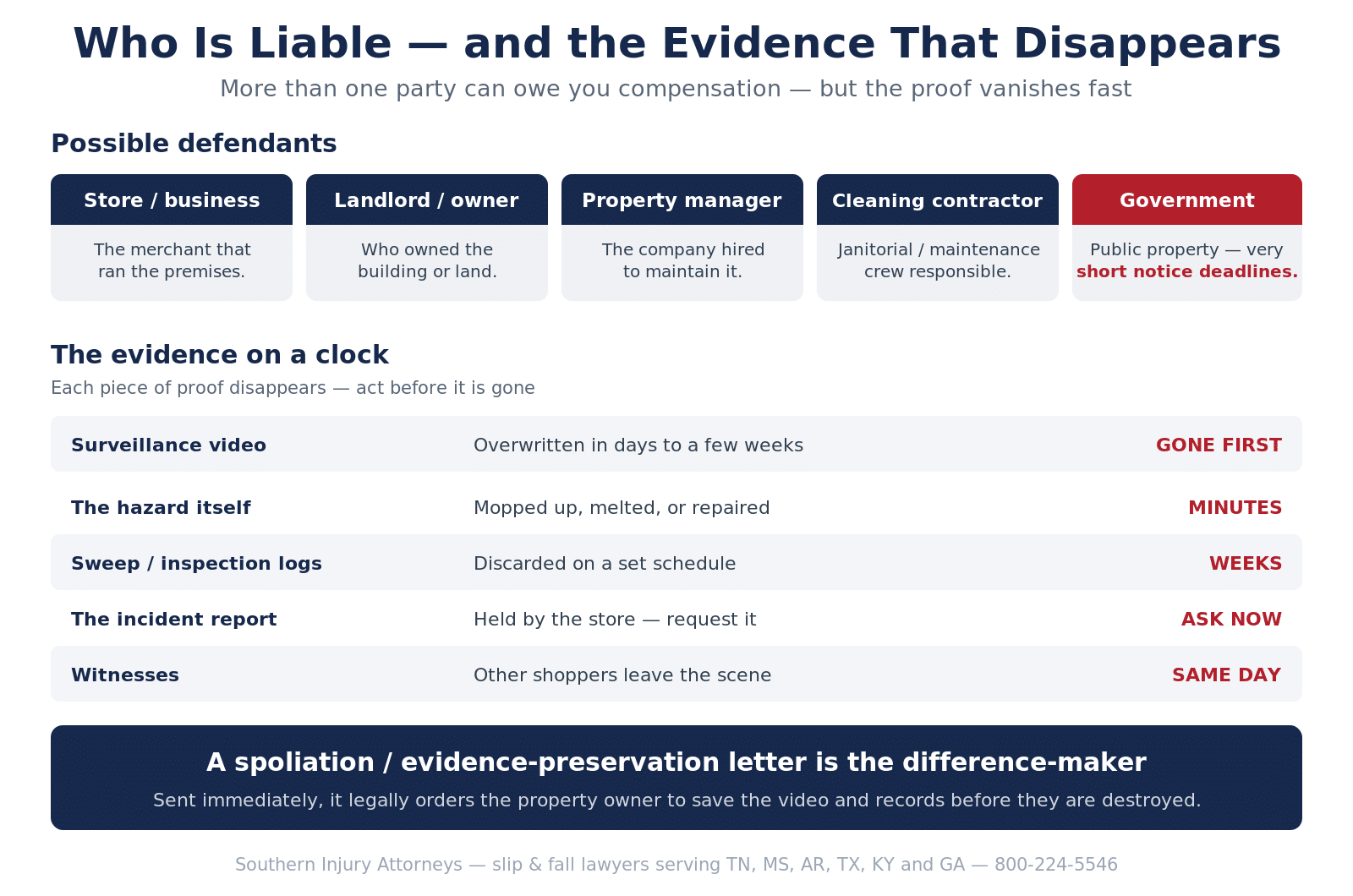
The defendant is whoever had control over and responsibility for the dangerous condition. In a leased storefront, the tenant business is usually responsible for spills inside, while the landlord may be responsible for the common areas, the parking lot, or a structural defect. A national chain may have hired an outside cleaning company whose crew created or missed the hazard. And a fall on a public sidewalk, government building, or transit property brings in a city, county, or state — with special, much shorter notice deadlines. Sorting this out early is essential, because the wrong defendant (or a missed one) can mean leaving compensation on the table.
What Do I Have to Prove in a Slip and Fall Case?
Two threshold questions decide a slip and fall case. First, what duty did the owner owe you, which depends on your status on the property. Second — and this is the heart of almost every case — did the owner have “notice” of the hazard: did they create it, actually know about it, or should they have known because it was there long enough that a reasonable owner would have found and fixed it? That last question usually comes down to a single issue: how long was the hazard there?
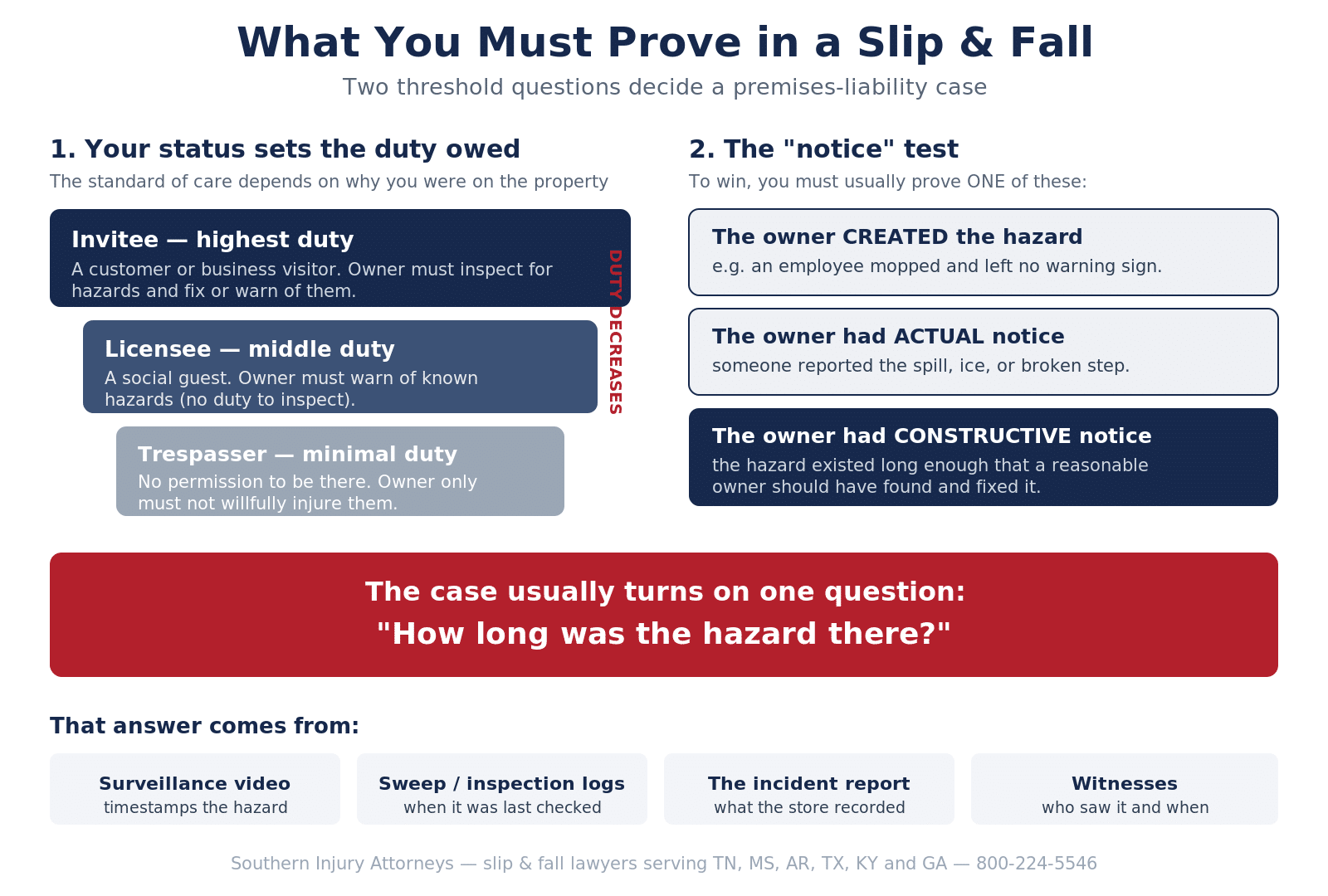
Your status on the property sets the standard of care. An invitee — a customer or business visitor — is owed the highest duty: the owner must inspect for hazards and either fix them or warn of them. A licensee — typically a social guest — is owed a duty to be warned of known hazards, but not a duty of inspection. A trespasser is owed only the minimal duty not to be willfully or wantonly injured. Most slip and fall cases involve invitees, which is why the owner’s failure to inspect for and clean up hazards is so often the central failure.
Then comes notice. You generally must prove one of three things: the owner created the hazard (an employee mopped and left no sign), had actual notice (someone reported the spill or the ice), or had constructive notice — the hazard existed long enough that a reasonable owner should have discovered and remedied it. A puddle that formed five seconds before you slipped is very different, legally, from one that sat in an aisle for an hour while employees walked past. That is why “how long was it there?” is the question that wins or loses these cases.
What Counts as “Notice,” and How Do You Prove It?
Constructive notice is proven with evidence that puts a clock on the hazard — and most of it is in the property owner’s hands, not yours. The most powerful proof is surveillance video, which can show exactly when a spill appeared and how many employees walked past it without cleaning it up. Close behind are the store’s “sweep logs” or inspection records, which are supposed to show how often the floors were checked — and often reveal they weren’t. The incident report the business fills out, the accounts of witnesses, and the condition of the hazard itself all help establish how long it was there.
The problem is that this evidence disappears fast. Surveillance footage is routinely overwritten within days to a few weeks. The spill gets mopped, the ice melts, and the broken step gets repaired. Witnesses scatter. That is why one of the first things a slip and fall lawyer does is send a spoliation letter — a formal demand that legally requires the property owner to preserve the video, the logs, and other evidence before it is destroyed. Sent immediately, that single letter is often the difference between a provable case and a “your word against theirs” dispute. Waiting even a couple of weeks can let the most important proof vanish for good.
What Are the Most Common Causes of Slip and Fall Accidents?
Most slip, trip, and fall hazards fall into a handful of preventable categories: wet or freshly mopped floors without warning signs, spills and leaks left in aisles, ice and snow on walkways and parking lots, uneven or cracked walkways and potholes, poor lighting in stairwells and lots, missing handrails and broken or worn stairs, loose mats, rugs, or carpeting, and falling merchandise in stores and warehouses. What these have in common is that a reasonable inspection-and-maintenance routine would have caught and corrected them — which is exactly what premises-liability law requires.
Slip and Fall Injuries
Falls produce some of the most serious injuries in personal-injury law, especially for older adults. The common ones include traumatic brain injuries and concussions (falls are the leading cause of TBI), hip and other fractures, spinal cord injuries, wrist, arm, and shoulder injuries from bracing the fall, and soft-tissue injuries. For an older adult, a broken hip or a head injury can be life-altering or even fatal — which is part of why cases involving seniors, head injuries, and hip fractures tend to carry higher value: the medical care is extensive and the long-term consequences are severe.
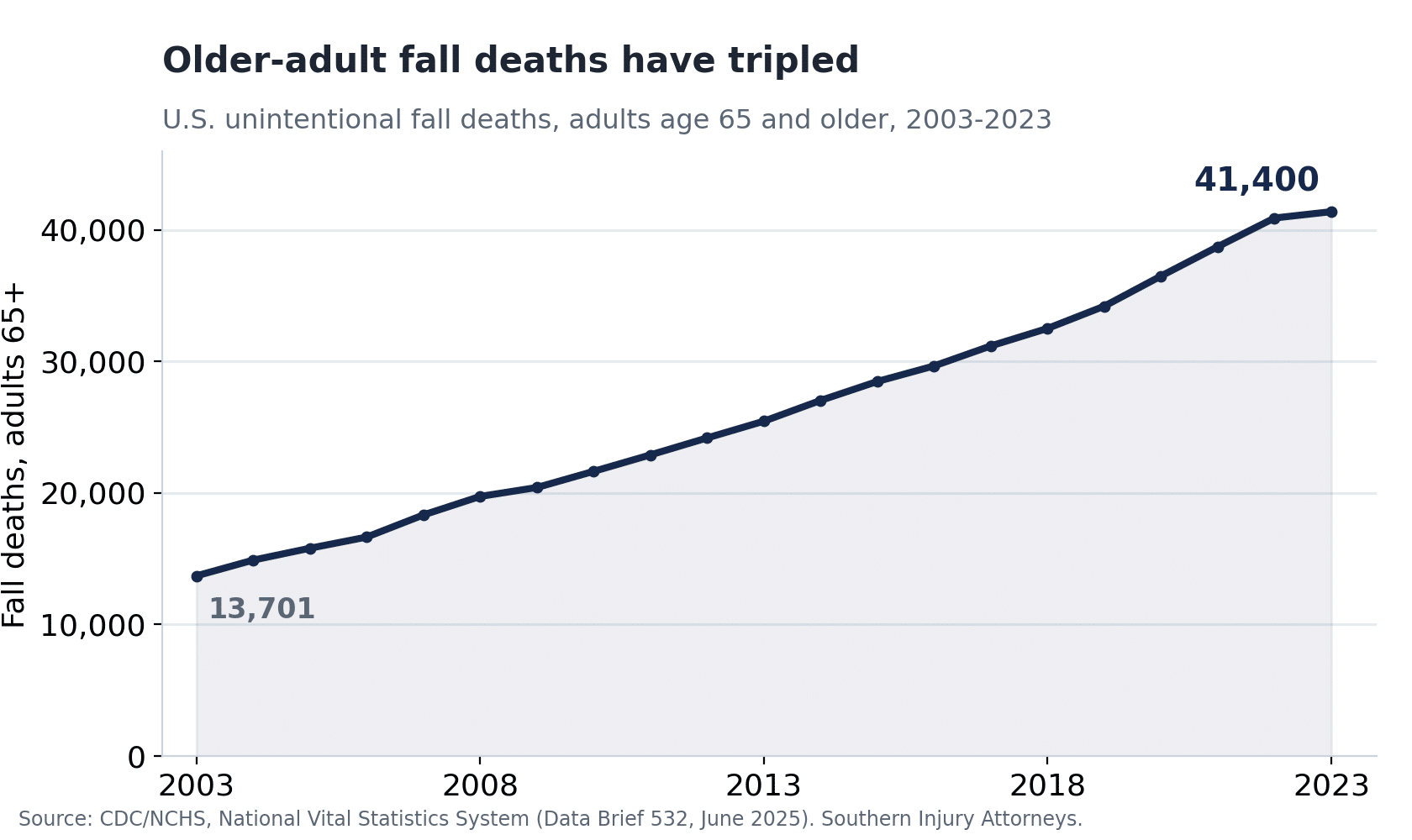
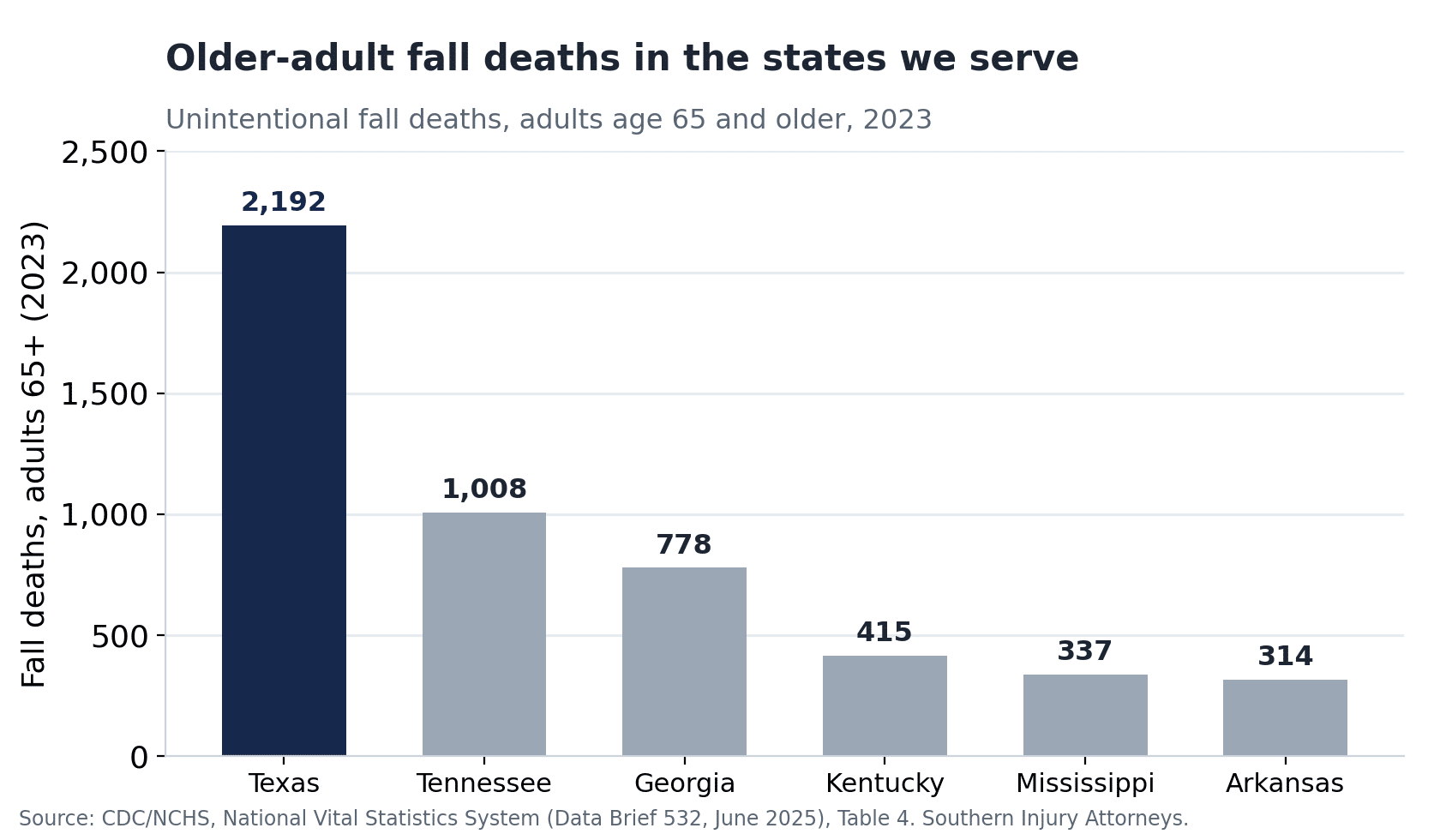
The danger to older adults is not a small footnote — it is a public-health crisis that has been climbing for two decades. Falls are the leading cause of injury death for adults 65 and older, more than one in four older adults falls each year, and U.S. fall deaths among seniors have roughly tripled since 2003, reaching 41,400 in 2023.
What If the Hazard Was “Open and Obvious” — or I Was Partly at Fault?
You can usually still recover. Property owners and their insurers lean on two defenses, and neither is the automatic loss they pretend it is. The first is the “open and obvious” doctrine — the argument that the hazard was so obvious you should have avoided it. How much this matters depends entirely on the state: in some it can reduce or bar recovery, while in others it is just one factor in comparative fault, and even an obvious hazard can impose liability if the owner should have expected people to be distracted or to encounter it anyway. The second defense is comparative fault — “you should have watched where you were walking.” But every state we serve uses some form of comparative negligence, so being partly at fault generally reduces your recovery rather than eliminating it.
| State | Rule | What it means for you |
|---|---|---|
| Tennessee | Modified — 50% bar (McIntyre v. Balentine, 833 S.W.2d 52 (Tenn. 1992)) | You can recover only if you are less than 50% at fault; your award is reduced by your share. |
| Mississippi | Pure comparative (Miss. Code § 11-7-15) | You can recover even if you are mostly at fault; the award is reduced by your percentage. |
| Arkansas | Modified — 50% bar (Ark. Code § 16-64-122) | Barred only if your fault is equal to or greater than the other party’s; otherwise reduced by your share. |
| Texas | Modified — 51% bar (Tex. Civ. Prac. & Rem. Code § 33.001) | You can recover unless your responsibility is greater than 50%; you may still recover at exactly 50%. |
| Kentucky | Pure comparative (KRS § 411.182) | You can recover even if you are largely at fault; the award is reduced by your percentage. |
| Georgia | Modified — 50% bar (O.C.G.A. § 51-12-33) | You can recover only if you are less than 50% at fault; your award is reduced by your share. |
How the “open and obvious” rule applies varies significantly by state and by the facts. Because insurers use both defenses to cut payouts, how the case is investigated and presented can change your recovery dramatically.
How Much Is a Slip and Fall Case Worth?
There is no fixed average — value depends on the severity of the injury, the full cost of future medical care, lost income and earning capacity, and how much insurance is available from the responsible parties. A soft-tissue injury that heals in weeks is worth far less than a traumatic brain injury or a hip fracture that requires surgery and long-term care. Cases involving older adults and head or hip injuries tend to be worth more precisely because the harm is so lasting. Because a slip and fall can involve more than one defendant and more than one policy — a store, a landlord, and a cleaning contractor, for example — identifying every source of recovery is a major part of maximizing value. When a fall is fatal, the family can pursue wrongful death damages. The first offer from an insurer is almost never the full value of the claim.
Slip and Falls at Work, in Stores, on Ice and Snow, and on Government Property
The setting of your fall changes how the claim works. A fall at work is usually covered by workers’ compensation regardless of fault — but if a third party (a different company’s cleaning crew, a property owner who isn’t your employer, an equipment maker) caused the hazard, you may also have a separate third-party premises-liability claim on top of comp, which can recover damages comp does not. Falls are the leading category of construction deaths and a top cause of fatal workplace injury overall.
A fall in a store is the classic premises case, and it turns on the notice and surveillance-video issues described above. A fall on ice or snow adds wrinkles that vary by state — some places limit liability for a “natural accumulation” of snow, while a property owner who plows, salts, or otherwise takes on the job can be liable for doing it carelessly. And a fall on government property — a public sidewalk, a courthouse, a transit station — is subject to a Tort Claims Act, which typically requires written notice within a very short window (often a matter of months, sometimes as little as 90 days) and follows strict rules. Miss that notice deadline and the claim can be barred no matter how strong it is, so a government-property fall is a reason to call a lawyer right away.
What to Do After a Slip and Fall Accident
- Report the fall and get an incident report. Tell the store manager or property owner right away and ask them to document it in writing; get a copy or the report number.
- Photograph the hazard before it’s cleaned up. Take pictures and video of the spill, ice, or broken step, the surrounding area, the lighting, and any missing warning signs — before anyone fixes or removes it.
- Get witness names and numbers. Anyone who saw the fall or the hazard can help prove how long it was there.
- Ask the business to preserve the surveillance video. Request in writing that they save the footage — it is the single most important piece of evidence, and it is overwritten quickly.
- See a doctor right away. Get checked even if you feel okay; head, hip, and back injuries are often masked by adrenaline, and prompt records connect the injury to the fall.
- Don’t give a recorded statement. Politely decline to give the property owner’s insurer a recorded statement until you have spoken with a lawyer.
Our Results in Serious Injury Cases
Every case is different, but our results reflect how hard we fight for injury victims:
- Six-figure recovery — Our client was stopped in traffic when an 18-wheeler failed to stop in time and rear-ended them.
- Six-figure settlement — An 18-wheeler pushed our client into a barrier wall, causing her injuries.
- $175,000 settlement — Our client’s Mercedes was rear-ended and caught fire; even with minimal medical treatment, we recovered $175,000.
Prior results do not guarantee a similar outcome. Every case depends on its own facts.
Why Choose Southern Injury Attorneys
We are a contingency-fee injury firm with attorneys licensed in Tennessee, Mississippi, Arkansas, Texas, Kentucky, and Georgia. A slip and fall is won or lost on evidence that disappears fast, so we move immediately to send a spoliation letter, secure the surveillance video and sweep logs, identify every responsible party and policy, and document the full cost of your injuries with medical and economic experts. We also handle the other ways people are hurt by someone else’s carelessness, from car accidents to wrongful death. You pay nothing unless we win. If your fall happened in Memphis, see our dedicated Memphis slip and fall attorneys page.
Headquarters: 5865 Ridgeway Center Pkwy, Suite 390, Memphis, TN 38120, with offices in Dallas, Houston, and Atlanta. Consultations are free and handled by phone anywhere we practice: 800-224-5546.
Deadlines to File a Slip and Fall Claim
The deadline to sue — the statute of limitations — depends on the state, and for a slip and fall it is the general personal-injury deadline, which is not the same as the deadline for a car crash in every state. Miss it and the claim is gone, so it is critical to talk to a lawyer early.
| State | Slip & fall filing deadline | Statute |
|---|---|---|
| Tennessee | 1 year | Tenn. Code § 28-3-104 |
| Mississippi | 3 years | Miss. Code § 15-1-49 |
| Arkansas | 3 years | Ark. Code § 16-56-105 |
| Texas | 2 years | Tex. Civ. Prac. & Rem. Code § 16.003 |
| Kentucky | 1 year | KRS § 413.140 |
| Georgia | 2 years | O.C.G.A. § 9-3-33 |
Two important wrinkles. First, Kentucky’s deadline for a slip and fall is just one year (KRS § 413.140) — shorter than its two-year deadline for motor-vehicle cases — so a Kentucky fall is especially time-sensitive. Second, if you fell on government property, a separate Tort Claims Act notice deadline applies that is far shorter than the statute of limitations — often only a few months, with strict written-notice requirements that vary by state and by the entity involved. Because these short deadlines are easy to miss, confirm exactly which ones apply to your case with a lawyer immediately.
We serve fall-injury victims throughout Tennessee, Mississippi, Arkansas, Texas, Kentucky, and Georgia — including local slip and fall help in Memphis, Nashville, Chattanooga, Knoxville, and Jackson. In Nashville we also handle premises liability matters.
Slip and Fall FAQs
Who is responsible for a slip and fall in a store?
Whoever controlled the area where you fell. Usually that is the store or business for spills and hazards inside, but it can also be the landlord or property owner (for common areas, the parking lot, or a structural defect), a property-management company, or an outside cleaning contractor whose crew created or missed the hazard. More than one party can be liable, and each may have separate insurance, so identifying every responsible party is important.
What do I have to prove in a slip and fall case?
That the property owner failed in a duty owed to you. Practically, you usually must prove the owner created the hazard, actually knew about it, or should have known because it existed long enough that a reasonable owner would have found and fixed it (called notice) — and that this failure caused your injury. Your status on the property (customer, guest, or trespasser) sets how high that duty was.
How do you prove the store knew about the hazard?
With evidence that shows how long the hazard was there. The most powerful is surveillance video, which can show when a spill appeared and how many employees walked past it. Sweep and inspection logs show how often the floors were supposed to be checked, the incident report shows what the store recorded, and witnesses can say how long the hazard existed. Because this proof disappears quickly, a lawyer sends a preservation letter right away.
What is constructive notice?
Constructive notice means the owner should have known about the hazard even if no one reported it, because it was there long enough that a reasonable owner conducting reasonable inspections would have discovered and fixed it. It is how you win a case when you cannot prove the owner created the hazard or got an actual report — and it is why “how long was the hazard there?” is the central question in most slip and fall cases.
Can I sue if the spill or ice was open and obvious?
Often yes. The “open and obvious” doctrine lets owners argue you should have avoided a visible hazard, but how much it matters depends on the state. In some it only reduces your recovery as a comparative-fault factor, and even an obvious hazard can create liability if the owner should have expected people to be distracted or to encounter it anyway. Don’t assume an obvious hazard means you have no case.
What if I was partly at fault for my fall?
You can usually still recover. Every state we serve uses comparative negligence, so being partly at fault generally reduces your compensation by your percentage of fault rather than eliminating it. In Tennessee, Arkansas, and Georgia you must be less than 50% at fault to recover; Mississippi and Kentucky allow recovery even if you are mostly at fault; Texas bars recovery only if you are more than 50% at fault.
Should I report the fall and get an incident report?
Yes. Report the fall to the manager or property owner right away and ask them to document it in writing, then get a copy or the report number. An incident report creates an official record of when and where you fell, and it can lock in details before memories change. Just stick to the facts and don’t speculate about fault or say you’re “fine.”
How long do I have to file, and is it shorter on government property?
It depends on the state: one year in Tennessee and Kentucky, two years in Texas and Georgia, and three years in Mississippi and Arkansas. Kentucky’s slip and fall deadline is only one year, shorter than its car-crash deadline. And if you fell on government property, a separate Tort Claims Act notice deadline applies that is far shorter — often just a few months — so contact a lawyer immediately.
How much is my slip and fall case worth?
There is no fixed average. Value depends on the severity of your injury, the full cost of future medical care, lost income and earning capacity, and how much insurance is available. Cases involving older adults, head injuries, and hip fractures tend to be worth more because the harm is so lasting, and cases with multiple defendants and policies can recover more. The insurer’s first offer is almost never the full value.
Should I give the insurance company a recorded statement?
Not before talking to a lawyer. The property owner’s insurer uses recorded statements to get you to guess about how the fall happened, downplay your injuries, or admit you weren’t watching where you were going — then uses your words to reduce or deny the claim. You are generally not required to give the other side’s insurer a recorded statement. Let your lawyer handle communications.
Can I sue for a fall at work?
Possibly more than one way. A fall at work is usually covered by workers’ compensation regardless of fault. But if a third party — not your employer — caused the hazard, such as another company’s cleaning crew or a property owner who isn’t your employer, you may also have a separate premises-liability claim that can recover damages workers’ comp does not, like full pain and suffering. The two can be pursued together.
How much does a slip and fall lawyer cost?
Nothing up front. We work on contingency — our fee comes out of the recovery, and you owe nothing unless we win. That matters in slip and fall cases, where preserving evidence and proving notice takes investigation and resources most people don’t have. Consultations are always free.
Talk to a Slip and Fall Lawyer — Free
If you were hurt in a fall on someone else’s property, the most important steps — preserving the surveillance video and meeting the deadlines — have to happen now. Get a free, no-obligation consultation with attorneys licensed in Tennessee, Mississippi, Arkansas, Texas, Kentucky, and Georgia. Call 800-224-5546 — no fee unless you win. You can also contact us online.
This page is general legal information, not legal advice. Every case is different and outcomes are never guaranteed. Contacting us does not create an attorney-client relationship.

