


Quick answer: If you were hurt in a truck or 18-wheeler crash in Lexington, Kentucky gives you two years to file an injury claim, measured from the crash date or your last no-fault (PIP) payment (KRS 304.39-230). A truck case is a claim against a federally regulated trucking industry — with multiple possible defendants (driver, motor carrier, cargo loader, maintenance company) and far larger insurance policies than a car case. It is won on records the carrier controls and can lawfully destroy — the ELD/hours-of-service logs and the truck’s “black box” — so evidence must be preserved immediately. Call 800-224-5546 for a free consultation — no fee unless you win.
- A truck crash is a case against a federally regulated industry. A violation of the federal trucking rules can be powerful proof of negligence.
- There are usually several defendants — and that is where the money is. The driver, the trucking company, the trailer or cargo owner, a maintenance contractor, or a parts maker can all share liability.
- Truck insurance dwarfs car insurance. Interstate carriers must carry at least $750,000 in coverage versus Kentucky’s $25,000 car minimum.
- The evidence disappears fast. ELD logs, the engine “black box,” and dispatch data can be lawfully overwritten in days — a preservation letter must go out at once.
- Kentucky gives you two years and uses pure comparative fault — you can recover even if you were partly at fault, with your share deducted.
Lexington Truck Accident Claims at a Glance
| Question | Short answer |
|---|---|
| How long do I have to file? | 2 years from the crash (or last PIP payment) — KRS 304.39-230. |
| Who can be liable? | Driver, trucking company, trailer owner, maintenance contractor, cargo loader, or parts maker — often several. |
| Minimum truck insurance? | $750,000 for interstate carriers (FMCSA); $1M+ common, more for hazmat. |
| What if I was partly at fault? | Kentucky uses pure comparative fault — you can still recover, reduced by your share (KRS 411.182). |
| What will a lawyer cost? | Nothing up front — contingency fee, paid only if you recover. |
| First thing to do? | Get medical care, preserve the vehicle, and don’t give the carrier’s insurer a recorded statement. |
Lexington & Kentucky Truck Crash Statistics
Sources: Kentucky State Police / Kentucky Office of Highway Safety (2024); Kentucky Transportation Center. Confirm against the latest release before relying on these figures.
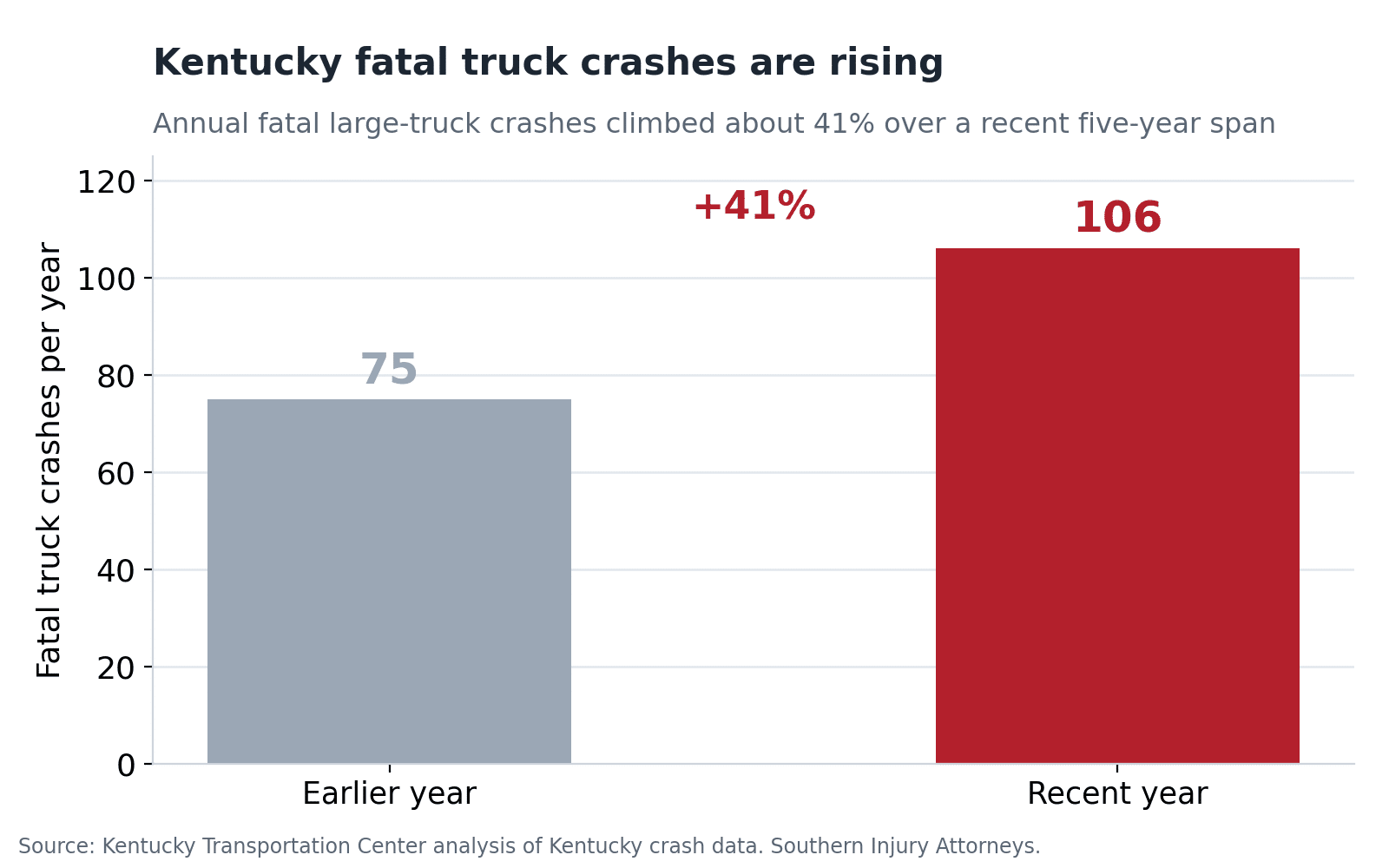
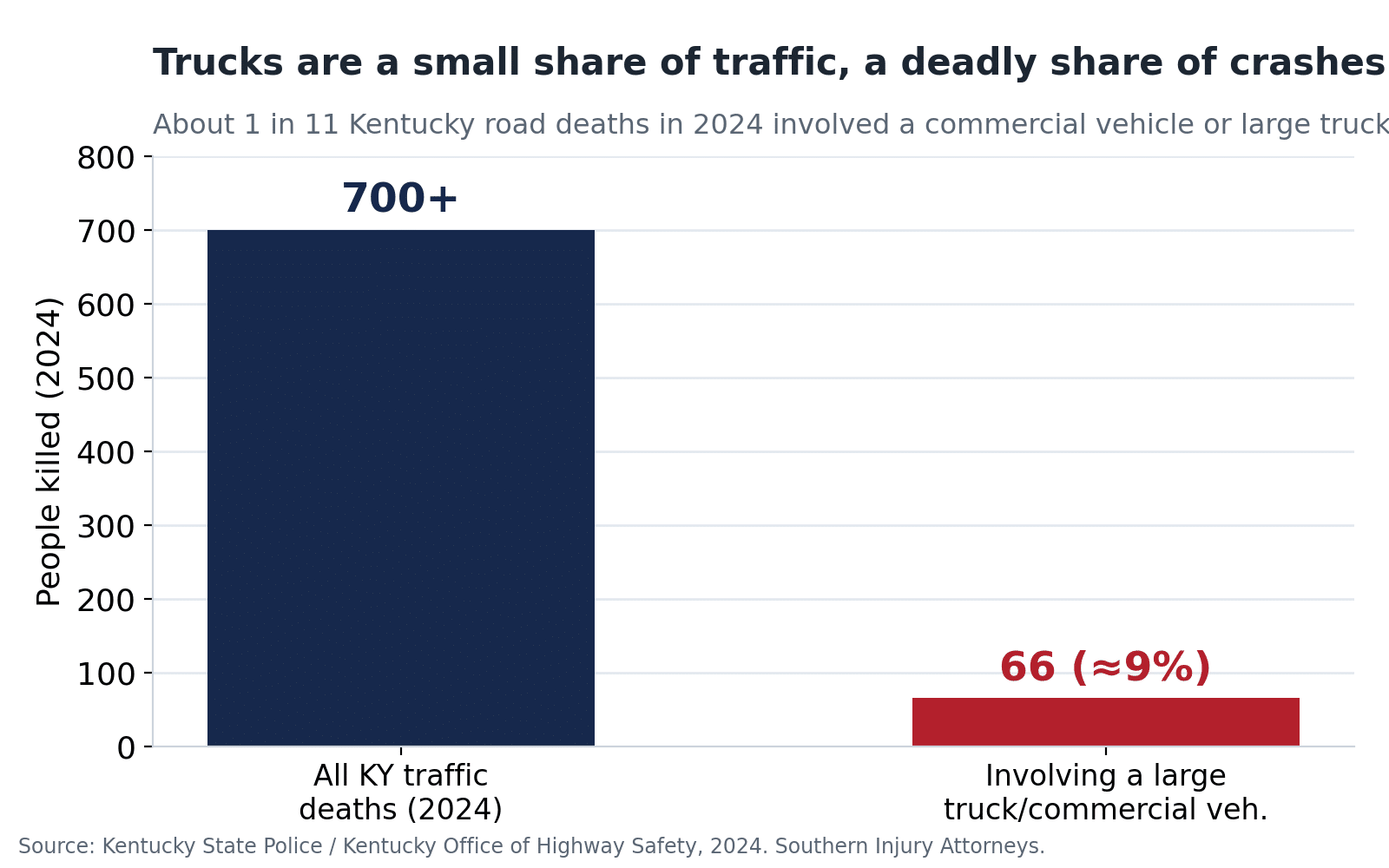
More than 700 people died on Kentucky roads in 2024, and large trucks and commercial vehicles were involved in 66 of those deaths — roughly one in eleven. The trend is worsening: the Kentucky Transportation Center found that annual fatal truck crashes climbed about 41% over a recent five-year period.
Lexington feels this risk directly. Interstates 75 and 64 carry heavy through-freight around the city, and Lexington police reported more than 11,000 collisions in Fayette County in the first nine-plus months of 2024 alone, including 37 fatal crashes for the year. Mixing fast interstate truck traffic with congested local roads like New Circle Road is a recipe for serious wrecks.
Why Lexington Truck Accident Cases Are Different
A truck accident claim is not just a larger car-accident claim — it is a different kind of case. It involves federal safety regulations, commercial policies worth hundreds of thousands to millions of dollars, several potentially liable businesses, and time-sensitive electronic evidence. The truck’s engine “black box” (event data recorder), the driver’s electronic logging device (ELD) records, and dispatch data can be overwritten or lawfully destroyed within days or weeks. Trucking companies often send investigators to the scene the same day. Acting quickly to send a legal evidence-preservation (spoliation) letter is one of the most important early steps a lawyer takes. Our truck teams handle these cases across the region, and you can read our broad truck accident lawyer overview for how these cases work nationwide.
Where Truck Accidents Happen in Lexington
Certain Lexington-area corridors concentrate commercial-truck traffic and crashes:
- Interstate 75: The major north-south freight route on the east side of the city — high speeds and dense truck volume.
- Interstate 64: The east-west artery that joins I-75 northeast of Lexington, a heavy merge point for through-trucks.
- New Circle Road (KY 4): The ring road around Lexington, where trucks mix with constant local traffic and frequent merges.
- Man o’ War Boulevard and US 60 (Versailles Road): Busy commercial arterials feeding warehouses, distribution, and the airport area.
Seriously injured victims are often taken to UK Albert B. Chandler Hospital, the region’s Level I trauma center — and those trauma bills become a central part of the claim.
Common Causes of Lexington Truck Accidents
Most truck crashes trace to preventable conduct: driver fatigue and hours-of-service violations; distracted driving; poor maintenance (worn brakes, bald tires, skipped inspections); speeding in congestion or work zones; improper or overloaded cargo; and the trucking company’s own negligent hiring, training, or scheduling. Inattention is the single most common contributing factor in Kentucky crashes overall. Pinpointing the cause is what establishes who is liable — and it frequently implicates the company, not just the driver.
Types of 18-Wheeler Accidents & Key Terms
Truck crashes take distinct forms — rear-end and override crashes in stopped traffic, jackknifes, underride collisions, rollovers, tire-blowout wrecks, and wide-turn or blind-spot accidents — and each carries a different injury pattern and investigation. Key terms to know:
- Underride accident
- When a smaller vehicle slides beneath a truck’s trailer — among the most deadly truck-crash types.
- Jackknife
- When a trailer swings out to form an angle with the cab, often after hard braking or loss of traction.
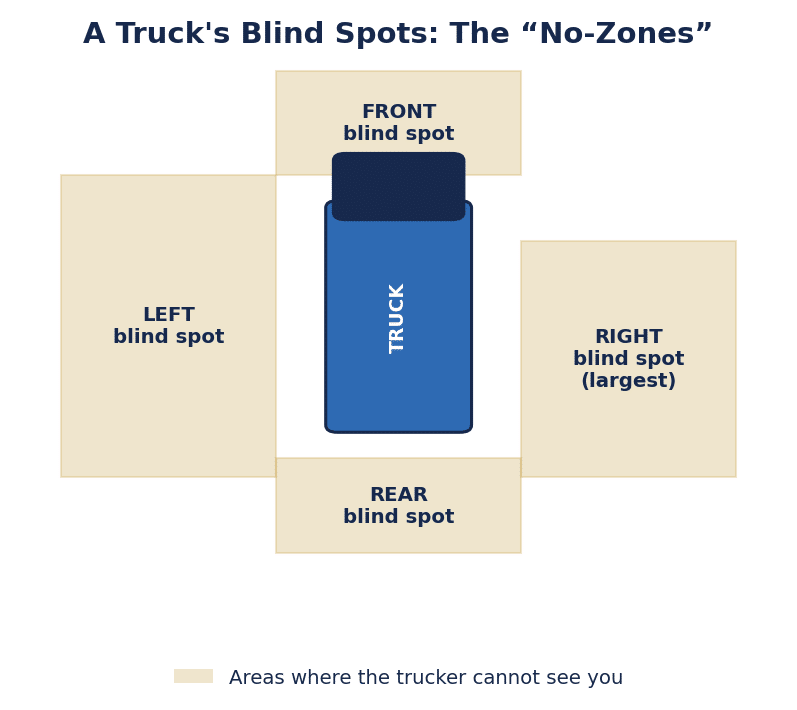
- No-zone
- A large truck’s blind spots — front, rear, and both sides — where the driver cannot see nearby vehicles.
- ELD (electronic logging device)
- Federally required equipment that records a driver’s hours of service — key evidence of fatigue or hours violations.
Catastrophic Truck Accident Injuries
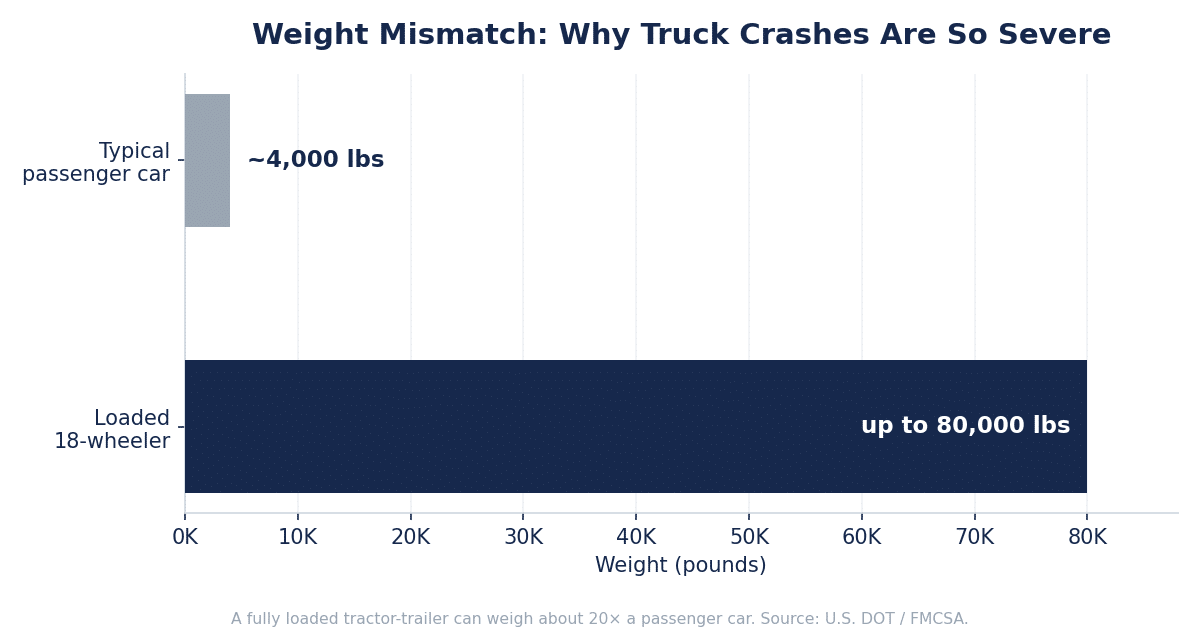
Because of the weight disparity — a loaded tractor-trailer can weigh up to 80,000 pounds, roughly twenty times a passenger car — truck crashes commonly cause traumatic brain injuries, spinal cord injuries and paralysis, multiple fractures, internal organ damage, amputations, severe burns, and wrongful death. These often require lifelong care. We work with treating physicians and life-care planners to document the full future cost of an injury, not just current bills.
How Much Is a Lexington Truck Accident Case Worth?
There is no fixed average — value turns on injury severity, total medical costs, lost income and earning capacity, pain and suffering, the strength of liability, and the insurance available. As a general illustration only (not a promise of any outcome):
| Injury severity | Typical range* |
|---|---|
| Minor, full recovery | Tens of thousands |
| Serious / surgical injuries | Mid–high six figures |
| Catastrophic / permanent disability | Seven figures and up |
| Wrongful death | Highly case-specific; frequently seven figures |
*Estimates for illustration; every case is unique and results are never guaranteed.
Why truck cases carry more value than car cases: federal law requires interstate carriers to carry far higher insurance than Kentucky’s $25,000 per person / $50,000 per accident / $25,000 property car minimum — generally at least $750,000 for general freight and often $1 million or more, with higher limits for hazardous materials. Catastrophic-crash costs often exceed a single policy, so we identify every applicable policy and every liable party.
Kentucky & Federal Trucking Regulations
Commercial trucks must follow Federal Motor Carrier Safety Administration (FMCSA) rules and Kentucky regulations on hours of service, driver qualifications, maintenance and inspection, drug and alcohol testing, and cargo securement. A documented violation is strong evidence of negligence — in many cases, negligence per se. We obtain and analyze the driver logs, ELD data, maintenance records, the driver-qualification file, and the carrier’s FMCSA safety record to surface violations the company would rather keep buried.
Who Is Liable for a Lexington Truck Accident?
Liability often spans several parties: the driver, the trucking company (which can be vicariously liable for its driver and directly liable for negligent hiring, training, or maintenance), the trailer owner or lessor, a maintenance contractor, the cargo loader, or a parts manufacturer. Kentucky uses a pure comparative fault rule (KRS 411.182) — you can recover even if you were partly at fault, with your award reduced by your percentage of fault, and there is no cutoff that bars recovery. Suits arising from a Lexington crash are typically filed in Fayette Circuit Court, or in the U.S. District Court for the Eastern District of Kentucky, Lexington Division, when federal jurisdiction applies.
What to Do After a Truck Accident in Lexington
- Get to safety and turn on your hazards.
- Call 911 — a police report creates the official record.
- Get medical care immediately, even if you feel okay; truck-crash injuries are often masked at first.
- Document everything — photos of the vehicles, the company name and USDOT number on the truck, road conditions, and injuries.
- Collect witness names and numbers.
- Decline a recorded statement to the trucking company’s insurer until you’ve spoken with a lawyer.
- Preserve evidence — don’t repair or scrap your vehicle until it’s inspected.
- Call a Lexington truck accident lawyer fast — electronic evidence such as the ELD logs and black box can vanish within days.
How Long Will My Lexington Truck Accident Claim Take?
Most truck accident claims move through five prelitigation stages — intake, medical treatment, collecting records and bills, sending the demand package, and settlement negotiation. Straightforward cases can resolve in a few months; serious cases often take about 8–9 months or longer, because the claim is strongest once your treatment is complete and the full cost of your injuries is known. Remember that even though trucking is federally regulated, your lawsuit deadline is set by Kentucky law — generally two years.
Our Results in Truck & Auto Accident Cases
Every case is different, but our results reflect how hard we fight for truck and auto accident victims:
- Six-figure recovery — Our client was stopped in traffic when an 18-wheeler failed to stop in time and rear-ended them.
- Six-figure settlement — An 18-wheeler pushed our client into a barrier wall, causing her injuries.
- $175,000 settlement — Our client’s Mercedes was rear-ended and caught fire; even with minimal medical treatment, we recovered $175,000.
Prior results do not guarantee a similar outcome. Every case depends on its own facts.
Why Choose Southern Injury Attorneys
We focus on serious auto and truck accident cases across Kentucky and the South, so we know how trucking companies and their insurers operate. We move fast to preserve evidence, retain accident-reconstruction and medical experts, handle every insurer conversation, and build each case for trial — which is what drives fair settlements. You pay nothing unless we win.
Lexington clients are served by our Kentucky-licensed attorneys from our regional offices, with our headquarters at 5865 Ridgeway Center Pkwy, Suite 390, Memphis, TN 38120 · 800-224-5546. Consultations are free and can be handled by phone — you never need to travel to talk to us. If your crash happened elsewhere in Kentucky, see our Louisville truck accident lawyers, and for car and auto wrecks visit our Lexington car accident lawyers.
Lexington Truck Accident FAQs
How long do I have to file a truck accident claim in Kentucky?
Generally two years — measured from the crash date or the date of your last no-fault (PIP) payment, whichever is later, under KRS 304.39-230. Because a truck crash is a motor-vehicle case, this two-year deadline applies (not Kentucky’s one-year general personal-injury rule). Limited exceptions can change the window, so talk to a lawyer promptly.
Who can be sued after a truck accident?
Often more than one party. Potentially liable are the driver, the motor carrier (for its driver’s conduct and its own negligent hiring, training, or maintenance), the truck or trailer owner, the cargo loader or shipper, a maintenance contractor, and sometimes a parts manufacturer or freight broker. Identifying every defendant is what maximizes recovery.
Is the trucking company responsible or just the driver?
Frequently both. A trucking company can be vicariously liable for its driver and directly liable for its own negligence in hiring, training, supervision, maintenance, or scheduling. Pinning down the company’s role is often where the largest recoveries come from.
How much insurance do trucking companies carry?
Far more than ordinary drivers. Interstate carriers must carry a federal minimum of $750,000 in liability coverage, and $1 million or more is common, with higher limits for hazardous cargo — compared with Kentucky’s $25,000 car minimum. That is a major reason truck cases carry more value.
What evidence matters most in a truck case?
The records the carrier controls: the ELD/hours-of-service logs, the engine “black box” (speed, braking, throttle), dashcam and telematics, the driver-qualification file, maintenance and inspection records, the bill of lading, and post-crash drug/alcohol testing. Federal rules let some of this be destroyed on a schedule, so a preservation letter must go out immediately.
What if I was partly at fault?
You can usually still recover. Kentucky follows pure comparative fault (KRS 411.182): your compensation is reduced by your percentage of fault, but there is no cutoff that bars recovery — even if you were mostly at fault, you may still recover something.
How does Kentucky no-fault (PIP) affect a truck claim?
Kentucky is a no-fault state, so your own Personal Injury Protection pays the first $10,000 of medical bills and lost wages regardless of fault. When injuries are serious — over $1,000 in medical bills, a broken bone, permanent injury, disfigurement, or death — you can step outside no-fault and pursue the at-fault trucking company for full damages, including pain and suffering.
How much does a Lexington truck accident lawyer cost?
Nothing up front. Southern Injury Attorneys work on a contingency fee — you pay legal fees only if we recover compensation for you. The initial consultation is free.
Talk to a Lexington Truck Accident Lawyer — Free
Don’t let the trucking company’s insurer control your story. Get a free, no-obligation consultation. Call 800-224-5546 — no fee unless you win. You can also contact us online.
This page is general legal information, not legal advice. Every case is different and outcomes are never guaranteed. Contacting us does not create an attorney-client relationship.

