


Quick answer: If you were rear-ended in Dallas, the driver who hit you is usually at fault — Texas law requires drivers to follow at a safe, “assured clear distance” and not more closely than is reasonable (Tex. Transp. Code § 545.062). You generally have two years to file (Tex. Civ. Prac. & Rem. Code § 16.003). Insurers fight these claims two ways: by arguing you “brake-checked” or stopped suddenly, and by claiming that minor vehicle damage means no real injury — even though low-speed rear-end crashes routinely cause whiplash and spine injuries. A consultation costs nothing, it is confidential, and you pay no fee unless we win. Call our Dallas office at 469-253-2533.
- Rear-end is the most common crash type in Texas and the U.S. — about 28% of all crashes — and the rear driver is usually at fault.
- Texas requires a safe following distance (Tex. Transp. Code § 545.062); tailgating and inattention are the leading causes.
- “Low damage” does not mean “low injury.” Whiplash and disc injuries are common even when the bumper looks fine, and they are the most frequently reported injury in U.S. auto claims.
- Watch for two insurer tactics: blaming you for a “sudden stop,” and using minor property damage to lowball your injury claim.
- You usually have two years to file (§ 16.003), and less if a government vehicle is involved.
- Consultations are free and confidential, with no fee unless we recover compensation for you.
Dallas Rear-End Accident Claims at a Glance
| Question | Short answer |
|---|---|
| Who is usually at fault? | The rear driver — for following too closely, speeding, or distraction (Tex. Transp. Code § 545.062). |
| Is the rear driver always at fault? | Usually, but not automatically; the lead driver can share fault (for example, broken brake lights). |
| My car barely has damage — do I have a case? | Yes. Low-speed rear-end crashes routinely cause whiplash and spine injuries. |
| How long do I have to file? | Generally two years from the crash (§ 16.003); less against a government entity. |
| What if a truck rear-ended me? | The trucking company and its insurer may also be liable — and the coverage is far larger. |
| What does a lawyer cost? | Nothing up front — consultations are free and the fee comes only from a recovery. |
Below, we explain who is at fault when you’re rear-ended in Dallas, why the rear driver usually bears responsibility, the injuries these crashes cause, and the two tactics insurers use to pay you less — plus the two-year deadline and what your claim may be worth.
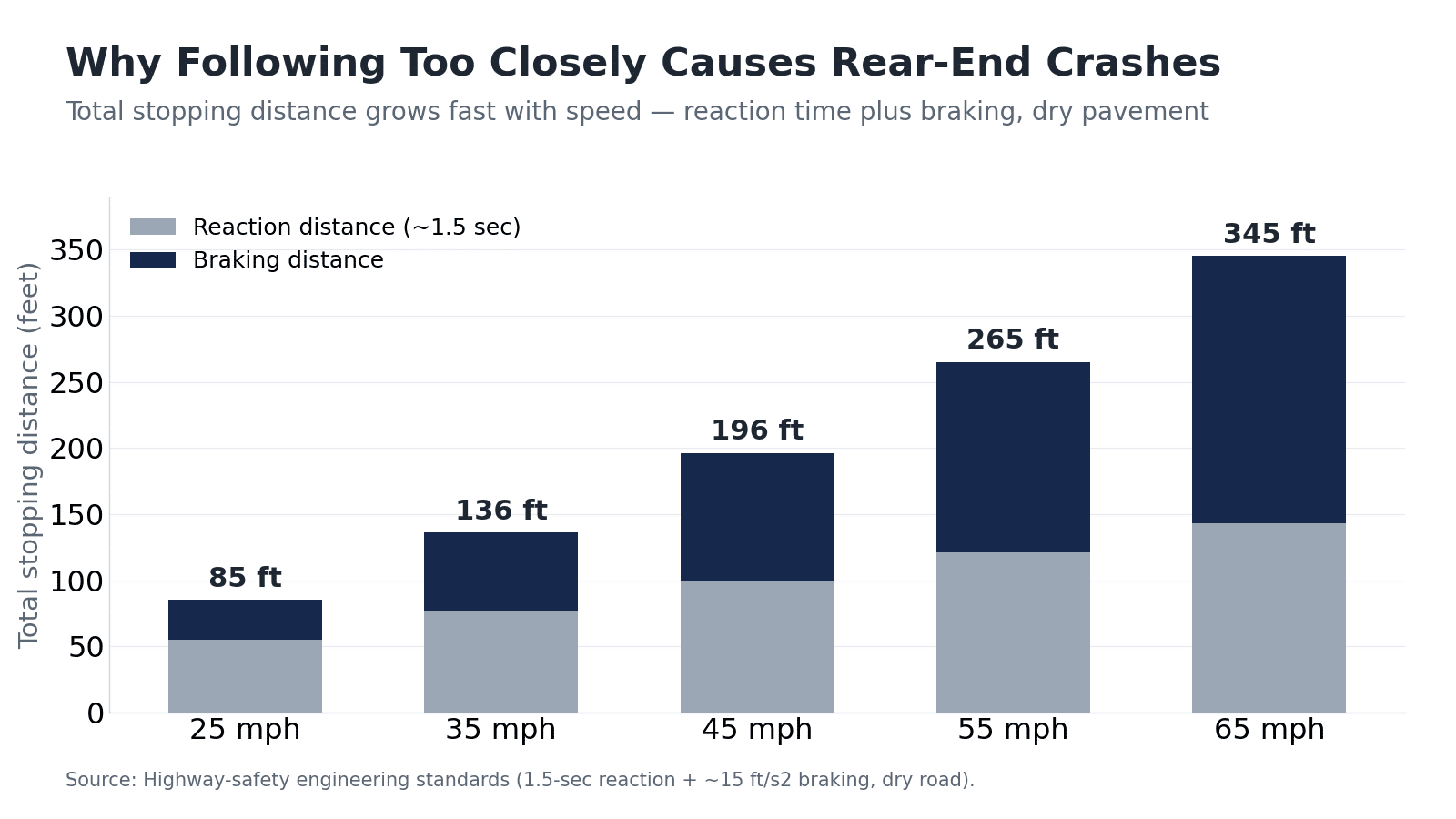
On Dallas’s stop-and-go corridors — Central Expressway (US 75), the LBJ Freeway (I-635), I-35E, and the rush-hour crawl between 5 and 7 p.m. — a driver who follows too closely or looks down at a phone simply cannot stop in time. That is the heart of almost every rear-end case.
Who Is at Fault in a Dallas Rear-End Accident?
In most rear-end crashes, the driver in back is at fault. Texas law (Tex. Transp. Code § 545.062) requires every driver to follow “not more closely than is reasonable and prudent,” keeping an assured clear distance so they can stop safely if traffic ahead slows or stops. A driver who rear-ends the car in front has almost always violated that duty — by tailgating, speeding, or not paying attention — and that violation is strong evidence of negligence.
The leading cause is driver inattention. In a landmark naturalistic-driving study, researchers found inattention was a contributing factor in the large majority of rear-end-striking crashes — the driver simply wasn’t watching the road. Distraction, following too closely, and speeding are the recurring themes.
Is the Rear Driver Always at Fault?
Usually — but not automatically. Texas does not have a rule that the rear driver is always 100% responsible. The driver in front can share fault in specific situations: brake lights that weren’t working, an unsafe or illegal lane change directly in front of the other car, stopping to make a turn that was never completed, or a vehicle left disabled in a travel lane without hazard lights. Even then, the rear driver’s duty to keep a safe distance still applies, and Texas’s comparative-fault rule lets you recover unless you were more than 50% at fault. We investigate exactly what happened — using the police report, witness statements, and any dash-cam or surveillance video — so fault is placed where it belongs.
What Causes Rear-End Crashes?
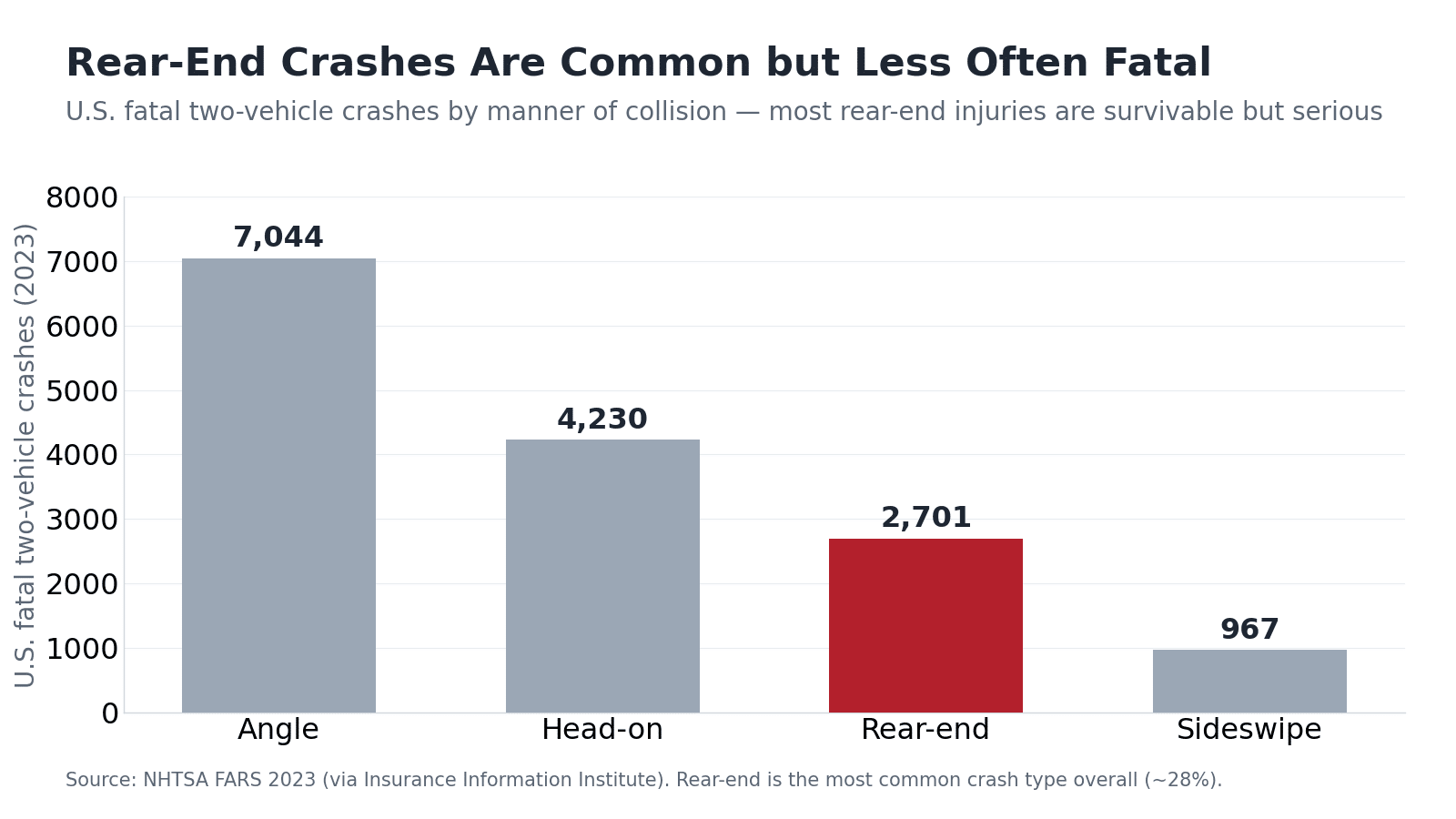
Rear-end collisions are the most common type of crash in Texas and nationally — roughly 28% of all crashes. The usual causes are:
- Distracted driving — texting, phones, and inattention, the single biggest factor.
- Following too closely (tailgating) — leaving no room to stop.
- Speeding and driving too fast for conditions, especially in rain or stop-and-go traffic.
- Impaired or drowsy driving, which slows reaction time.
- Sudden, heavy traffic on Dallas freeways where speeds change quickly.
Although rear-end crashes are the most common type, they are less often fatal than angle or head-on crashes — which is exactly why insurers try to treat them as minor. The injuries, however, are frequently anything but.
Rear-End Injuries and the “Low Damage” Myth
The most common rear-end injury is whiplash — a neck injury caused when the head is snapped back and forth on impact — along with herniated discs, back and spine injuries, concussions, and shoulder injuries. Whiplash and related soft-tissue and spine injuries are the most frequently reported injuries in U.S. auto-insurance claims, accounting for roughly one in three injury claims.
Insurers love to argue that “minor vehicle damage” means “minor injury.” It is not true. Modern bumpers are designed to absorb low-speed impacts with little visible damage, while the forces still transfer to the occupant’s neck and spine. Symptoms also frequently show up a day or two later, once the adrenaline fades — which is why prompt medical care and consistent treatment are so important to both your health and your claim.
How Insurers Fight Rear-End Claims
Even though fault is usually clear, insurers have two go-to tactics in rear-end cases. The first is to shift blame — claiming you “brake-checked,” stopped suddenly for no reason, or cut in front of their driver. The second is the “low-damage, low-injury” lowball — pointing to photos of an undented bumper to argue you couldn’t really be hurt, then offering a fraction of what your care is worth.
We counter both. For the fault-shift, we use the police report, witness accounts, the physical evidence, and any video to show the rear driver simply wasn’t watching. For the lowball, we document your injuries thoroughly with your treating doctors and, where needed, medical and biomechanical experts who explain how a low-speed impact causes real, lasting harm. The goal is a recovery that reflects your actual injuries, not the appearance of your bumper.
What Compensation Can a Dallas Rear-End Victim Recover?
A Texas rear-end injury claim can seek several categories of compensation:
- Medical expenses — ER care, imaging, physical therapy, injections, surgery, and future treatment for neck, back, and spine injuries.
- Lost income and lost earning capacity — time missed and any lasting limits on your ability to work.
- Pain and suffering and the impact on your daily life.
- Property damage to your vehicle.
- Exemplary (punitive) damages where the at-fault driver’s conduct was grossly negligent — for example, a drunk or extremely reckless driver.
Texas does not cap these damages outside of medical-malpractice cases. If a commercial truck rear-ended you, the trucking company and its much larger insurance policy may also be on the hook — see our Dallas truck accident lawyers page. And if the at-fault driver was uninsured or fled, your own uninsured/underinsured motorist coverage may pay.
How Long Do I Have to File? (Texas Statute of Limitations)
In Texas, the deadline to file a rear-end injury lawsuit is generally two years from the date of the crash (Tex. Civ. Prac. & Rem. Code § 16.003). The deadline can be paused for an injured minor, but it is otherwise strict, and a wrongful death claim also runs two years from the date of death. If a government vehicle — a city, county, or DART bus — was involved, a much shorter notice deadline applies first under the Texas Tort Claims Act, sometimes only months, and Texas cities including Dallas set their own short notice deadlines by charter. It is best to confirm the exact deadline early — there is no cost to ask.
What If I Was Partly at Fault?
You can usually still recover. Texas uses a modified comparative-fault rule with a 51% bar (Tex. Civ. Prac. & Rem. Code § 33.001): you may recover as long as you were not more than 50% responsible, and your compensation is reduced by your share of fault. This is exactly why the insurer’s “you stopped suddenly” argument matters — every percentage point of blame they shift onto you lowers what they pay. Careful investigation and presentation can keep the fault where it belongs.
Our Results in Serious Accident Cases
Every case is different, but our results reflect how hard we work for the people we represent:
- Six-figure recovery — Our client was stopped in traffic when an 18-wheeler failed to stop in time and rear-ended them.
- Six-figure settlement — An 18-wheeler pushed our client into a barrier wall, causing her injuries.
- $175,000 settlement — Our client’s Mercedes was rear-ended and caught fire; even with minimal medical treatment, we recovered $175,000.
Prior results do not guarantee a similar outcome. Every case depends on its own facts.
Why Dallas Drivers Choose Southern Injury Attorneys
We are a contingency-fee injury firm with attorneys licensed in Texas and in Tennessee, Mississippi, Arkansas, Kentucky, and Georgia, and we fight to maximize what rear-end victims recover. We pin down fault, document your injuries fully, take on the “low-damage” lowball, identify every at-fault party and insurance policy, and handle the insurers and defense lawyers — so you can focus on healing. We also handle the related cases in Dallas, including Dallas car accidents, Dallas truck accidents, Dallas motorcycle accidents, and Dallas pedestrian accidents, plus the broad areas on our rear-end collision lawyer page. Consultations are free and confidential, and there is no fee unless we recover for you.
Our Dallas office: 4245 N Central Expy, Suite 490, Dallas, TX 75205 · 469-253-2533. We are part of a firm headquartered in Memphis, with additional offices in Houston and Atlanta, serving people throughout Texas and the surrounding states. When you’re ready, you can also call our firm line at 800-224-5546 or reach out online.
Dallas Rear-End Accident FAQs
Who is at fault in a rear-end collision in Dallas?
Usually the driver in back. Texas law (Tex. Transp. Code 545.062) requires drivers to follow at a safe, assured clear distance so they can stop if traffic ahead slows. A driver who rear-ends the car in front has almost always violated that duty by tailgating, speeding, or not paying attention, and that violation is strong evidence of negligence. Fault is not automatic, though — the lead driver can share blame in specific situations — so the police report, witness statements, and any video matter.
Is the rear driver always at fault in Texas?
Usually, but not automatically. Texas has no rule making the rear driver 100% responsible in every case. The lead driver can share fault when, for example, their brake lights were not working, they made an unsafe lane change directly in front of the other car, they stopped for a turn they never completed, or they left a disabled vehicle in a lane without hazard lights. Even then, the rear driver’s duty to keep a safe following distance still applies, and under Texas’s comparative-fault rule you can recover unless you were more than 50% at fault.
My car barely has damage — do I still have a rear-end injury case?
Yes. The idea that minor vehicle damage means minor injury is a myth insurers use to pay less. Modern bumpers absorb low-speed impacts with little visible damage while the force still transfers to your neck and spine, and whiplash and disc injuries are common even in low-speed rear-end crashes. Symptoms often appear a day or two later once adrenaline fades. Prompt medical care and consistent treatment protect both your health and your claim, and we use your treating doctors and, when needed, medical experts to document the real injury.
What injuries do rear-end crashes usually cause?
The most common is whiplash — a neck injury from the head being snapped back and forth — along with herniated discs, back and spine injuries, concussions, and shoulder injuries. Whiplash and related soft-tissue and spine injuries are the most frequently reported injuries in U.S. auto-insurance claims, roughly one in three injury claims. Because symptoms can be delayed and worsen over time, it is important to be examined promptly and to follow through with treatment.
The insurance company says I “brake-checked.” What now?
This is one of two go-to insurer tactics in rear-end cases (the other is using minor vehicle damage to lowball the injury). Shifting blame onto you for a “sudden stop” lets the insurer reduce or deny the claim under Texas’s comparative-fault rule. We counter it with the police report, witness accounts, the physical evidence, and any dash-cam or surveillance video showing the rear driver simply was not keeping a safe distance or watching the road. You should not give a recorded statement to the other driver’s insurer before talking to a lawyer.
How long do I have to file a rear-end accident claim in Texas?
Generally two years from the date of the crash (Tex. Civ. Prac. & Rem. Code 16.003), and a wrongful death claim runs two years from the date of death. The deadline can be paused for an injured minor but is otherwise strict. If a government vehicle — such as a city, county, or DART bus — was involved, a much shorter notice deadline applies first under the Texas Tort Claims Act, sometimes only months, and Texas cities including Dallas set their own short notice deadlines by charter. It is best to confirm the exact deadline early.
What if a commercial truck rear-ended me?
A rear-end crash caused by an 18-wheeler or commercial truck is far more dangerous, and the trucking company and its insurer may be liable in addition to the driver — with much larger insurance coverage than a typical car policy. Federal regulations require carriers to keep driver logs, inspection records, and electronic data that can prove the driver was speeding, fatigued, or following too closely, but the company can lawfully destroy some of it quickly, so a preservation letter should go out immediately. See our Dallas truck accident page for more detail.
How much does a Dallas rear-end accident lawyer cost?
Nothing up front. We handle rear-end accident cases on a contingency fee, which means our fee comes only from a recovery — if there is no recovery, you owe no attorney’s fee. The initial consultation is always free and completely confidential, so there is no cost or obligation to ask questions and understand your options.
Will my Dallas rear-end accident case have to go to court?
Not necessarily. Many rear-end cases settle once liability is established and your injuries and losses are documented, without a trial. Others — especially those where the insurer disputes fault or undervalues a serious injury with the “low-damage” argument — may need to be litigated, and some are tried before a Dallas County jury. We prepare every case as if it will go to trial, because that is often what produces the strongest settlement, while sparing you the courtroom whenever a fair resolution can be reached.
Talk to a Dallas Rear-End Accident Lawyer — Free Consultation
If you were rear-ended in Dallas, you don’t have to face the insurance companies alone. We offer a free, confidential consultation — no pressure, no obligation, and no fee unless we recover for you. Our attorneys are licensed in Texas and five neighboring states. Call our Dallas office at 469-253-2533, our firm line at 800-224-5546, or reach out online.
This page is general legal information, not legal advice. Every case is different and outcomes are never guaranteed. Contacting us does not create an attorney-client relationship. Prior results do not guarantee a similar outcome.

