


Quick answer: If you were hurt in an Atlanta motorcycle crash — or lost a rider you love — you generally have two years to file a claim in Georgia (O.C.G.A. § 9-3-33). Georgia is a universal-helmet state (O.C.G.A. § 40-6-315), lane-splitting is illegal (O.C.G.A. § 40-6-312), and Georgia follows a modified comparative-negligence rule with a 50% bar (O.C.G.A. § 51-12-33) — you can recover as long as you were less than 50% at fault, with your award reduced by your share. Most serious motorcycle crashes are caused by another driver, often one turning left across a rider’s path. A consultation costs nothing, it is confidential, and you pay no fee unless we win. Call our Atlanta office at 800-224-5546.
- Most motorcycle crashes are the other driver’s fault — nationally, in 46% of fatal car-vs-motorcycle crashes the other vehicle was turning left while the rider went straight (NHTSA, 2023).
- Georgia requires a DOT helmet for every rider, of every age (O.C.G.A. § 40-6-315) — one of the strictest helmet laws in the country.
- Lane-splitting is illegal in Georgia (O.C.G.A. § 40-6-312), and doing it can be used to shift blame onto a rider.
- You usually have two years to file (O.C.G.A. § 9-3-33), and Georgia’s 50% bar means partial fault reduces — but does not erase — your recovery.
- Atlanta’s congestion makes riding here uniquely dangerous — the I-285 Perimeter, the I-75/I-85 Downtown Connector, and GA 400 put riders among fast, heavy, multi-lane traffic nearly year-round.
- Consultations are free and confidential, with no fee unless we recover compensation for you.
Atlanta Motorcycle Accident Claims at a Glance
| Question | Short answer |
|---|---|
| Who is usually at fault? | Most often the other driver — especially in left-turn, lane-change, and following-too-closely crashes. |
| How long do I have to file? | Generally two years from the crash (O.C.G.A. § 9-3-33); a fatal-crash claim also runs two years. |
| Does Georgia require a helmet? | Yes — a DOT-approved helmet for every rider and passenger of every age (O.C.G.A. § 40-6-315). |
| Is lane-splitting legal? | No (O.C.G.A. § 40-6-312); two motorcycles may share a lane, but no rider may split between cars. |
| What if I was partly at fault? | Georgia uses a 50% bar (O.C.G.A. § 51-12-33); you can recover if you were under 50% responsible. |
| What does a lawyer cost? | Nothing up front — consultations are free and the fee comes only from a recovery. |
Below we explain, plainly, who is usually at fault in an Atlanta motorcycle crash, how Georgia’s helmet and lane-splitting laws affect your claim, the two-year deadline, what your case may be worth, and the local realities — from the Downtown Connector to the Perimeter — that shape these cases across metro Atlanta.
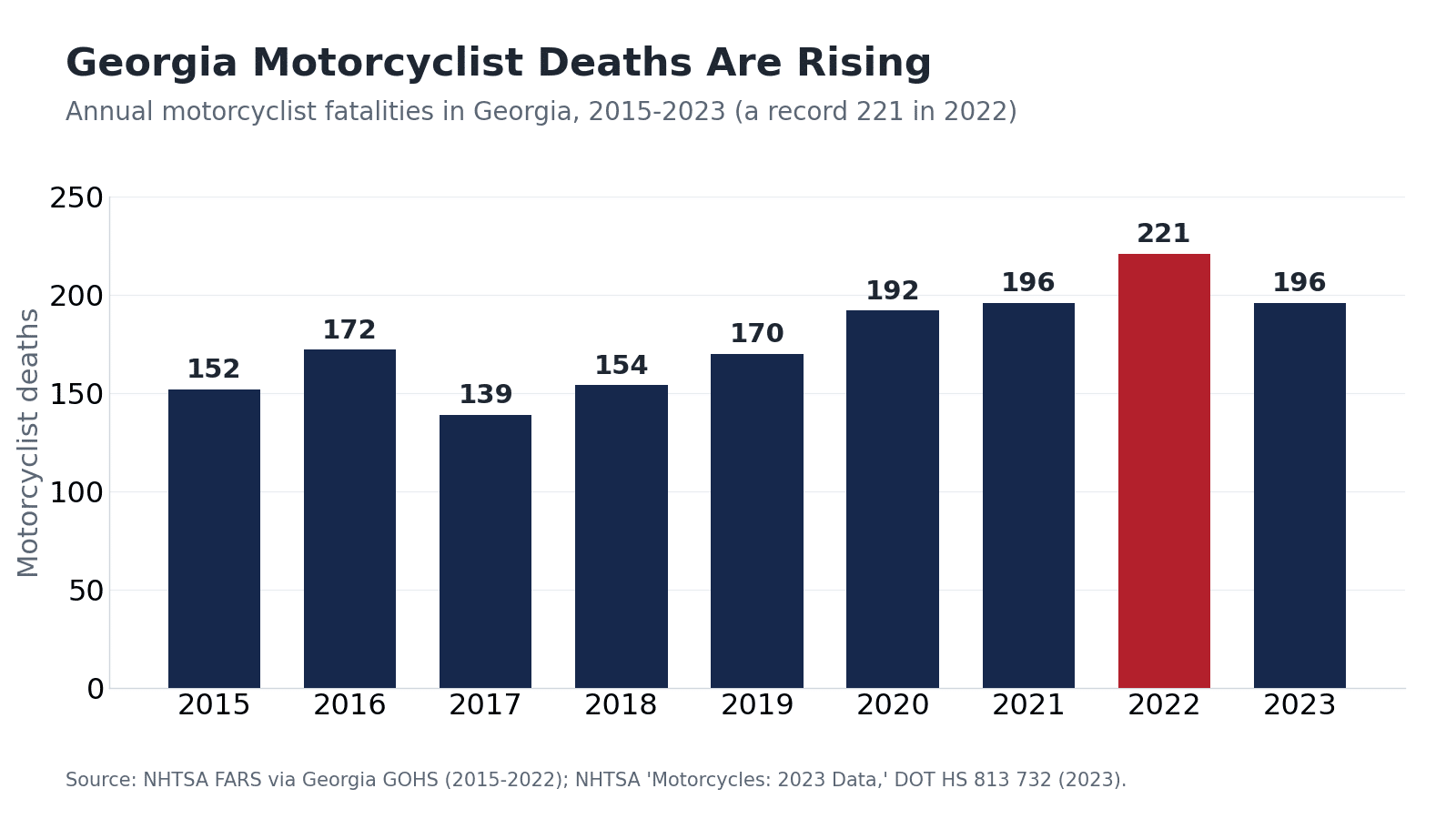
Every one of those numbers was a person — a rider, and a family. Georgia’s near-year-round riding climate puts more motorcycles on the road for more of the year than most states, and metro Atlanta’s traffic is among the worst in the nation. The result is a steady stream of high-speed, multi-vehicle crashes in which the rider almost always pays the higher price.
What Should I Do After a Motorcycle Accident in Atlanta?
The most important steps after an Atlanta motorcycle crash are to protect your health and protect the evidence. If you are able, do the following — and if your injuries kept you from doing them, a lawyer can still reconstruct what happened.
- Get medical care right away, even if you feel “okay.” Adrenaline masks injuries, and a gap in treatment is the first thing an insurer uses to argue you weren’t really hurt.
- Call 911 and make sure a police report is created. The responding officer’s report and any citation issued to the other driver are powerful early evidence.
- Photograph everything — both vehicles, the roadway, skid marks, traffic signals, debris, and your gear and injuries.
- Get names and numbers for the other driver, witnesses, and anyone who stopped to help.
- Do not admit fault or downplay your injuries at the scene or to the other driver’s insurer.
- Preserve your motorcycle and gear exactly as they are — don’t repair or discard anything until it has been documented.
- Talk to a lawyer before giving a recorded statement to the at-fault insurer. That call is free, and it can keep an early misstep from costing you later.
Who Is at Fault in an Atlanta Motorcycle Accident?
In most motorcycle crashes, the other driver is at fault — not the rider. The single most common fatal pattern is the left-turn crash: a driver turns left across an intersection or into a driveway directly in front of an oncoming motorcycle. Nationally, in 46% of fatal two-vehicle crashes involving a motorcycle and another vehicle, the other vehicle was turning left while the motorcycle was going straight, passing, or overtaking (NHTSA, 2023). Drivers routinely say they “never saw” the motorcycle — which is exactly the point: a motorcycle’s narrow profile is easy to miss and its speed is easy to misjudge, and a driver’s duty is to look.
Other frequent causes include unsafe lane changes into a rider’s path, following too closely and rear-ending a slowing or stopped motorcycle, distracted driving, and impaired driving. These crashes are so severe because the rider has no steel cage, airbags, or crumple zone — which is why motorcyclists are so badly over-represented in traffic deaths.
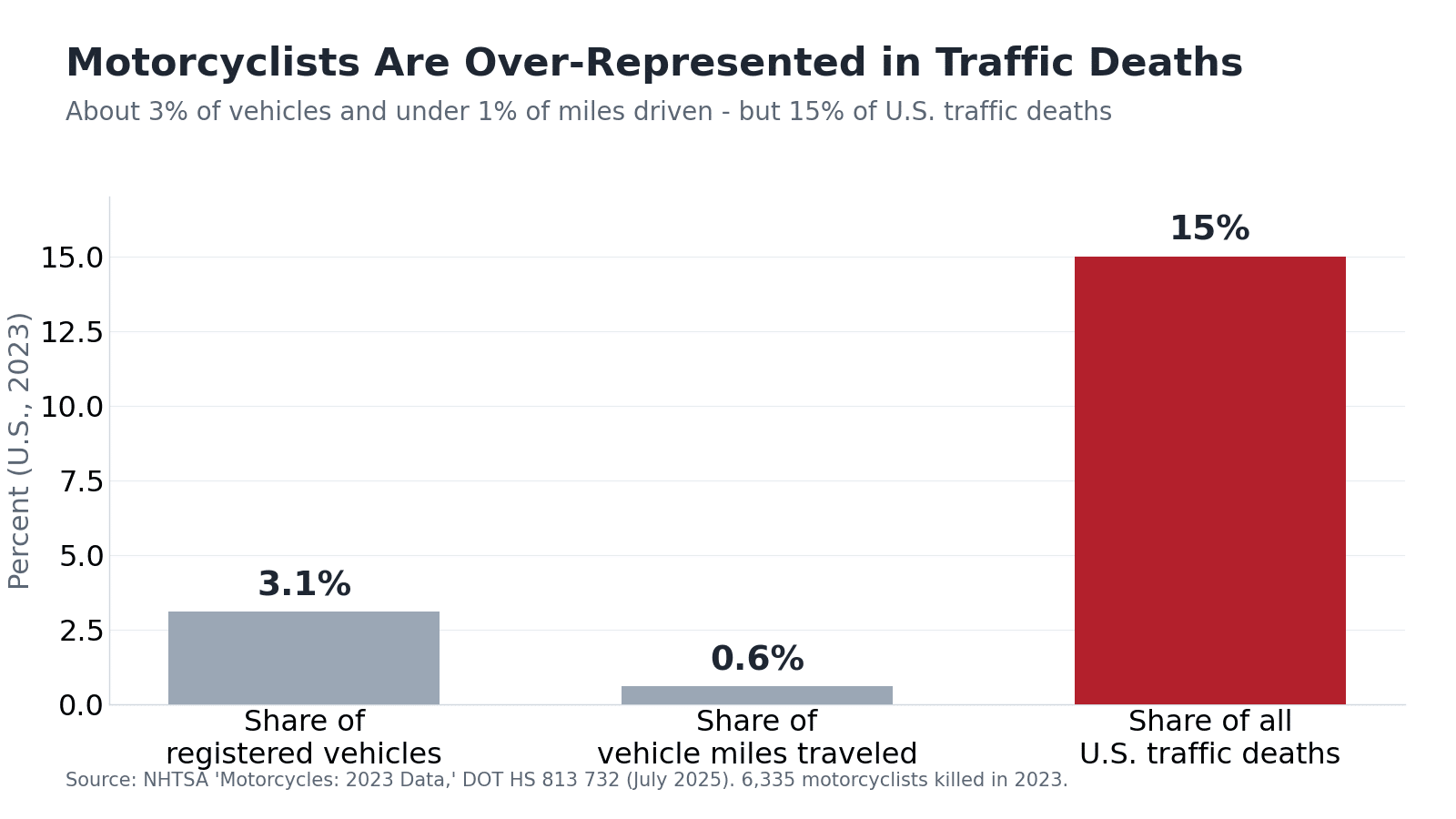
Establishing that the other driver was at fault — and overcoming the bias that “the biker must have been speeding” — takes real work: the police report, intersection and traffic-signal data, nearby surveillance or dash-cam video, vehicle damage patterns, and often an accident-reconstruction expert. We build that case so the insurer cannot simply blame the rider.
Does Georgia’s Helmet Law Affect My Claim?
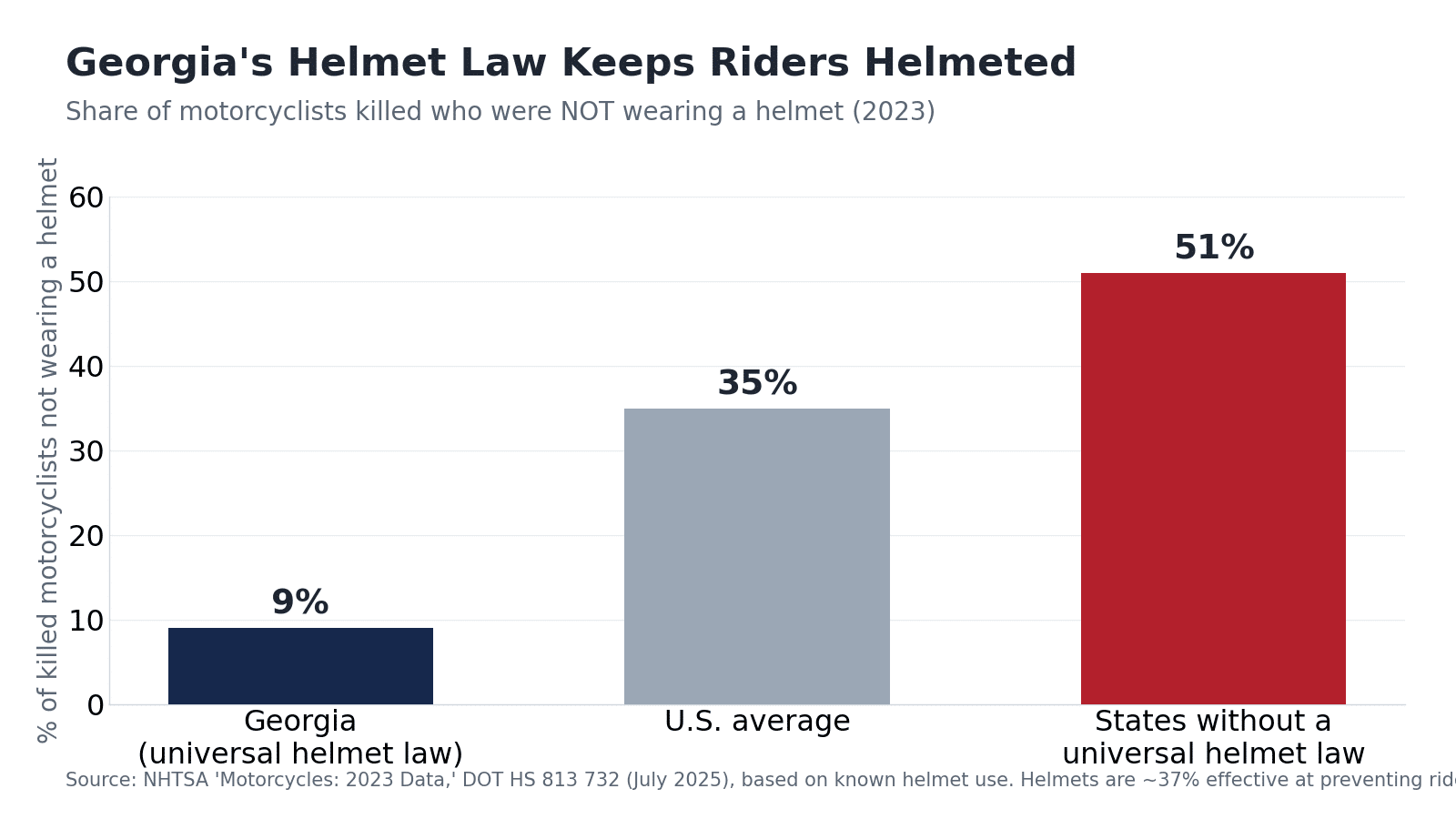
Yes — in two ways. First, Georgia requires every motorcycle rider and passenger, of every age, to wear a DOT-approved helmet (O.C.G.A. § 40-6-315), and to use eye protection if the motorcycle has no windshield. It is one of roughly 18 states with a true universal helmet law, with no age or insurance exception. Because of that law, Georgia riders wear helmets at very high rates — only about 9% of Georgia motorcyclists killed in 2023 were unhelmeted, compared with 35% nationwide and 51% in states without a universal law.
Second, helmet use can affect how much you recover. If you were wearing a compliant helmet — as the law requires — this is a non-issue. If a rider was not wearing one, an at-fault driver’s insurer may argue the rider shared fault under Georgia’s comparative-negligence rule (O.C.G.A. § 51-12-33). That argument is generally limited to head and neck injuries — it does not reduce recovery for broken bones, road rash, internal injuries, or other harm a helmet would not have prevented, and it does not bar a claim unless a rider is found 50% or more at fault. How this issue is handled can significantly change the outcome, so it should never be navigated without a lawyer.
Is Lane-Splitting Legal in Georgia?
No. Lane-splitting is illegal in Georgia. Under O.C.G.A. § 40-6-312, a motorcycle may not be operated between lanes of traffic or between adjacent rows of vehicles. Georgia does allow two motorcycles to ride side by side in a single lane, but a rider may never split or filter between cars. As of 2026 no bill legalizing lane-splitting has passed the Georgia General Assembly.
This matters for your claim because if a rider was lane-splitting when a crash occurred, the other driver’s insurer will use it to shift blame. But illegal lane-splitting does not automatically make a rider responsible — the other driver’s own negligence (an abrupt lane change, distraction, a door opening) still counts, and Georgia’s comparative-fault rule allows recovery so long as the rider was less than 50% at fault. These are exactly the fights where having a lawyer who knows how to apportion fault makes the difference.
What Compensation Can I Recover After an Atlanta Motorcycle Crash?
A Georgia motorcycle injury claim can seek several categories of compensation:
- Medical expenses — emergency care, surgery, hospitalization, rehabilitation, future and ongoing treatment, and assistive devices. Motorcycle injuries are often catastrophic: traumatic brain injury, spinal-cord injury, fractures, internal injuries, and severe road rash.
- Lost income and lost earning capacity — the wages you missed and the future earnings a permanent injury takes away.
- Pain and suffering — the physical pain and emotional toll of the crash and recovery.
- Permanent scarring and disfigurement — common and compensable in serious motorcycle cases.
- Property damage — repair or replacement of your motorcycle and gear.
- Punitive damages — available where the conduct was egregious, and notably uncapped in Georgia when the at-fault driver was DUI (O.C.G.A. § 51-12-5.1(f)).
If a rider was killed, Georgia law allows the family to recover the “full value of the life of the decedent” (O.C.G.A. §§ 51-4-1, 51-4-2), measured without deducting the deceased person’s own living expenses, and the estate may bring a separate claim for funeral, medical, and pre-death pain and suffering. If you lost a loved one, please see our wrongful death lawyer page, and accept our sincere condolences.
How Long Do I Have to File? (Georgia Statute of Limitations)
In Georgia, you generally have two years from the date of the crash to file a motorcycle-accident injury lawsuit (O.C.G.A. § 9-3-33). A wrongful death claim for a rider who was killed also carries a two-year deadline, though in some cases the clock can be paused while a related criminal case or the estate’s administration is resolved.
There are important exceptions. The deadline can be tolled (paused) for an injured minor, and a claim involving a government entity — a city or county vehicle, a transit bus, or a dangerous public road — carries a much shorter ante litem notice deadline (as little as six months for a municipality and twelve months for the State or a county) that comes long before the two-year suit deadline. Because these rules are technical and unforgiving, it is best to confirm the exact deadline that applies to you early — there is no cost to ask.
What If I Was Partly at Fault?
You can usually still recover. Georgia follows a modified comparative-negligence rule with a 50% bar (O.C.G.A. § 51-12-33): you may recover as long as you were less than 50% responsible for the crash, and your compensation is reduced by your percentage of fault. If your damages are $200,000 and you are found 20% at fault, you recover $160,000; if you are found 50% or more at fault, you recover nothing. Insurers know this, so they work hard to pin extra blame on riders — arguing you were speeding, lane-splitting, or hard to see. Being blamed is a reason to call a lawyer, not a reason to give up; how fault is investigated and presented often decides how much of that 50% line you end up on.
Where Do Atlanta Motorcycle Crashes Happen?
Metro Atlanta’s geography concentrates risk on a handful of notorious, high-speed corridors. The I-285 “Perimeter” rings the city with relentless multi-lane traffic and heavy truck volume; the I-75/I-85 “Downtown Connector” funnels the region’s traffic through the heart of the city; and GA 400 carries fast commuter traffic north. Add surface-street intersections across Fulton and DeKalb counties — which consistently lead Georgia in motorcycle crashes — and a near-year-round riding season, and the exposure for riders is among the highest in the Southeast.
Most serious Atlanta motorcycle cases are filed in the State Court of Fulton County, which handles the bulk of serious personal-injury and wrongful-death suits, or the Superior Court of Fulton County; a case with federal jurisdiction would be heard in the U.S. District Court for the Northern District of Georgia, Atlanta Division. Knowing the local courts, judges, and how metro Atlanta juries view motorcycle cases is part of building maximum value.
What Is an Atlanta Motorcycle Accident Case Worth?
There is no fixed average, and any lawyer who quotes you a number before reviewing the facts is guessing. Value depends on the severity and permanence of your injuries, your medical bills and lost income, the strength of the liability evidence, and — critically — how much insurance coverage is available. A catastrophic injury can easily exceed the at-fault driver’s policy limits, which makes it essential to identify every source of recovery.
That often includes your own uninsured/underinsured motorist (UM/UIM) coverage, which can pay when the at-fault driver has no insurance or not enough — a real risk in Georgia, where roughly one in five drivers is uninsured. See our Atlanta uninsured motorist lawyer page and our broad uninsured motorist accident lawyer page. Finding every responsible party and every available policy is frequently what separates a quick, low offer from a recovery that truly reflects the harm.
Our Results in Serious Accident Cases
Every case is different, but our results reflect how hard we work for the people we represent:
- Six-figure recovery — Our client was stopped in traffic when an 18-wheeler failed to stop in time and rear-ended them.
- Six-figure settlement — An 18-wheeler pushed our client into a barrier wall, causing her injuries.
- $175,000 settlement — Our client’s Mercedes was rear-ended and caught fire; even with minimal medical treatment, we recovered $175,000.
Prior results do not guarantee a similar outcome. Every case depends on its own facts.
Why Atlanta Riders Choose Southern Injury Attorneys
We are a contingency-fee injury firm with attorneys licensed in Georgia and in Tennessee, Mississippi, Arkansas, Texas, and Kentucky, and we fight to maximize what injured riders and grieving families recover. We investigate the crash, take on the bias against motorcyclists, identify every at-fault party and insurance policy, work with accident-reconstruction and medical experts, and handle the insurers and defense lawyers — so you can focus on healing. We also handle the related cases in metro Atlanta, including Atlanta car accidents, Atlanta truck accidents, and uninsured-motorist claims. Consultations are free and confidential, and there is no fee unless we recover for you.
Our Atlanta office: 730 Peachtree Street NE, #570, Atlanta, GA 30308 · 800-224-5546. We are part of a firm headquartered in Memphis, with additional offices in Houston and Dallas, serving riders throughout Georgia and the surrounding states. When you’re ready, you can also reach out online.
Atlanta Motorcycle Accident FAQs
Does Georgia require motorcycle helmets?
Yes. Georgia is a universal-helmet state: under O.C.G.A. 40-6-315, every motorcycle rider and passenger, of every age, must wear a DOT-approved helmet (one that meets Federal Motor Vehicle Safety Standard 218), and must wear eye protection if the motorcycle has no windshield. There is no exception for older or insured riders. Riding without a compliant helmet is a misdemeanor, and it can also be used by an at-fault driver’s insurer to argue a rider shared fault for head or neck injuries — though that argument does not affect recovery for other injuries and does not bar a claim unless the rider is 50% or more at fault.
Is lane-splitting legal in Georgia?
No. Under O.C.G.A. 40-6-312, a motorcycle may not be operated between lanes of traffic or between adjacent rows of vehicles, so lane-splitting and lane-filtering are both illegal in Georgia. The law does permit two motorcycles to ride side by side in the same lane, but a rider may never split between cars or trucks. If a rider was lane-splitting when a crash happened, the other driver’s insurer will use it to shift blame — but the other driver’s own negligence still counts, and a rider can still recover so long as they were less than 50% at fault.
What is the average motorcycle accident settlement in Atlanta?
There is no reliable average, because the value of a motorcycle case depends on the specific facts — the severity and permanence of your injuries, your medical bills and lost income, the strength of the liability evidence, and how much insurance coverage is available. Motorcycle injuries are often catastrophic, which can push damages well past the at-fault driver’s policy limits and make uninsured/underinsured motorist coverage important. Anyone who promises a specific figure before reviewing the facts is guessing. A lawyer can give you a realistic assessment after reviewing what happened.
How much does an Atlanta motorcycle accident lawyer cost?
Nothing up front. We handle motorcycle accident cases on a contingency fee, which means our fee comes only from a recovery — if there is no recovery, you owe no attorney’s fee. The initial consultation is always free and completely confidential, so there is no cost or obligation to ask questions and understand your options.
Who is at fault in most Atlanta motorcycle accidents?
Most often the other driver. The most common serious pattern is the left-turn crash, where a driver turns left across a motorcycle’s path — nationally, in 46% of fatal two-vehicle motorcycle crashes the other vehicle was turning left while the motorcycle went straight (NHTSA, 2023). Other frequent causes are unsafe lane changes into a rider’s path, following too closely, and distracted or impaired driving. Drivers often claim they “never saw” the motorcycle, but the law requires them to look. Proving the other driver’s fault — and overcoming the bias against riders — takes the police report, traffic-signal and video evidence, and often an accident-reconstruction expert.
How long do I have to file a motorcycle accident claim in Georgia?
Generally two years from the date of the crash (O.C.G.A. 9-3-33), and a wrongful death claim for a rider who was killed also carries a two-year deadline. There are important exceptions: the deadline can be paused for an injured minor, and a claim against a government entity — a city or county vehicle, a transit bus, or a dangerous public road — requires a much earlier ante litem notice, sometimes as little as six months. Because missing a deadline can end a valid claim, it is best to confirm the exact date that applies to you as early as possible.
What if the driver who hit me had no insurance?
You may still be able to recover through your own uninsured/underinsured motorist (UM/UIM) coverage, which is designed to pay when the at-fault driver has no insurance or not enough to cover your injuries. This matters in Georgia, where roughly one in five drivers is uninsured, and motorcycle injuries frequently exceed a minimum policy. A UM/UIM claim is made against your own insurer, which can become an adversary even though you pay its premiums, so it helps to have a lawyer handle it. See our Atlanta uninsured motorist page for more.
What if a family member was killed in a motorcycle crash?
Georgia law allows the family to bring a wrongful death claim seeking the “full value of the life of the decedent” (O.C.G.A. 51-4-1 and 51-4-2), measured without deducting the deceased person’s own living expenses, and the estate may bring a separate claim for funeral and medical bills and the pain and suffering the rider endured before death. The deadline is generally two years. We handle these cases with the care they deserve; please accept our condolences, and see our wrongful death lawyer page for more detail.
Will my Atlanta motorcycle accident case have to go to court?
Not necessarily. Many motorcycle cases settle once liability is established and your injuries and losses are documented, without a trial. Others — especially those where the insurer disputes fault or undervalues a serious injury — may need to be litigated, and some are tried before a Fulton County jury. We prepare every case as if it will go to trial, because that is often what produces the strongest settlement, while sparing you the courtroom whenever a fair resolution can be reached.
Talk to an Atlanta Motorcycle Accident Lawyer — Free Consultation
If you were injured in an Atlanta motorcycle crash, or lost a rider you love, you don’t have to face the insurance companies alone. We offer a free, confidential consultation — no pressure, no obligation, and no fee unless we recover for you. Our attorneys are licensed in Georgia and five neighboring states. Call our Atlanta office at 800-224-5546 or reach out online when you’re ready.
This page is general legal information, not legal advice. Every case is different and outcomes are never guaranteed. Contacting us does not create an attorney-client relationship. Prior results do not guarantee a similar outcome.

