What Is the Hardest Injury to Prove in a Personal Injury Case?
Last Updated: February 19, 2026By: Larry “Jimmy” Peters, Managing AttorneyLicensed in TN, GA, TX, AR, KY
Find A Lawyer
The hardest injury to prove in a personal injury case is one that doesn’t show up on standard imaging, relies on subjective symptoms, or develops over time — such as soft tissue injuries, traumatic brain injuries (TBIs), chronic pain conditions, and psychological trauma. These “invisible injuries” are real and often severely debilitating, but insurance companies routinely exploit their complexity to deny or underpay claims. At Southern Injury Attorneys, we represent injury victims across Tennessee, Mississippi, Arkansas, and Texas who are fighting for fair compensation on exactly these types of difficult cases. If an insurer told you your injury is “hard to prove,” that’s not the end — it’s the beginning of the fight.
Table of Contents
Why Are Some Injuries Harder to Prove Than Others?
In any personal injury claim, your attorney must demonstrate two things: (1) that the injury is real and (2) that it was caused by someone else’s negligence. Most successful claims rest on objective medical evidence — things like X-rays, CT scans, and MRIs that show measurable physical damage. The problem is that many of the most painful and life-altering injuries produce no visible findings on standard diagnostic imaging. When there’s no image to show a jury or insurance adjuster, the burden shifts to detailed medical records, specialist evaluations, expert witnesses, and your own testimony — making these cases far more complex to win. Insurance adjusters are trained to minimize claims involving subjective symptoms. They will argue the injury is:
Pre-existing and unrelated to the accident
Exaggerated or inconsistent with the mechanism of injury
Not documented consistently enough to verify
Caused by a separate, unrelated event
Understanding which injuries face these challenges — and how experienced attorneys overcome them — is critical to protecting your rights.
The Hardest Injuries to Prove in Court
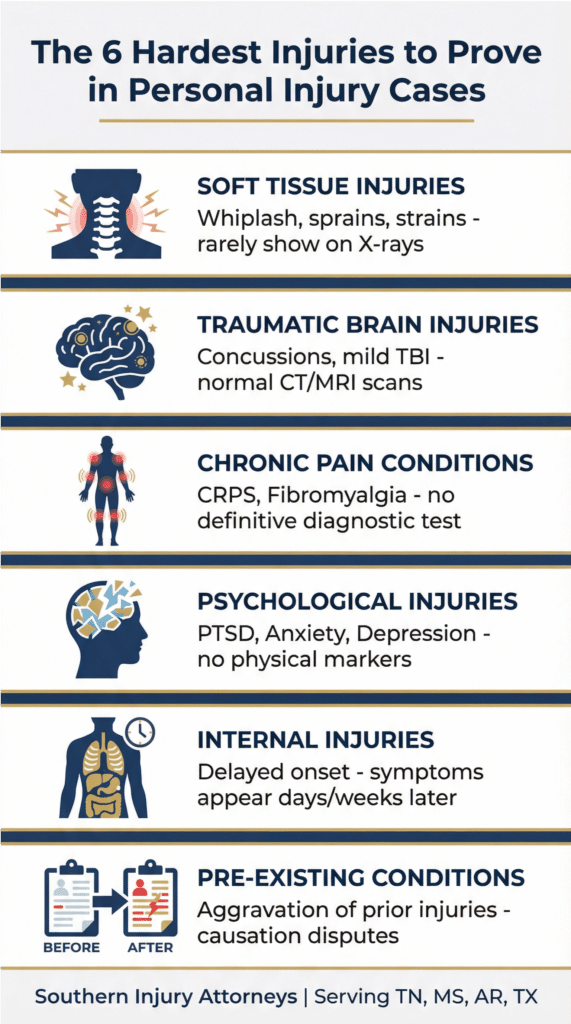
1. Soft Tissue Injuries (Whiplash, Sprains, and Strains)
Soft tissue injuries are the most common yet most disputed injuries in personal injury law. They involve damage to muscles, ligaments, tendons, and connective tissue — none of which appear clearly on a standard X-ray.
Why they’re hard to prove:
Standard imaging rarely captures soft tissue damage
Symptoms fluctuate day to day, undermining credibility
Insurance companies label them “minor” or claim they’re pre-existing
There is no single definitive test to confirm the severity
How we prove them: Consistent chiropractic and physical therapy records, treating physician testimony, MRI findings when available, and in advanced cervical injury cases — Digital Motion X-Ray (DMX/fluoroscopy), which captures ligament instability in real-time motion that static imaging misses entirely. A cervical ligament injury documented with DMX showing joint translation greater than 3.5mm constitutes a 25% permanent impairment of the whole body under the AMA Guidelines — a major value driver in settlement negotiations.
2. Traumatic Brain Injuries (TBIs) and Concussions
Traumatic brain injuries — including mild TBIs and concussions — are notoriously difficult to prove, especially when standard CT or MRI scans return normal or inconclusive results. Yet victims can suffer profound, life-altering symptoms. In fact, according to data from the 2023 National Health Interview Survey, an estimated 9.7 million Americans reported a TBI in the past year 1.
Why they’re hard to prove:
Symptoms like memory loss, mood changes, and cognitive fog are invisible on scans
Symptoms may not appear or worsen until days or weeks after the accident
Defense experts argue that complaints are exaggerated or related to anxiety/depression
Mild TBIs don’t always register on standard neuroimaging
How we prove them: Neuropsychological testing, fMRI or diffusion tensor imaging (DTI) when warranted, detailed neurological evaluations, expert witness testimony from neurologists, and documented functional limitations in daily activities.
3. Chronic Pain Conditions (CRPS, Fibromyalgia)
Complex Regional Pain Syndrome (CRPS) is perhaps the single most difficult physiological injury to prove in a courtroom. It occurs when the nervous system malfunctions after an injury — causing burning, severe pain that is disproportionate to the original trauma. A minor ankle sprain could trigger CRPS, leaving a victim unable to walk months later. Fibromyalgia is similarly difficult — characterized by widespread musculoskeletal pain, fatigue, and cognitive difficulties, it has no definitive diagnostic test and is diagnosed by ruling out other conditions.
Why they’re hard to prove:
No objective test definitively confirms CRPS or fibromyalgia
Symptoms are highly variable and subjective
Defense argues the condition is pre-existing or psychological
Insurance companies label these conditions as unverifiable
How we prove them: Pain management specialist records, documented treatment history, pain journals, testimony from treating physicians, and expert witness medical opinions that connect the diagnosis directly to the accident.
4. Psychological and Emotional Injuries (PTSD, Anxiety, Depression)
Accidents don’t only break bones — they break people. Post-traumatic stress disorder (PTSD), anxiety disorders, and depression are legitimate, diagnosable injuries that can follow car accidents, workplace accidents, and traumatic events. But because they leave no physical mark, they are frequently minimized or denied.
Why they’re hard to prove:
No physical test or scan diagnoses a psychological condition
Defendants argue symptoms existed before the accident
Jurors may be skeptical of “emotional” damage claims
Proving causation between the accident and the mental health condition requires expert testimony
How we prove them: Psychiatric and psychological evaluations, counseling and therapy records, testimony from mental health professionals, statements from family and coworkers who observed behavioral changes, and personal journals documenting daily struggles.
5. Internal Injuries With Delayed Onset
Some serious injuries — including internal bleeding, organ damage, and nerve injuries — produce no immediate symptoms. Victims often feel fine at the scene and only develop pain, swelling, or dysfunction days or even weeks later. This delay becomes a weapon for insurance companies.
Why they’re hard to prove:
The gap between accident and diagnosis creates causation disputes
Insurers argue the injury happened after the accident (a separate event)
Delayed treatment can appear to undermine credibility
Overlapping symptoms may suggest pre-existing conditions
How we prove them: Emergency and follow-up medical records tracing the onset of symptoms, physician opinions on injury timelines, imaging ordered after delayed symptom onset, and detailed treatment documentation from the moment symptoms appeared.
6. Aggravation of Pre-Existing Conditions
Many injury victims have prior medical histories — old back problems, prior surgeries, or degenerative disc disease. When an accident aggravates or worsens a pre-existing condition, insurance companies almost always try to blame your symptoms entirely on your prior history. Tennessee, Mississippi, Arkansas, and Texas law all recognize the “eggshell plaintiff” doctrine — which holds that a negligent party takes the victim as they find them. You cannot be denied compensation simply because you were more vulnerable to injury than the average person.
How we prove them: A clear before-and-after comparison of medical records, specialist testimony explaining how the accident worsened a prior condition, and baseline imaging or records predating the accident.
What Makes Any of These Injuries Winnable?
Even the hardest-to-prove injuries can support a strong claim with the right strategy. Here is what makes the difference:
Action
Why It Matters
Seek medical care immediately after the accident
Establishes a direct link between accident and injury
Provides subjective evidence of how the injury affects daily life
Obtain specialist referrals
Specialist findings carry more evidentiary weight
Work with an experienced personal injury attorney
Attorneys know which experts to retain and which strategies insurers fear
Document life changes (work, family, hobbies)
Supports non-economic damages like pain and suffering
Areas We Serve
Menu
Accidents We Handle
Menu
Will Insurance Companies Automatically Fight These Claims?
Yes — and aggressively. Insurance adjusters are not neutral parties. They are trained to protect their employer’s bottom line, which means disputing, delaying, or denying claims involving injuries that are difficult to verify objectively. Common tactics include:
Requesting your complete medical history to find pre-existing conditions
Conducting surveillance to catch you appearing “fine” on a good day
Offering quick, lowball settlements before the full extent of your injury is known
Claiming you failed to mitigate damages by not seeking treatment fast enough
Hiring their own expert witnesses to challenge your treating physician’s conclusions
The only effective counter is an experienced personal injury attorney who knows these tactics and builds an airtight evidentiary record from day one.
How Long Does It Take to Settle a Hard-to-Prove Injury Case?
There is no simple answer, as the timeline for a hard-to-prove injury case depends heavily on the complexity of the evidence and the insurance company’s willingness to negotiate fairly. These cases almost always take longer than claims involving straightforward, objective injuries.
Simple Cases (6-12 months): Cases with clear liability and well-documented “invisible” injuries might settle within a year, but this is less common.
Moderate Cases (1-2 years): If your case requires extensive medical expert testimony, advanced imaging, and depositions to prove the extent of a TBI or chronic pain, it could take one to two years to build the necessary evidence for a strong settlement.
Complex Cases (2-3+ years): Cases that go to trial will take the longest. Litigation involves a lengthy process of discovery, motions, and court dates. For a high-value, hard-to-prove injury, preparing for and going to trial can easily extend the timeline to three years or more.
An experienced attorney can give you a more accurate estimate based on the specifics of your case, but it is crucial to understand that these complex claims require patience and a commitment to seeing the fight through.
Hard-to-Prove Injuries in Tennessee, Texas, and Mississippi Courts
While the challenges of proving invisible injuries are universal, how these cases are handled can vary by state. At Southern Injury Attorneys, our multi-state presence gives us unique insight into the nuances of litigating these claims in local courts across the South.
Tennessee: With a very short one-year statute of limitations, victims in Tennessee have the least amount of time to file a lawsuit. This makes it critical to contact an attorney immediately, especially for an injury with delayed symptoms. Tennessee courts, particularly in metropolitan areas like Memphis and Nashville, are familiar with TBI and chronic pain litigation, but success still hinges on credible, well-presented expert testimony.
Case Example: *A client in Nashville was involved in a rear-end collision and diagnosed with whiplash. The insurer offered a nuisance-value settlement, arguing the MRI was “clean.” We retained a DMX expert who documented significant ligamentous laxity. Faced with this objective evidence of a permanent injury, the insurer’s settlement offer increased by over 1,500% before trial.*Tennessee’s one-year deadline is fast approaching — contact us now to protect your rights.
Texas: Texas has a two-year statute of limitations. Juries in Texas can be conservative, and insurance defense firms are aggressive. Proving a mild TBI or a disputed soft tissue injury in cities like Houston or Dallas often requires a robust legal strategy that includes not just medical experts, but also vocational experts to testify about the injury’s impact on your ability to work and earn a living.
Case Example: *In a Houston truck accident case, our client suffered a concussion that didn’t show on a CT scan. The defense claimed he was fine. We hired a neuropsychologist whose testing revealed significant cognitive deficits impacting his executive function. This expert report was the key to securing a seven-figure settlement for his TBI.*Don’t let the two-year deadline pass — call our Texas attorneys today.
Mississippi & Arkansas: Both states have a more generous three-year statute of limitations, which provides more time to gather the necessary medical evidence. However, success in these cases still depends on the quality of your medical records and legal arguments. Our attorneys are experienced in navigating the procedural rules in Mississippi and Arkansas to build a compelling case.
Case Example: *An Arkansas client developed CRPS after a slip-and-fall. The defense argued the pain was disproportionate to the initial ankle injury. We compiled extensive records from pain management specialists and presented testimony from the client’s family on the devastating impact on his daily life, overcoming the defense’s arguments and securing a favorable verdict at trial.*Even with three years, evidence can fade. Schedule a free consultation to get started.
Georgia: Like Texas, Georgia has a two-year statute of limitations for personal injury claims. Georgia’s legal environment is complex, and successfully litigating a hard-to-prove injury requires a deep understanding of local court precedents. Insurers frequently challenge claims involving delayed-onset injuries or the aggravation of pre-existing conditions like arthritis.
Case Example: *A client in Atlanta was in a minor car accident but experienced a severe flare-up of a pre-existing degenerative disc disease. The insurer refused to pay, blaming his pain on his prior condition. We used the “eggshell plaintiff” rule and medical expert testimony to prove the accident directly caused the aggravation, forcing the insurer to cover all related medical treatment and pain and suffering.*You only have two years to file in Georgia. Protect your claim by calling our Georgia personal injury lawyers today.
Frequently Asked Questions
What is the absolute hardest injury to prove in a personal injury case?
A: Chronic pain conditions like CRPS (Complex Regional Pain Syndrome) and mild traumatic brain injuries are widely considered the hardest, because they have no definitive diagnostic test and rely almost entirely on subjective patient-reported symptoms and specialist interpretation.
Are soft tissue injuries hard to win in court?
A: They can be, but they are winnable with consistent medical documentation, physical therapy records, treating physician testimony, and in advanced cases, Digital Motion X-Ray imaging that captures ligament damage that standard MRI misses.
Can I win a case if my MRI came back normal?
A: Yes. A normal MRI does not mean you are uninjured. Ligament injuries, soft tissue damage, and mild TBIs frequently do not show on standard imaging. An experienced attorney will know how to obtain the right diagnostic tools and expert testimony to document your true injury.
How do you prove pain and suffering in a lawsuit?
A: Pain and suffering is proven through medical records showing consistent treatment, personal pain journals, testimony from treating physicians, statements from family and coworkers, and expert opinions on how the injury has impacted your quality of life.
Does having a pre-existing condition hurt my case?
A: Not if you have the right attorney. Tennessee, Mississippi, Arkansas, Texas, and Georgia all recognize that defendants must compensate you for worsening a pre-existing condition. The “eggshell plaintiff” rule protects you.
What is the hardest injury to prove in a car accident case?
A: Soft tissue injuries like whiplash and mild traumatic brain injuries (TBIs) are often the hardest to prove after a car accident. This is because they are not always visible on initial X-rays or CT scans, leading insurance companies to unfairly dispute the severity of the injury despite the victim’s real pain.
How do you prove an injury that doesn’t show on an MRI?
A: To prove an injury that doesn’t appear on a standard MRI, we use advanced diagnostic tools like Digital Motion X-Ray (DMX) to show ligament instability, neuropsychological testing to document cognitive deficits from a TBI, and detailed testimony from medical experts who can connect your symptoms to the accident.
Can you sue for emotional distress without physical injury?
A: In most states we serve, including Tennessee and Texas, suing for standalone emotional distress is very difficult unless you were in the “zone of danger” of physical impact. However, you can almost always recover damages for emotional distress (like PTSD or anxiety) when it accompanies a physical injury, even a minor one.
What evidence do insurance companies fear most?
A: Insurance companies fear clear, objective, and undeniable evidence. This includes advanced imaging like DMX or DTI that proves an injury they claimed was fake, testimony from a highly credible medical expert, and a well-documented history of consistent medical treatment. They also fear a law firm with a known reputation for taking complex cases to trial and winning.
What is the eggshell plaintiff rule?
A: The eggshell plaintiff rule (or thin skull rule) is a legal doctrine stating that a defendant is responsible for all damages resulting from their negligence, even if the victim was unusually susceptible to injury. In other words, the at-fault party must “take the victim as they find them” and cannot use a pre-existing condition as an excuse to evade liability.
Why should I hire Southern Injury Attorneys for a hard-to-prove injury case?
A: We specialize in complex personal injury cases across Tennessee, Mississippi, Arkansas, and Texas. We know which medical experts to retain, which diagnostic tools insurance companies fear, and how to build the evidentiary record that turns a hard-to-prove injury into a winning case. Your consultation is free — call us today.
People Also Ask
Which injuries are easiest to fake?
While no legitimate injury is “faked,” insurance companies often accuse victims of faking injuries that are based on subjective complaints, such as whiplash, chronic pain, and psychological trauma. Because these conditions lack clear visibility on an X-ray, insurers exploit this to argue the victim is exaggerating for financial gain. A skilled attorney is essential to fight back against these baseless accusations.
What type of injury has the highest settlement?
Catastrophic injuries that result in permanent disability, require lifelong medical care, and cause a total loss of earning capacity typically have the highest settlements. These include severe traumatic brain injuries, spinal cord injuries leading to paralysis, and cases involving wrongful death. The settlement value is driven by the immense economic and non-economic damages.
How long does a soft tissue injury case take?
A soft tissue injury case can take anywhere from six months to two years, or even longer. A simple case with clear evidence might settle in under a year. However, if the insurer disputes the injury’s severity and the case requires litigation and expert testimony, it can easily extend to 18-24 months before reaching a resolution.
The Bottom Line: Hard to Prove Is Not Impossible to Win
If you suffered a serious injury that an insurance company is trying to dismiss as “minor” or “hard to prove,” do not give up. At Southern Injury Attorneys, we have built our reputation on winning complex cases that other firms turn down. We are a litigation-ready firm that prepares every case for trial, giving our clients maximum leverage against insurers. We serve clients across Tennessee, Mississippi, Arkansas, and Texas, and we work on a contingency fee basis — meaning you owe us nothing unless we win your case. Contact us today for a free, no-obligation consultation to discuss your legal options.