Call Us Now – 800-224-5546

Dog Bite Accident Lawyer: Your 2026 National Guide to Compensation, Laws, Injuries & What to Do After a Dog Attack

By:Attorney Jimmy Peters, Managing Attorney at Southern Injury Attorneys. Licensed in TN, AR, TX, and KY. Full Bio | Updated: March 4, 2026

Find A Lawyer

Key Facts About Dog Bites in 2026

  • 4.5 million people are bitten by dogs annually in the U.S., with children being the most common victims (AVMA).
  • $69,272 was the average homeowners insurance claim for a dog-related injury in 2024 (Insurance Information Institute).
  • $1.57 billion was paid out by U.S. insurers for dog bite claims in 2024.
  • Dog owner liability laws vary by state — strict liability, “one-bite” rules, or negligence.
  • Statutes of limitations range from just 1 year (Tennessee) to 3 years (Mississippi, Arkansas).

Being attacked by a dog is a deeply traumatic experience. In the aftermath, victims and their families are left with serious injuries, mounting medical bills, and profound questions about their legal rights. The most critical first step is to seek immediate medical evaluation, as the U.S. Centers for Disease Control and Prevention (CDC) notes that nearly 1 in 5 dog bites become infected.

This comprehensive national guide is designed to provide clear, authoritative answers for victims of dog attacks anywhere in the United States. We will cover dog owner liability, how to pursue a dog bite lawsuit, the compensation available for your injuries, and how dangerous dog laws work in your state. While this guide provides extensive information, every case is unique. For advice specific to your situation, it is essential to consult with an experienced personal injury lawyer in your area.

Table of Contents

What Should You Do Immediately After a Dog Bite?

If a dog just bit you, the actions you take in the next few hours can make or break both your medical recovery and any future dog attack lawsuit. The moments following an attack are often filled with pain and confusion, but following these seven steps will protect your health and preserve your legal options.

  1. Prioritize Safety. Your first and most important job is to get yourself and any others to a safe location away from the animal. Create as much distance as possible between you and the dog.
  2. Administer Basic First Aid. The American Veterinary Medical Association (AVMA) recommends immediately washing any wound with soap and warm water. This simple step can help reduce the risk of a serious bacterial infection.
  3. Seek Professional Medical Care. Any dog bite that breaks the skin requires professional medical attention. Deep puncture wounds can trap bacteria far beneath the surface, leading to dangerous infections like cellulitis or sepsis. A doctor can properly clean the wound and determine if stitches, a tetanus booster, or rabies treatment is necessary.
  4. Identify the Dog and Its Owner. If it is safe to do so, get the name and contact information of the dog’s owner. Ask for the dog’s vaccination records, especially for rabies. If the owner is uncooperative, try to get a physical description of them and their vehicle, including a license plate number.
  5. File an Official Bite Report. Contact your local animal control agency or police department to report the attack. This creates an official record that is essential for establishing dog owner liability and for any claim made against their homeowners insurance for the dog bite.
  6. Document Everything. Use your phone to take clear pictures of your injuries right after the attack and in the following days as they heal. Photograph the location where the bite occurred and any torn clothing. Write down every detail you can remember about the incident, including the date, time, location, and a detailed sequence of events.
  7. Consult a Personal Injury Lawyer. Before you speak with any insurance adjusters, consult with a lawyer who has experience handling dog bite cases. An attorney will protect your rights and advise you on how to proceed with a claim. Learn more about what to look for in a personal injury lawyer.

What Are the Most Common Dog Bite Injuries?

What Are the Most Common Dog Bite Injuries A dog’s jaws can exert hundreds of pounds of pressure, leading to a wide range of serious injuries. The potential for complications is high, and victims often require extensive medical treatment that stretches over months or even years. Understanding the types of injuries can help you appreciate the potential value of a dog bite injury claim.

Puncture wounds are the hallmark of a dog attack. A dog’s teeth can create deep, narrow wounds that are difficult to clean and are prime sites for infection. Lacerations and avulsions occur when the tearing and ripping motion of an attack causes deep cuts or tears away skin and tissue from the body entirely. The force of a bite from a large dog can also cause crush injuries and broken bones, particularly in the hands, arms, and legs of a victim.

Deep bites can sever or damage peripheral nerves, potentially leading to chronic pain, numbness, or permanent loss of function in the affected area. This type of nerve damage can require surgical repair and extensive physical therapy. Attacks to the face and neck are among the most devastating, as they can result in severe and permanent scarring and disfigurement, often requiring multiple reconstructive surgeries over a period of years.

Finally, the risk of dog bite infection is significant. A dog’s mouth contains a host of dangerous bacteria. If a wound is not properly treated, a victim can develop serious infections like Pasteurella, MRSA, or Capnocytophaga, which can lead to sepsis, a life-threatening condition.

Medical Complications from Dog Bites

Complication

Description

Impact on Victim

Bacterial Infection

Bacteria from the dog’s saliva (e.g., Pasteurella, Capnocytophaga) enters the wound, leading to cellulitis, sepsis, or other serious conditions.

Requires antibiotics, potential hospitalization, and can be life-threatening if untreated.

Rabies

A fatal viral disease transmitted through the saliva of an infected animal.

Requires immediate post-exposure prophylaxis (a series of shots) if the dog’s vaccination status is unknown.

Tetanus

A serious bacterial infection that causes painful muscle spasms and can be fatal.

Requires a tetanus booster shot if the victim’s vaccination is not current.

Permanent Scarring

Disfiguring scars, especially on the face, can cause lifelong emotional distress and social anxiety.

May require costly plastic surgery and can significantly impact quality of life.

Nerve Damage

Direct trauma from the bite severs or compresses nerves, leading to numbness, weakness, or paralysis.

May require surgical repair, physical therapy, and long-term pain management.

Children and Dog Bite Statistics: A Vulnerable Population

Children and Dog Bite Statistics Children are, by a significant margin, the most frequent victims of dog bites. Their small size, combined with a natural curiosity and lack of understanding of canine behavior, puts them at a higher risk for severe and fatal attacks. The AVMA confirms that children are the most common victims of dog bites, and they are far more likely than adults to receive medical attention for their injuries.

Several factors contribute to this heightened risk. A child’s head and neck are at the same level as a large dog’s mouth, which is why a disproportionate number of severe and fatal attacks on children involve injuries to the head, face, and neck. Children are also more likely to engage in behaviors that a dog may perceive as threatening, such as hugging the dog tightly, pulling its tail or ears, or disturbing it while it is eating or sleeping. Young children simply cannot recognize the subtle warning signs of fear or aggression in a dog, such as a tucked tail, flattened ears, or a low growl.

The vast majority of dog bites to children involve a dog that is familiar to the child — often the family pet or a dog belonging to a neighbor or friend. This underscores the importance of constant adult supervision whenever children and dogs are together, regardless of the dog’s breed or past behavior. A dog attack lawsuit involving a child often results in a higher settlement value due to the potential for lifelong physical and emotional scarring, and the need for a child dog bite lawyer who understands how to present these damages to a jury.
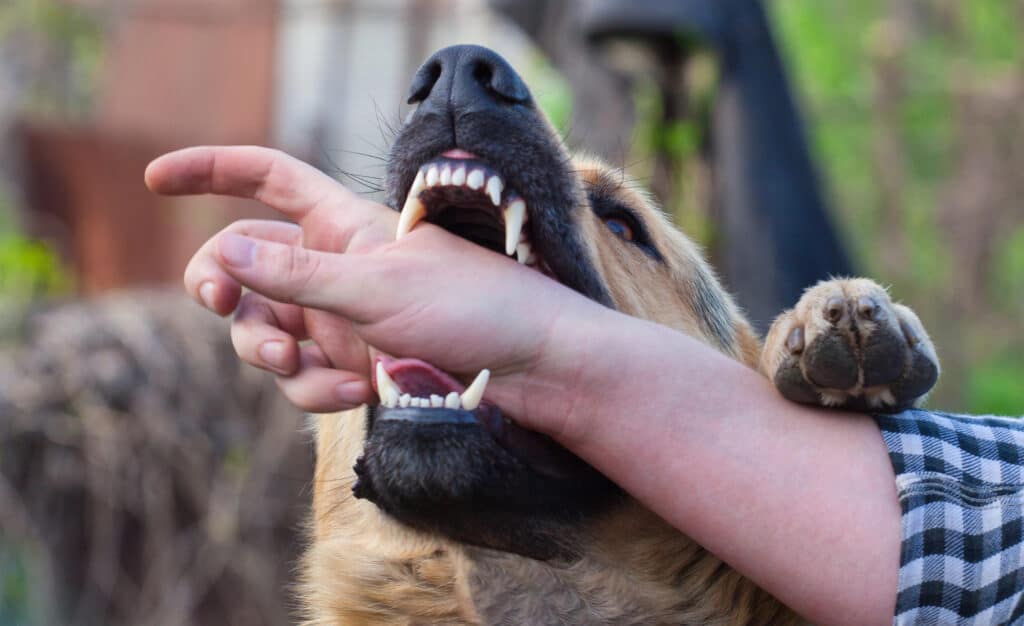
Emotional Trauma and PTSD After a Dog Attack

The physical scars from a dog bite often heal much faster than the emotional ones. The psychological trauma of a violent animal attack can be profound and long-lasting, affecting victims for years or even a lifetime. This is especially true for children, who are the most frequent victims of severe dog bites.

Research published by the American Academy of Pediatrics found that nearly half of children who were victims of dog bites developed symptoms of Post-Traumatic Stress Disorder (PTSD) in the months following the attack. A separate review published in the National Library of Medicine confirmed that PTSD, depression, and anxiety disorders are common psychological consequences of dog attacks in children.

Common symptoms of PTSD after a dog attack include:

  • Intrusive Memories: Flashbacks, nightmares, or recurring, distressing thoughts about the attack that can be triggered by seeing a dog or even hearing a bark.
  • Avoidance: Actively avoiding dogs, parks, walking paths, or any situation that reminds the victim of the trauma. This can severely limit daily activities.
  • Cynophobia: A debilitating and irrational fear of all dogs that can persist for years without treatment.
  • Hyperarousal: Being easily startled, feeling constantly on edge, having difficulty sleeping, or experiencing angry outbursts.
  • Negative Changes in Mood: Persistent fear, anxiety, anger, guilt, or feelings of detachment from friends and family.

For a child, the world can suddenly feel like a much more dangerous place. They may suffer from separation anxiety, regress in their development, or struggle in school. It is crucial that victims of all ages seek professional mental health counseling to process the trauma. The cost of this necessary therapy — which can extend for years — is a key component of recoverable damages in a dog bite injury claim. An experienced lawyer will work with mental health experts to document the full extent of the emotional harm and ensure it is reflected in the settlement demand.

How Much Is a Dog Bite Settlement Worth in 2026?

How Much Is a Dog Bite Settlement Worth in 2026 For victims facing mounting medical bills and lost income, one of the most urgent questions is: “What is the average dog bite settlement?” While there is no single answer, we can analyze national data and the key legal factors that determine the value of a dog bite injury claim.

According to the most recent 2024 data from the Insurance Information Institute, which analyzes homeowners insurance dog bite claims, the average payout for a dog-related injury in the U.S. was $69,272. This national average has surged by over 86% in the last decade, reflecting the rising costs of medical care and the increasing size of jury awards in dog attack lawsuit cases. Total payouts by U.S. insurers reached a staggering $1.57 billion in 2024.

It is critical to understand that this is only an average. A case involving minor injuries without stitches might settle for $10,000 to $20,000. In contrast, a severe attack resulting in permanent disfigurement could lead to a settlement or verdict well over $250,000, and potentially into the millions.

National Dog Bite Claim Trends (2015-2024)

This table illustrates the dramatic increase in the cost and frequency of dog bite insurance claims over the past decade.

Year

Number of Claims

Average Cost Per Claim

Total Value of Claims ($ Millions)

2015

15,352

$37,214

$571.3

2017

18,522

$37,051

$686.3

2019

17,802

$44,760

$796.8

2021

17,989

$49,025

$881.9

2023

19,062

$58,545

$1,116.0

2024

22,658

$69,272

$1,569.6

Source: Insurance Information Institute, State Farm® (2025)

How Is Pain and Suffering Calculated for a Dog Bite?

Calculating the value of a claim involves adding up economic damages and non-economic damages. Economic damages are the tangible, verifiable financial losses you have suffered, including all medical expenses (past and future), lost wages and diminished earning capacity, costs of physical and psychological therapy, and property damage such as broken glasses or torn clothing.

Non-economic damages, often called “pain and suffering,” are more subjective. They are intended to compensate you for the intangible human cost of the attack. There is no fixed formula, but a common method used by attorneys and insurance companies is the “multiplier method.” In this approach, the total economic damages are multiplied by a number between 1.5 and 5, depending on the severity of the injury, the degree of emotional trauma and PTSD, the visibility and permanency of scarring or disfigurement, and the impact on your daily life and relationships.

An experienced lawyer will compile extensive evidence — including medical records, expert testimony, and personal journals — to argue for the highest possible multiplier and maximize your recovery for pain and suffering.

Dog Bite Statistics by State: Where Do Most Attacks Occur?

While dog bites are a national problem, data from homeowners insurance claims reveals that some states have a significantly higher frequency of incidents and higher costs associated with those claims. This data provides insight into where the risk of a dog attack is most pronounced and the financial exposure associated with dog owner liability across the country.

According to the 2024 analysis by the Insurance Information Institute, California consistently leads the nation in the sheer number of dog bite claims, followed by Florida and Texas. This is partly due to their large populations, but it also highlights a greater prevalence of incidents requiring insurance intervention.

Top 10 States for Dog Bite Claims (2024)

Rank

State

Number of Claims

Average Cost Per Claim

Value of Claims ($ Millions)

1

California

2,417

$86,229

$208.4

2

Florida

1,821

$55,680

$101.4

3

Texas

1,190

$75,674

$90.1

4

Michigan

1,138

$63,656

$72.4

5

Pennsylvania

1,004

$88,668

$89.0

6

New York

994

$110,488

$109.8

7

Ohio

985

$44,885

$44.2

8

Illinois

940

$64,941

$61.0

9

New Jersey

782

$72,375

$56.6

10

Georgia

671

$46,724

$31.4

Source: Insurance Information Institute, State Farm® (2025)

It is noteworthy that while California has the most claims, New York has the highest average cost per claim at over $110,000, indicating that the injuries sustained in those cases were particularly severe. Texas, a state served by our firm, ranked third nationally with 1,190 claims and an average cost per claim of $75,674.

Understanding Dog Bite Laws: A National Overview

The legal responsibility of a dog owner for an attack — known as dog owner liability — is determined by state law. These laws generally fall into three categories. Understanding which legal doctrine applies in your state is critical to the success of a dog attack lawsuit.
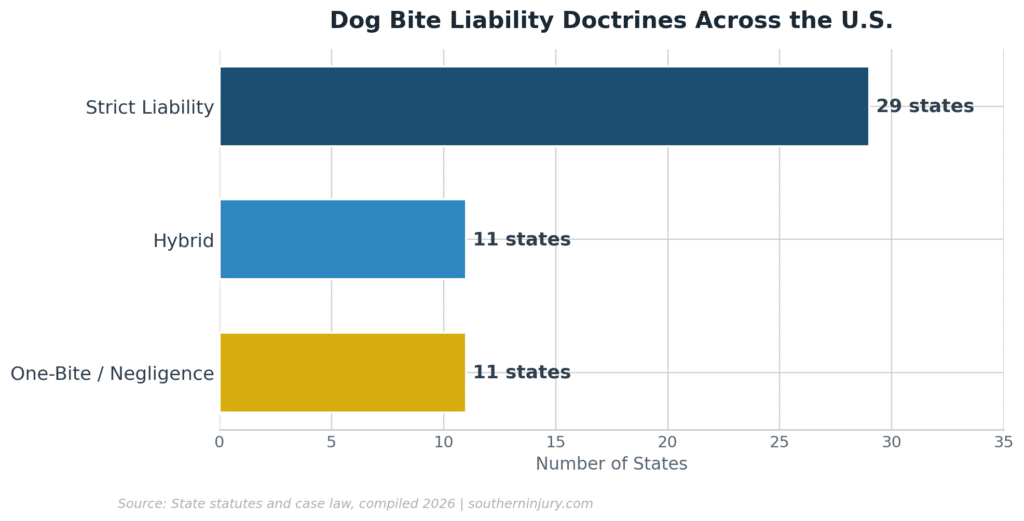
Dog Bite Liability Doctrines Across the U.S.

Strict Liability States hold owners liable for injuries their dogs cause, even if the owner had no prior knowledge of the dog being dangerous. As the chart shows, this is the most common approach, used in 29 states. If you are bitten in a strict liability state, you generally do not have to prove the owner was negligent to win your case. One-Bite Rule States follow the traditional doctrine that an owner is only liable if they knew or should have known that their dog had a dangerous propensity. This often requires proving a prior bite or other aggressive behavior. Hybrid States combine elements of both, often holding owners strictly liable for medical costs but requiring proof of negligence for other damages like pain and suffering.

Dangerous Dog Laws & Statutes of Limitations

In addition to civil liability, most states have dangerous dog laws that impose criminal penalties on owners of dogs that cause severe injury or death. These laws may also require owners of dogs deemed “dangerous” to take specific precautions, such as carrying a certain amount of liability insurance or keeping the dog in a secure enclosure. These laws are separate from, but often support, a civil claim for damages.

Equally important is the statute of limitations, which is the strict deadline for filing a lawsuit. Missing this deadline means you lose your right to sue forever.
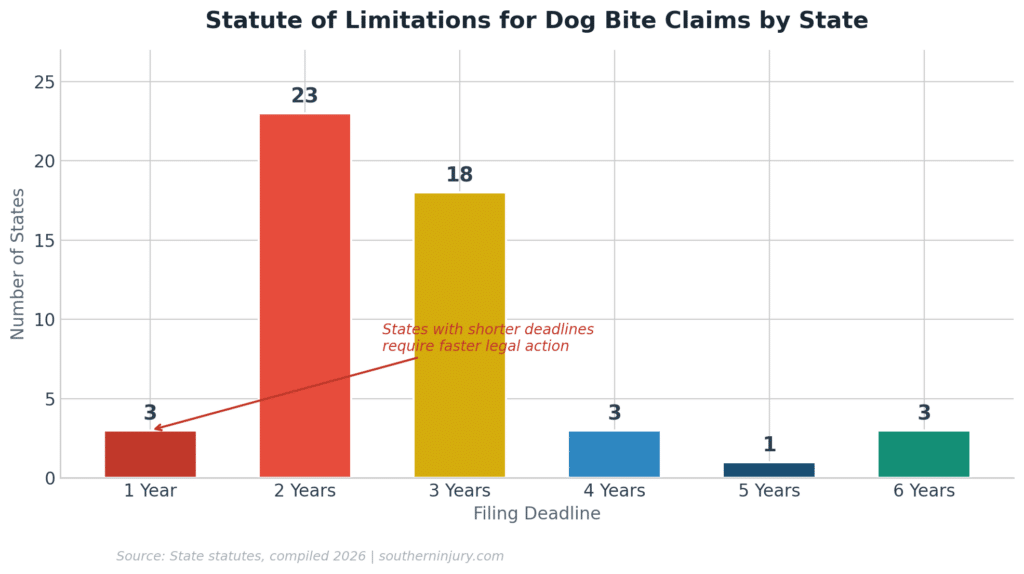
Statute of Limitations for Dog Bite Claims by State

As the data shows, these deadlines vary dramatically, from just one year in states like Tennessee and Kentucky to six years in states like Maine and Minnesota. This is one of the most important reasons to contact a lawyer immediately after an attack.

50-State Guide to Dog Bite Laws

For a complete reference, the following table details the primary liability doctrine, statute of limitations, and key legal notes for all 50 states and the District of Columbia.
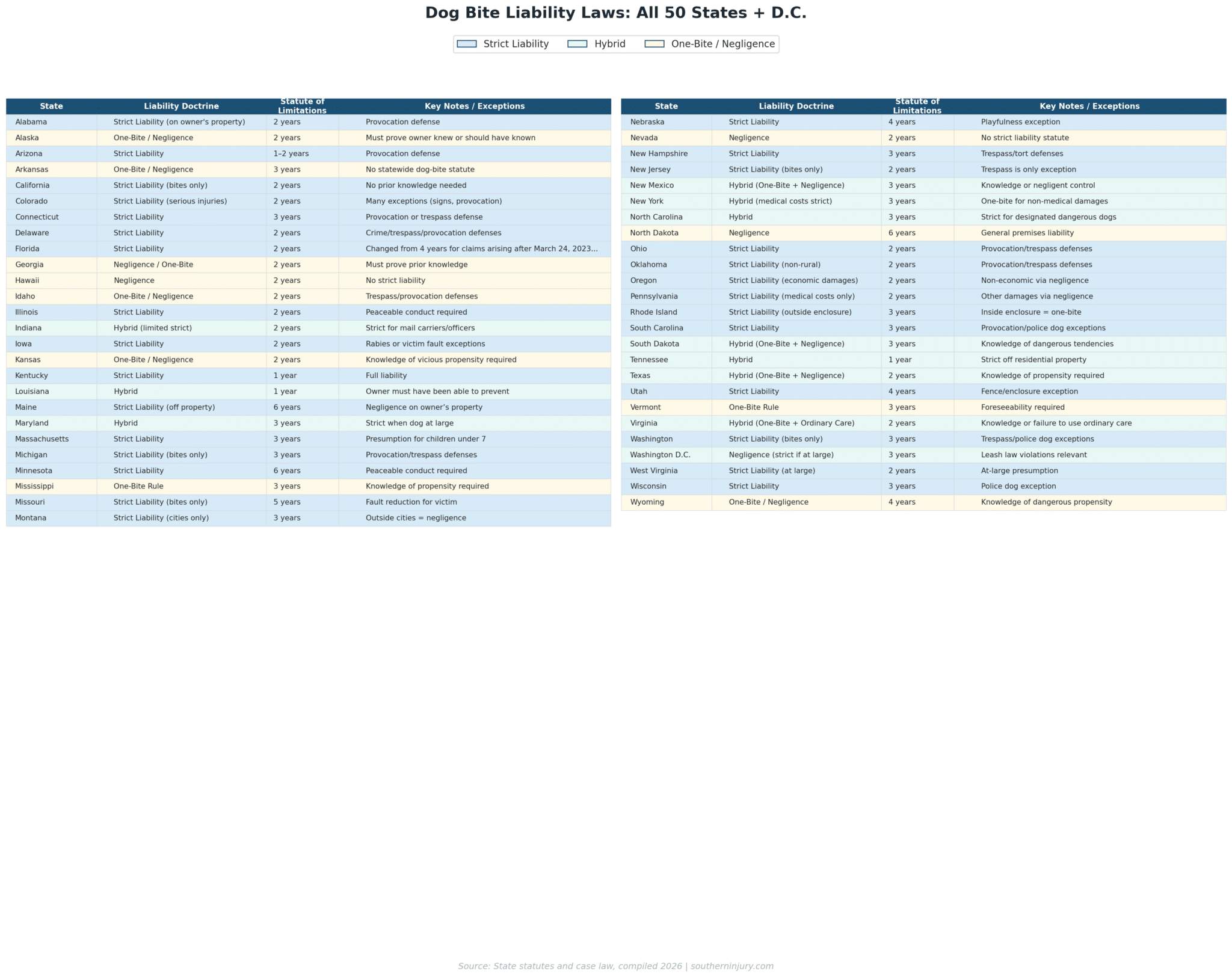
50-State Guide to Dog Bite Laws

What Happens to the Dog After a Bite Report?

A common reason people hesitate to report a dog bite, especially when the owner is a neighbor or family member, is the fear that the dog will be euthanized. While this is a valid concern, it is important to understand that euthanasia is not the automatic outcome.

When a bite is reported to animal control, a legal process begins to determine the dog’s future and protect public safety. The typical steps include a quarantine period, usually lasting 10 days, during which the dog is observed for signs of rabies. This can often be done at the owner’s home if it is secure. If the attack was severe or if the dog has a history of aggression, the local health department or court may hold a viciousness hearing, where both the owner and the victim will have an opportunity to present evidence about the dog’s temperament and the circumstances of the attack.

Based on the hearing, an animal control board or judge may designate the dog as “dangerous,” “potentially dangerous,” or “vicious.” If a dog is declared dangerous, the owner is typically allowed to keep the animal but must comply with strict requirements. These may include keeping the dog in a secure, locked enclosure, muzzling the dog whenever it is in public, posting “Beware of Dog” signs on their property, and purchasing a special liability insurance policy.

Euthanasia is reserved for the most extreme cases, such as when a dog has caused a severe injury, has a history of unprovoked attacks, or has been trained to fight. Reporting a bite is a crucial step for public safety and for your legal claim; it does not automatically mean a death sentence for the dog.

How to Choose the Right Dog Bite Accident Lawyer

Dog Bite Accident Lawyer After a serious dog bite, selecting the right legal representation is one of the most critical decisions you will make. The outcome of your case and your ability to secure fair dog bite compensation often depend on the skill and experience of your attorney. Not all personal injury lawyers have the specific expertise required to navigate the complexities of a dog attack lawsuit.

When searching for a lawyer, you need a firm that understands the nuances of state-specific dog owner liability laws, has a proven method for investigating and proving negligence, and possesses the trial experience to stand up to large insurance companies. Avoid “settlement mills” — high-volume firms that aim to settle cases quickly for less than their full value.

Ask these key questions during your consultation:

  1. What is your specific experience with dog bite cases? Ask for examples of cases they have handled and the results they have achieved.
  2. How do you approach settlement negotiations versus trial? You want a lawyer who prepares every case for trial from day one. This litigation-ready approach signals to the insurance company that you are serious and often leads to higher settlement offers.
  3. What is your strategy for proving liability in a “one-bite” state? An experienced attorney will have a clear plan for uncovering evidence of a dog’s prior aggressive behavior, even if there is no official record.
  4. How do you calculate the full value of a claim? A thorough lawyer will consult with medical and life-care planning experts to project the full, long-term costs of your injury, including future surgeries, therapy, and loss of earning capacity.
  5. What is your fee structure? Reputable personal injury lawyers work on a contingency fee basis. This means you pay no upfront costs, and the lawyer only collects a fee if they successfully recover compensation for you.

Making the right choice in legal representation can be the difference between a settlement that covers a fraction of your costs and one that provides true financial security for your future. Learn more about what makes a good personal injury lawyer.

Contact a Dog Bite Accident Lawyer for a Free Consultation

If you or a loved one has been injured by a dog, you do not have to face the consequences alone. An experienced attorney can protect your rights, handle all communication with insurance companies, and help you secure the financial resources needed to rebuild your life.

At Southern Injury Attorneys, we offer a free, no-obligation consultation to evaluate your case and explain your legal options. We work on a contingency fee basis — you pay nothing unless we win. With offices in Memphis and Houston, and attorneys licensed across Tennessee, Mississippi, Arkansas, and Texas, we are ready to fight for you.

Call now: 800-224-5546 | Contact Us Online | View All Areas We Serve

This article is for informational purposes only and does not constitute legal advice. Every case is unique, and results vary. Contact a qualified personal injury lawyer in your jurisdiction for advice specific to your situation.

About the Author

Jimmy Peters is the Managing Attorney of Southern Injury Attorneys, a personal injury law firm with offices in Memphis, Tennessee and Houston, Texas. With over 25 years of experience, Attorney Peters has dedicated his career to representing victims of serious accidents, including complex dog bite and animal attack cases. He is licensed to practice law in Tennessee, Arkansas, Texas, and Kentucky. Attorney Peters is committed to holding negligent parties accountable and ensuring that injured individuals receive the full compensation they deserve.

Sources

Texas Civil Practice and Remedies Code § 33.001. https://statutes.capitol.texas.gov/Docs/CP/htm/CP.33.htm

Get Answers To Your Most Asked Questions

The national average homeowners insurance dog bite claim was $69,272 in 2024. Settlements range from a few thousand dollars for minor bites to over $250,000 for severe injuries requiring surgery or causing permanent disfigurement.

The statute of limitations varies by state — as short as one year in Tennessee, two years in Texas, and three years in Mississippi and Arkansas. Missing the deadline means losing your right to sue.

Yes. You can sue for medical costs, infection treatment, emotional trauma, and pain and suffering even if the bite did not require stitches. The absence of stitches does not eliminate your right to file a claim.

Approximately 29 states have some form of strict liability law. In these states, the dog owner is liable even if the dog has never shown aggression before, making it easier for victims to recover compensation.

Lawyers often use a “multiplier” method. Your total medical bills are multiplied by a factor of 1.5 to 5, based on the severity of the injury, permanency of scarring, and degree of emotional trauma like PTSD.

 Recovery is more challenging but not impossible. An attorney can investigate whether the owner has other personal assets, renters insurance, or an umbrella policy that could satisfy a judgment.

No. Do not give a recorded statement to an opposing insurance adjuster without first consulting your own lawyer. Their goal is to minimize your claim, and they will use your words against you.

You are filing a claim against their homeowners insurance policy, not against them personally. The policy exists specifically to cover incidents like dog bites.

The defense may argue provocation, but unless you were actively teasing, tormenting, or abusing the animal, this defense often fails. Courts rarely find that a child’s normal behavior constitutes provocation.

Not automatically. In most cases, the dog is quarantined for 10 days to check for rabies. Euthanasia is typically reserved only for dogs with a history of severe, unprovoked attacks.

Yes. Emotional trauma, including PTSD, anxiety, and cynophobia (fear of dogs), is a major component of non-economic damages in a dog bite settlement. The cost of therapy is also recoverable.

You may have both a workers’ compensation claim through your employer and a separate personal injury claim against the dog owner. An attorney can help you navigate both processes simultaneously.

An experienced lawyer will investigate thoroughly — interviewing neighbors, checking for prior police or animal control reports, subpoenaing veterinary records, and looking for evidence like “Beware of Dog” signs.

If the dog was truly a stray, there may be no individual owner to hold liable. However, a lawyer can investigate whether a landlord, property manager, or municipality had a duty to address the stray animal problem.

A dog attack claim can encompass injuries beyond just a bite, such as being knocked down by a large dog, which can cause broken bones or head injuries. Homeowners insurance typically covers all dog-related injuries, not just bites.

Even for seemingly minor bites, consulting a lawyer is advisable. Dog bite infections can develop days later and lead to significant medical costs. A lawyer can ensure you are protected if complications arise.

EnglishenEnglishEnglish
Scroll to Top